

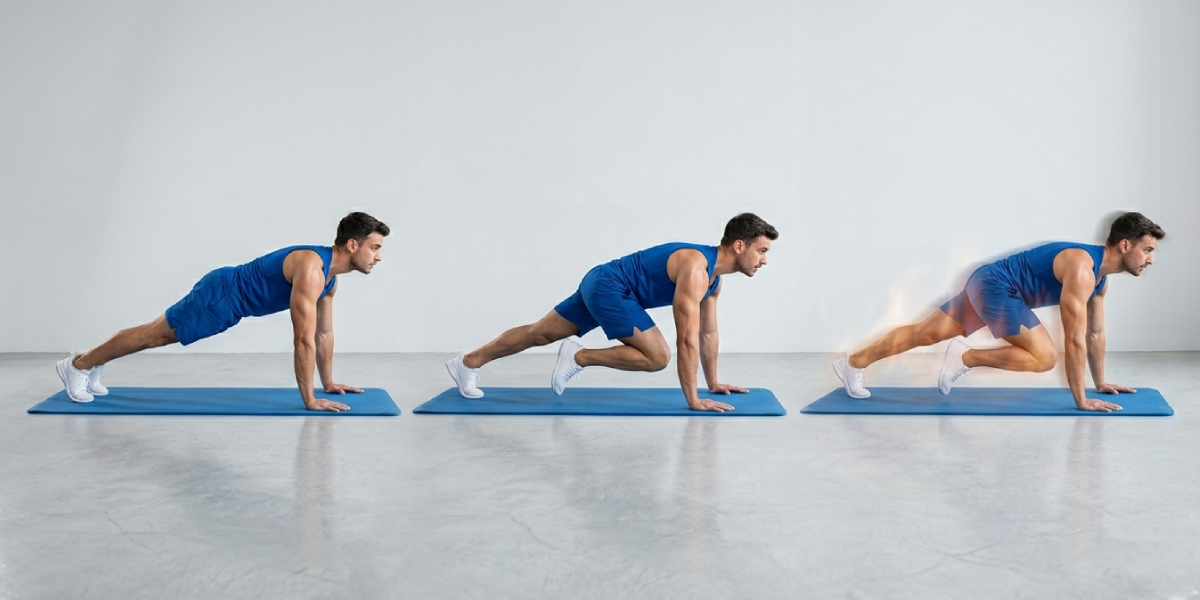
The mountain climbers exercise is one of the most efficient full-body movements you can add to your fitness routine. Combining cardiovascular conditioning with serious core engagement, this bodyweight exercise requires zero equipment and can be done virtually anywhere.
Whether you are a beginner looking to build a foundation or an experienced athlete seeking a high-intensity finisher, mountain climbers deliver measurable results in every session.
This guide covers everything you need to know — from proper form and common mistakes to advanced variations and structured workout plans — so you can perform mountain climbers safely, effectively, and with long-term progress in mind.
What Are Mountain Climbers and Why Are They So Effective?

Mountain climbers are a dynamic, compound bodyweight exercise performed from a high plank position. You alternate driving your knees toward your chest in a running-like motion while keeping your hands flat on the floor and your body in a straight line.
The movement simultaneously trains your cardiovascular system, core musculature, hip flexors, shoulders, and lower body — all in one seamless exercise.
What makes the mountain climbers exercise particularly valuable is its dual-purpose nature. At a slow, controlled tempo, it functions as a core stability and muscle endurance drill. When performed at speed, it becomes a high-intensity cardio exercise that spikes your heart rate and burns significant calories. Few exercises can claim that kind of metabolic versatility.
From a physiological standpoint, mountain climbers activate the rectus abdominis, transverse abdominis, obliques, hip flexors, glutes, and shoulder stabilizers all at once. This multi-muscle recruitment means your body expends more energy per repetition compared to isolated exercises, which is why they are a staple in fat-loss and conditioning programs worldwide.
Muscles Worked During Mountain Climbers
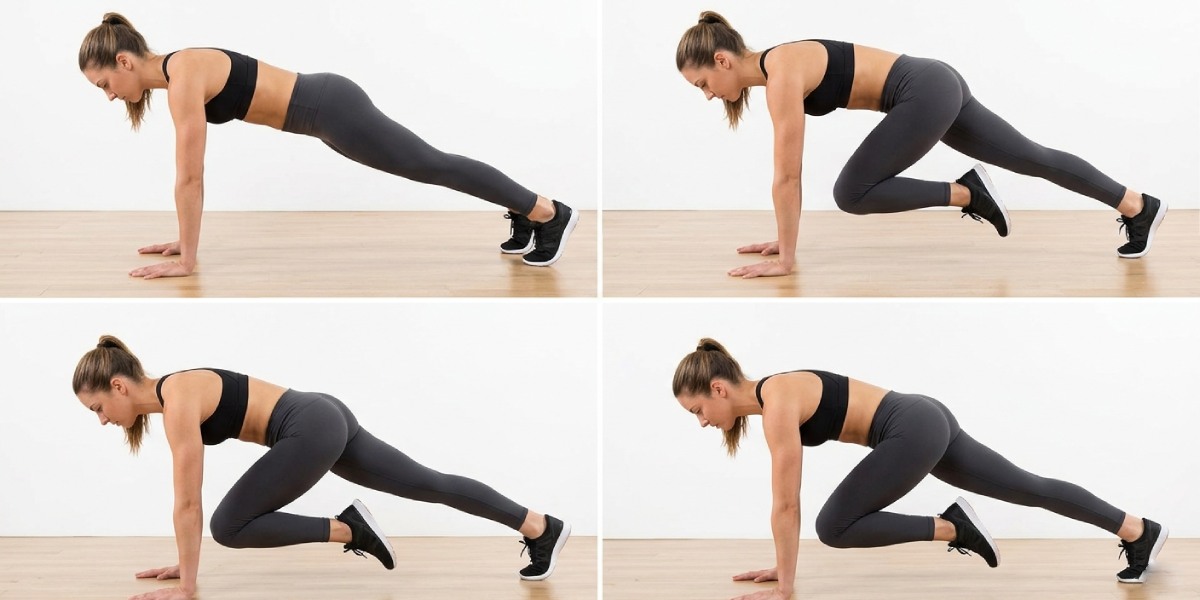
Understanding which muscles the mountain climbers exercise targets helps you appreciate how to program it and what to expect in terms of soreness and adaptation.
- Core muscles: The rectus abdominis and transverse abdominis work to keep your hips level and prevent your lower back from sagging. Every knee drive demands active bracing from these deep stabilizers.
- Hip flexors: The iliopsoas muscles initiate each knee drive, making mountain climbers an excellent hip flexor strengthening and mobility movement.
- Shoulders and chest: Holding the plank base places sustained isometric demand on the deltoids, rotator cuff, and pectoral muscles throughout the set.
- Glutes and hamstrings: The extended leg drives the glutes into isometric contraction, while the hamstrings assist in hip extension and knee control.
- Cardiovascular system: At higher tempos, mountain climbers significantly elevate heart rate, training the aerobic and anaerobic energy systems depending on intensity and duration.
How to Do Mountain Climbers Exercise with Proper Form
Executing the mountain climbers exercise with correct technique is essential for maximizing results and preventing injury. Follow these steps precisely, especially if you are new to the movement.
Step-by-Step Instructions
Step 1: Set Up Your Plank Begin in a high plank position with your hands placed directly under your shoulders, fingers spread wide for stability. Your body should form a straight diagonal line from your head to your heels. Engage your core by drawing your navel toward your spine, squeeze your glutes, and keep your neck neutral so your gaze is directed slightly ahead of your hands rather than directly down.
Step 2: Drive Your First Knee Without lifting your hips or rotating your pelvis, draw your right knee toward your chest as far as comfortably possible. Your foot should remain low to the ground. Keep your hips level — avoid letting them rise toward the ceiling, which would shift load away from the core.
Step 3: Switch Legs Return your right foot back to the starting position and immediately drive your left knee toward your chest with the same controlled motion. This alternating switch completes one full repetition.
Step 4: Control Your Tempo Beginners should start at a slow, deliberate pace — approximately two seconds per knee drive — to master the mechanics. As your form becomes consistent, gradually increase the speed to build cardiovascular intensity. Advanced practitioners can perform mountain climbers at a sprinting pace, nearly mimicking a running motion in place.
Step 5: Breathe Rhythmically Do not hold your breath. Exhale as you drive each knee in and inhale as you extend the leg back. At faster tempos, natural breathing will sync itself to the movement rhythm.
Common Form Mistakes to Avoid
Even experienced exercisers fall into form errors with mountain climbers. Here are the most frequent mistakes and how to correct them.
- Piking the hips: This is the most common error. When your hips rise too high, the core loses tension and the exercise becomes ineffective. Focus on keeping your body in a rigid plank line throughout.
- Sagging the lower back: A dropped lower back places excessive compression on the lumbar spine. If you notice this, reduce your speed and focus on bracing your core harder before each rep.
- Looking up or down too far: Hyperextending or over-flexing the neck creates strain. Keep your gaze neutral and your spine long.
- Letting the shoulders collapse: Your shoulder blades should remain slightly protracted and stable. Do not allow your upper body to sink toward the floor as fatigue sets in.
- Rushing before you are ready: Speed is a progression, not a starting point. Prioritizing speed over form at the beginning leads to compensation patterns that are difficult to unlearn.
Mountain Climbers Exercise Variations for All Fitness Levels
One of the greatest strengths of the mountain climbers exercise is how well it scales across fitness levels. Whether you need a modified version or a more challenging alternative, there is a variation that fits your needs.
Beginner: Slow Mountain Climbers
Perform the movement at a deliberate, controlled pace with a three-second hold when your knee reaches the chest. This builds core stability, hip flexor strength, and plank endurance before adding speed. Aim for three sets of eight repetitions per leg.
Beginner to Intermediate: Elevated Mountain Climbers
Place your hands on a bench, box, or step instead of the floor. The elevated angle reduces the demand on your core and shoulders, making it accessible for those still building upper body and core strength. It is also a useful regression for individuals experiencing wrist discomfort on flat surfaces.
Intermediate: Cross-Body Mountain Climbers
Instead of driving your knee straight toward your chest, aim each knee toward the opposite elbow — right knee to left elbow and vice versa. This cross-body motion dramatically increases oblique activation, making it one of the best anti-rotation core exercises available in a dynamic format.
Intermediate to Advanced: Sliding Mountain Climbers
Place your feet on furniture sliders or smooth paper plates on a hardwood floor. The sliding surface removes the impact of foot contact with the ground, forces greater hip flexor control, and increases time under tension on the core and shoulders. The movement feels distinctly harder than standard mountain climbers despite the similar setup.
Advanced: Spider Mountain Climbers
As you drive your knee toward your chest, simultaneously rotate your torso so that knee comes to the outside of the same-side elbow. This requires exceptional hip mobility, shoulder stability, and core rotation strength. It is a full-body anti-rotation and mobility challenge wrapped into one movement.
Advanced: Band-Resisted Mountain Climbers
Loop a resistance band around both feet before getting into the plank position. The added resistance forces your core to work harder to maintain hip position while your hip flexors drive against the band. This variation is particularly popular in athletic training programs.
How to Incorporate Mountain Climbers into Your Workout
The mountain climbers exercise is versatile enough to serve multiple functions within a training plan. How you use it depends on your current goals and overall program structure. If your focus is building an effective exercise routine, mountain climbers can anchor several different training styles.
As a Warm-Up Drill
Performed at a moderate pace for 30 to 45 seconds, mountain climbers are an excellent warm-up movement. They elevate your heart rate, activate the core, mobilize the hips, and prime the shoulders before a strength training session. Use two sets at the start of any upper body, lower body, or full-body workout.
As Part of a HIIT Circuit
Mountain climbers are a cornerstone of high-intensity interval training. A popular structure is 40 seconds of all-out mountain climbers followed by 20 seconds of rest, repeated for six to eight rounds. Combining them with exercises like burpees, jump squats, and push-ups creates a complete metabolic conditioning circuit that burns calories both during and after the session through the EPOC (excess post-exercise oxygen consumption) effect.
As a Core Finisher
At the end of a strength training session, use slow mountain climbers as a core finisher. Three to four sets of 20 to 30 controlled reps per leg will fatigue the deep core stabilizers without placing additional spinal load, which is important when the lower back is already taxed from heavy compound lifts.
As Standalone Cardio
When you are short on time and equipment, mountain climbers alone can constitute an effective cardio session. Twenty minutes of interval-style mountain climbers — alternating between 30-second all-out bursts and 15-second recoveries — is a legitimate cardiovascular training stimulus, particularly when combined with other bodyweight movements.
Sample Mountain Climbers Workout Plans
| Level | Sets | Duration or Reps | Rest Between Sets |
|---|---|---|---|
| Beginner | 3 | 20 seconds | 60 seconds |
| Intermediate | 4 | 30 seconds | 45 seconds |
| Advanced | 5 | 45 seconds | 30 seconds |
| HIIT Protocol | 6–8 | 40 seconds on, 20 off | None (continuous) |
Mountain Climbers and Weight Management
For those focused on managing their body composition, the mountain climbers exercise offers a meaningful caloric burn. Depending on body weight and intensity, a person can burn approximately eight to twelve calories per minute during vigorous mountain climbers — comparable to jogging at a moderate pace.
When combined with a balanced diet and appropriate recovery, consistent mountain climber training contributes to improved body composition. If you are tracking your progress alongside weight management, using tools like a BMI calculator can help you establish a useful baseline and monitor changes over time alongside your exercise and dietary habits.
It is worth noting that overall health goes beyond exercise alone. Sleep, stress management, nutrition, and hydration all interact with your exercise outcomes. Mountain climbers are a powerful tool, but they work best as part of a holistic health strategy rather than in isolation.
Safety Considerations and Who Should Modify the Exercise
The mountain climbers exercise is generally safe for healthy adults when performed with proper technique. However, certain populations should approach the movement with caution or use modified versions.
Individuals with wrist pain, carpal tunnel syndrome, or prior wrist injuries may find flat-palm mountain climbers uncomfortable. Performing the exercise on push-up handles, dumbbells, or using the elevated variation on a bench significantly reduces wrist extension stress.
Those with lower back pain should master the standard plank before attempting mountain climbers. The dynamic nature of the exercise increases the demand on lumbar stabilizers, and if the foundational plank cannot be held for 30 seconds with good form, mountain climbers will likely exacerbate discomfort rather than strengthen the area.
Pregnant individuals, particularly in the second and third trimester, should consult their healthcare provider before performing mountain climbers, as the prone plank position and abdominal compression may not be appropriate at certain stages.
People new to exercise should also ensure their cardiovascular fitness can support the demands of faster-paced mountain climbers. Starting slow and building up over three to four weeks is a responsible and effective approach that minimizes injury risk while building a durable fitness base.
Tracking Progress with Mountain Climbers
Progress with mountain climbers can be tracked in several meaningful ways. Rather than simply counting repetitions, consider measuring performance across multiple dimensions to get a complete picture of your improvement over time.
- Duration at quality form: How long can you maintain perfect plank position while performing mountain climbers? This measures core endurance and is arguably the most important metric.
- Speed over a fixed duration: Count how many total knee drives you complete in 30 seconds. Track this number monthly to measure power and rate improvements.
- Recovery rate: Note how quickly your heart rate returns to baseline after a set. Faster recovery reflects improved cardiovascular conditioning over time.
- Variation progression: Moving from standard to cross-body to spider mountain climbers is a qualitative marker of improved mobility, strength, and coordination.
Frequently Asked Questions
How many mountain climbers should I do as a beginner?
Beginners should start with three sets of 20 to 30 seconds of mountain climbers with at least 60 seconds of rest between sets. Focus entirely on maintaining proper plank form rather than maximizing speed. Once you can sustain 45 seconds with no form breakdown, you are ready to progress in intensity or duration.
Do mountain climbers actually build core strength or just cardio?
Mountain climbers build both simultaneously. At slow tempos, they are primarily a core stability and endurance exercise, activating the transverse abdominis, rectus abdominis, and obliques under sustained load. At faster tempos, the cardiovascular demand takes priority. Many coaches program both speeds within the same session to train both qualities in a time-efficient way.
Can mountain climbers help reduce belly fat?
Mountain climbers contribute to overall caloric expenditure, which supports fat loss when combined with a nutritional deficit. However, spot reduction — losing fat from a specific area through targeted exercise — is not supported by current exercise science. Mountain climbers will strengthen your core and burn calories, but fat reduction occurs systemically based on overall energy balance, not exercise location.
How often should I do mountain climbers each week?
Two to four times per week is appropriate for most people, depending on overall training volume. Because mountain climbers are a high-demand exercise involving core, shoulders, and cardiovascular effort, adequate recovery between sessions matters. If you are using them as a warm-up or low-intensity movement, daily use at moderate intensity is generally well-tolerated.
Are mountain climbers better than running for cardio?
Mountain climbers and running serve overlapping but distinct roles. Running is generally superior for sustained aerobic conditioning and building cardiovascular base fitness over long durations. Mountain climbers excel at delivering intense cardio stimulus in shorter sessions and simultaneously strengthening the core and upper body. They are complementary rather than interchangeable.
What is the difference between mountain climbers and a plank?
A plank is a static isometric hold that builds core stability and endurance through sustained tension. Mountain climbers begin from the same plank position but add dynamic leg drives, transforming the exercise into a cardio-and-core hybrid. The plank is the foundation upon which the mountain climbers exercise is built, and strength in the plank directly transfers to better performance in mountain climbers.
Do mountain climbers work the glutes?
Yes, the glutes are actively engaged during mountain climbers. The extended leg must maintain hip extension and keep the body aligned, which requires continuous glute activation throughout the set. Cross-body and spider mountain climber variations place even greater demand on the glutes and hip rotators due to the rotational component of those movements.
Can I do mountain climbers every day?
Light to moderate mountain climbers can be performed daily if total volume is managed appropriately. However, high-intensity mountain climber sessions — particularly those performed as part of HIIT circuits — require 24 to 48 hours of recovery to allow the involved muscles and cardiovascular system to adapt. Varying intensity day to day is a practical strategy for daily practitioners who want to avoid overuse fatigue.
Are mountain climbers safe for people with knee pain?
Many people with mild knee discomfort can perform mountain climbers without issue because the knee does not bear weight during the exercise. However, if the knee drive causes pain at the end range of flexion or during loading, the elevated variation on a bench reduces the range of motion and may be better tolerated. Anyone with a diagnosed knee condition should get medical clearance before beginning.
How do mountain climbers compare to burpees for full-body conditioning?
Both exercises offer excellent full-body conditioning, but they differ in structure. Burpees involve a jump, a push-up, and a full stand — making them a higher-impact, higher-skill movement that trains explosive power. Mountain climbers are lower impact, easier to maintain for longer durations, and better for sustained core and cardiovascular training. Combining both in a single session provides a comprehensive conditioning stimulus.