

The best no-equipment exercises to do at your desk can transform how you feel throughout the workday — no gym membership, no special gear, and no commute required. If you spend most of your working hours sitting in front of a screen, you already know the toll it takes: tight hips, a stiff neck, low energy by mid-afternoon, and the nagging sense that your body deserves better.
The good news is that consistent, targeted movement at your workstation can counteract most of these effects — and it takes far less time than you might think.
This guide draws on established principles from occupational health, physical therapy, and sports science to give you a practical, actionable routine you can start today. Whether you work from a home office or a busy open-plan floor, every exercise here requires nothing but your body, a few square feet of space, and a willingness to move.
Why Moving at Your Desk Matters More Than You Think
Extended sitting has been associated with a range of health concerns including reduced circulation, weakened core muscles, increased lower back pain, and elevated cardiovascular risk. Research published in the Annals of Internal Medicine found that people who sit for prolonged, uninterrupted periods have higher mortality risk even when they meet general physical activity guidelines.
The takeaway is not that exercise is useless — it is that the hours you spend motionless between workouts matter just as much.
Integrating short movement breaks into your workday addresses this directly. Even two to five minutes of movement every hour can improve circulation, sharpen focus, reduce muscle tension, and help regulate blood sugar levels after meals.
Over weeks and months, these micro-sessions compound into meaningful improvements in posture, strength, and overall well-being.
If you are tracking your health holistically, consider pairing your desk exercise habit with a baseline health assessment. You can use a BMI calculator as one starting reference point for understanding where your body is today — keeping in mind that BMI is one tool among many and works best alongside other metrics like waist circumference, resting heart rate, and energy levels.
The Best No-Equipment Exercises to Do at Your Desk

The exercises below are organized by category so you can mix and match based on your available time, workspace, and physical goals. Each one can be done silently at a standing desk, in a cubicle, or in a home office without disturbing anyone around you.
Seated Core Strengtheners
Your core does not just mean your abs — it includes the muscles running along your spine, through your pelvis, and around your hips. A strong, engaged core is the single most important factor in good sitting posture, and these exercises target it without you needing to leave your chair.
Seated Abdominal Bracing: Sit tall with your feet flat on the floor. Take a deep breath in, and as you exhale, draw your navel gently toward your spine without holding your breath. Hold for five seconds, release, and repeat ten times. This activates the deep transverse abdominis — the muscle most responsible for spinal stability.
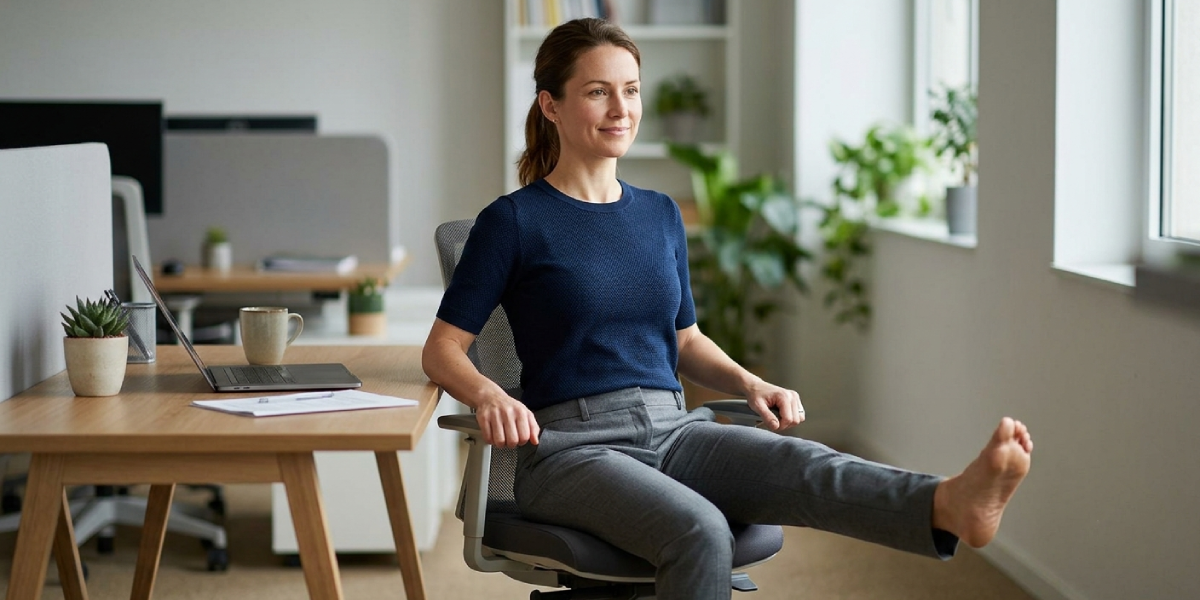
Seated Leg Raises: Sit at the edge of your chair with your back straight. Extend one leg until it is parallel to the floor, hold for three seconds, lower it slowly, and switch sides. Complete ten repetitions on each side. This move works the hip flexors and lower abdominal region while improving circulation in the legs.
Chair Pelvic Tilts: Sit upright and alternate between gently arching your lower back (anterior tilt) and flattening it against your chair (posterior tilt). Move slowly and with control for ten repetitions. This exercise counteracts the frozen, compressed lower spine that comes from hours of static sitting.
Upper Body and Shoulder Exercises
Desk workers commonly develop tension in the neck, shoulders, and upper back due to sustained forward posture and the constant forward reach toward a keyboard or mouse. These exercises release that tension and rebuild the muscular balance that prevents chronic pain.
Shoulder Blade Squeezes: Sit tall and pull your shoulder blades toward each other as if trying to hold a pencil between them. Hold for five seconds and release. Repeat fifteen times. This activates the rhomboids and mid-trapezius — muscles that are chronically underworked in most desk setups.
Neck Half-Circles: Drop your chin to your chest and slowly roll your head to one shoulder, pause, then roll it back to center and to the other shoulder. Never roll your head fully backward, as this can compress the cervical spine. Do five slow, controlled repetitions. This releases tension in the levator scapulae and upper trapezius.
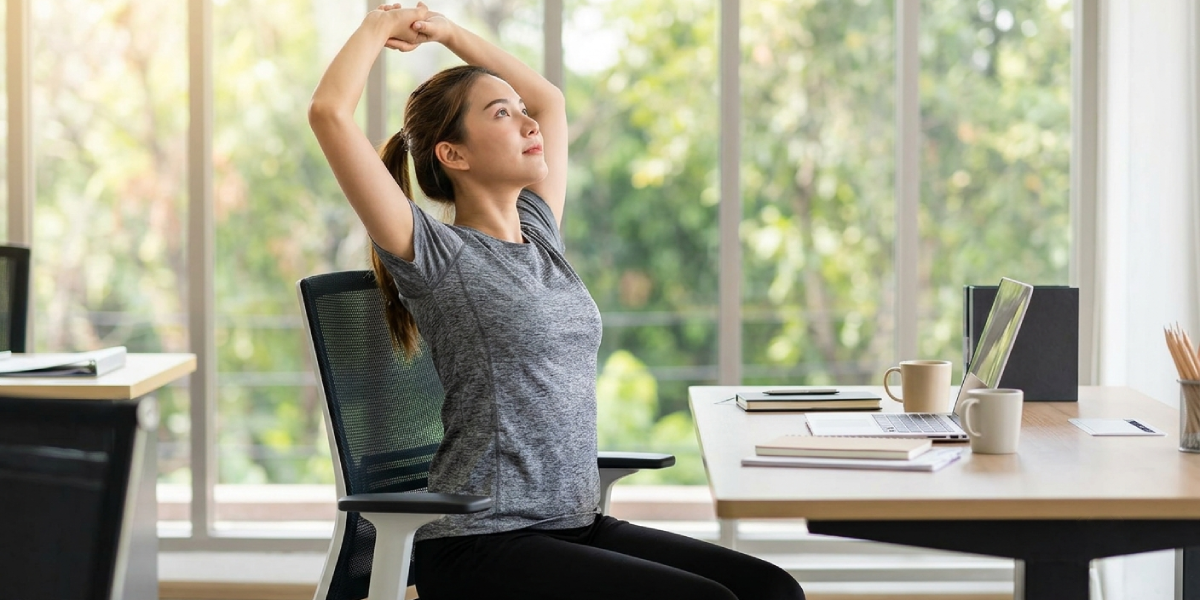
Overhead Arm Reaches: Interlace your fingers and press both palms toward the ceiling, lengthening your spine as you reach. Hold for ten seconds. Lower and repeat five times. This counters the rounded upper back posture that forms after long hours of typing.
Wrist and Finger Extensions: Extend one arm in front of you, palm facing out, and use your other hand to gently pull your fingers back toward you. Hold for fifteen seconds per side. This is particularly important for anyone prone to repetitive strain or carpal tunnel symptoms.
Lower Body Exercises You Can Do Standing
If you have a standing desk or can step away from your chair briefly, these lower body exercises dramatically increase caloric expenditure and muscle activation compared to seated alternatives.
Calf Raises: Stand behind your chair and hold the back for balance. Rise slowly onto your toes, hold for two seconds, and lower with control. Do twenty repetitions. Calf raises actively pump blood from the lower legs back toward the heart — a critical function that sitting completely eliminates.
Bodyweight Squats: Stand with feet shoulder-width apart. Lower as if sitting into a chair until your thighs are parallel to the floor, then drive through your heels to stand. Keep your chest tall and your knees tracking over your toes. Do ten to fifteen repetitions. ‘
Squats engage the glutes, quadriceps, and hamstrings — the largest muscle groups in the body — which means they also provide the most significant metabolic benefit.
Standing Hip Circles: Stand with feet hip-width apart and hands on your hips. Make slow, controlled circles with your hips in one direction, then the other. Do ten circles each way. This loosens the hip joint capsule and activates the muscles that become locked in flexion during prolonged sitting.
Lateral Side Steps: Step to the right, bring your feet together, then step right again — traveling sideways for four steps before returning. Repeat for thirty seconds. This activates the hip abductors and adductors, which are almost never challenged during seated work.
Posture Reset Exercises
Beyond strengthening, certain exercises function as posture resets — interrupting the compensatory patterns your body adopts when it holds one position too long. These are best performed every ninety minutes as a deliberate break.
Chest Opener Stretch: Clasp your hands behind your lower back and gently squeeze your shoulder blades together while lifting your chest toward the ceiling. Hold for fifteen seconds. This directly counteracts the hunched, chest-collapsed posture of typical computer work.
Seated Spinal Twist: Sit tall and place your right hand on the outside of your left knee. Gently rotate your torso to the left as far as is comfortable, using the hand for light leverage. Hold for twenty seconds per side. Spinal rotation mobilizes the thoracic spine and releases the paraspinal muscles that stiffen during static sitting.
Figure-Four Glute Stretch: Sitting in your chair, cross your right ankle over your left knee, forming a figure four. Sit tall and gently lean forward at the hips until you feel a stretch in the right glute. Hold for twenty to thirty seconds per side.
This releases the piriformis muscle, whose tightness is a common contributor to sciatic-type lower back discomfort in desk workers.
How to Build a Realistic Desk Exercise Routine
The most effective desk exercise habit is the one you will actually stick to. Rather than attempting a comprehensive session once a day and hoping for the best, research on behavior change and occupational health consistently supports a distributed model: short, frequent movement breaks throughout the day.
| Time of Day | Recommended Exercises | Duration |
|---|---|---|
| Morning (start of workday) | Overhead reaches, shoulder blade squeezes, seated leg raises | 3 minutes |
| Mid-morning (after 90 minutes) | Bodyweight squats, calf raises, chest opener | 4 minutes |
| Post-lunch | Seated spinal twist, figure-four stretch, neck half-circles | 4 minutes |
| Mid-afternoon | Hip circles, lateral side steps, abdominal bracing | 3 minutes |
| End of workday | Full-body stretch sequence, wrist extensions, pelvic tilts | 5 minutes |
Setting a recurring reminder on your phone or computer every ninety minutes is one of the most effective ways to interrupt sedentary behavior patterns. Over time, the habit becomes automatic.
The Connection Between Desk Exercise and Long-Term Health
Desk exercises are not a replacement for structured physical training — they are a complement to it. Think of them as maintenance work that keeps your body functional, pain-free, and capable between your more intensive workouts or recreational activities.
When paired with good nutrition, adequate sleep, and regular cardiovascular and strength training, a consistent desk movement habit contributes to a comprehensive approach to health. You can explore a wider range of exercise strategies and guidance to build out your full fitness picture beyond the workday.
It is also worth understanding that the health benefits of reduced sedentary time are distinct from the benefits of formal exercise. They operate through different mechanisms — primarily circulation, glucose metabolism, and postural muscle endurance — which is why both matter independently.
Doing thirty minutes on the treadmill in the morning does not erase the physiological effects of sitting for eight hours afterward.
Ergonomics and Exercise Work Together
No amount of desk exercise fully compensates for a fundamentally poor workstation setup. Your chair height, monitor distance, keyboard position, and lighting all influence how your body holds itself for hours at a time. If your setup forces you into awkward positions to begin with, you will be fighting an uphill battle regardless of how often you stretch.
A well-configured workspace reduces the baseline tension your muscles are fighting all day. Your monitor should be at or just below eye level, your elbows should rest at roughly ninety degrees when typing, and your feet should be flat on the floor or a footrest. From this neutral foundation, the exercises in this guide deliver their maximum benefit.
If you are dealing with persistent discomfort despite making these changes, consulting a physical therapist or occupational health professional is a worthwhile step. They can identify postural imbalances and prescribe targeted corrective exercises specific to your body.
Staying Consistent When Motivation Dips
Motivation fluctuates — that is normal. On high-pressure days when your workload feels overwhelming, the first thing most people drop is their movement routine. Building cues and environmental triggers into your day reduces the reliance on willpower.
Some strategies that work well in practice: pairing your movement break with an existing habit (standing up every time you finish a call), keeping a sticky note on your monitor as a visual prompt, doing calf raises while waiting for files to load or pages to refresh, and taking walking calls whenever the conversation does not require a screen.
Small, consistent actions tend to outlast ambitious routines that depend on ideal conditions.
You can also explore broader health and wellness resources to support the lifestyle habits that make desk exercise easier to sustain — including stress management, sleep hygiene, and nutrition fundamentals that affect your energy levels and motivation throughout the day.
Frequently Asked Questions
How often should I do desk exercises throughout the workday?
Aim for a short movement break every sixty to ninety minutes. Even two to five minutes of exercise per break is enough to meaningfully improve circulation, reduce muscle stiffness, and refresh mental focus. Consistency matters more than duration — brief, frequent movement beats one long midday session followed by hours of immobility.
Can desk exercises actually replace going to the gym?
No — desk exercises are not a substitute for structured training. They serve a different physiological purpose: maintaining circulation, reducing postural tension, and breaking up sedentary time. They complement gym work by keeping your body more functional and pain-free between sessions, but they do not provide the cardiovascular or progressive resistance stimulus that formal workouts deliver.
Are these exercises safe for people with existing back pain?
Most of the exercises in this guide are gentle and appropriate for mild back discomfort, particularly the stretches and posture resets. However, if you have a diagnosed spinal condition, recent injury, or severe chronic pain, consult a physical therapist or physician before starting any new exercise program. Some movements, like leg raises, may need modification depending on your specific condition.
How long does it take to see results from desk exercises?
Many people notice reduced neck and shoulder tension within the first week of consistent movement breaks. Improvements in posture and lower back comfort typically become more noticeable within two to four weeks. Structural changes in strength and flexibility develop more gradually over six to twelve weeks of regular practice.
Do I need a standing desk to do these exercises?
No. The majority of exercises in this guide are designed specifically for seated workers and require nothing more than a standard office chair. The standing exercises — squats, calf raises, and hip circles — are beneficial additions if you have space, but they are optional enhancements rather than requirements.
Can desk exercises help with stress and mental fatigue?
Yes, and quite effectively. Physical movement triggers the release of endorphins and increases cerebral blood flow, both of which improve mood and cognitive clarity. Even a three-minute movement break has been shown in workplace studies to reduce perceived stress and improve focus during the hour that follows. It is one of the most accessible and immediate stress-management tools available during a workday.
What is the best single exercise to do at a desk if I only have one minute?
Shoulder blade squeezes combined with a chest opener stretch address the most common tension pattern in desk workers — rounded shoulders and a compressed upper back — and can be done in under sixty seconds without leaving your chair. If you have slightly more time, adding ten bodyweight squats significantly increases the metabolic and circulatory benefit.
Is it awkward to do these exercises in an open office?
It can feel uncomfortable at first, but the reality is that most exercises in this guide are subtle enough that colleagues will barely notice. Seated leg raises, abdominal bracing, shoulder squeezes, and wrist stretches are invisible to anyone more than a few feet away. More visible moves like squats are worth taking to a stairwell or quiet corner. As workplace wellness culture continues to grow, open movement is increasingly normalized in most modern offices.
Should I stretch before or after desk exercises?
For brief desk sessions, a distinction between warm-up and cool-down is less critical than it is for intense training. Starting with gentler movements — neck rolls, seated twists, or shoulder circles — before progressing to more active exercises like squats or leg raises is a sensible approach. Ending with static stretches (held for fifteen to thirty seconds) helps release any tension built up during the session.