

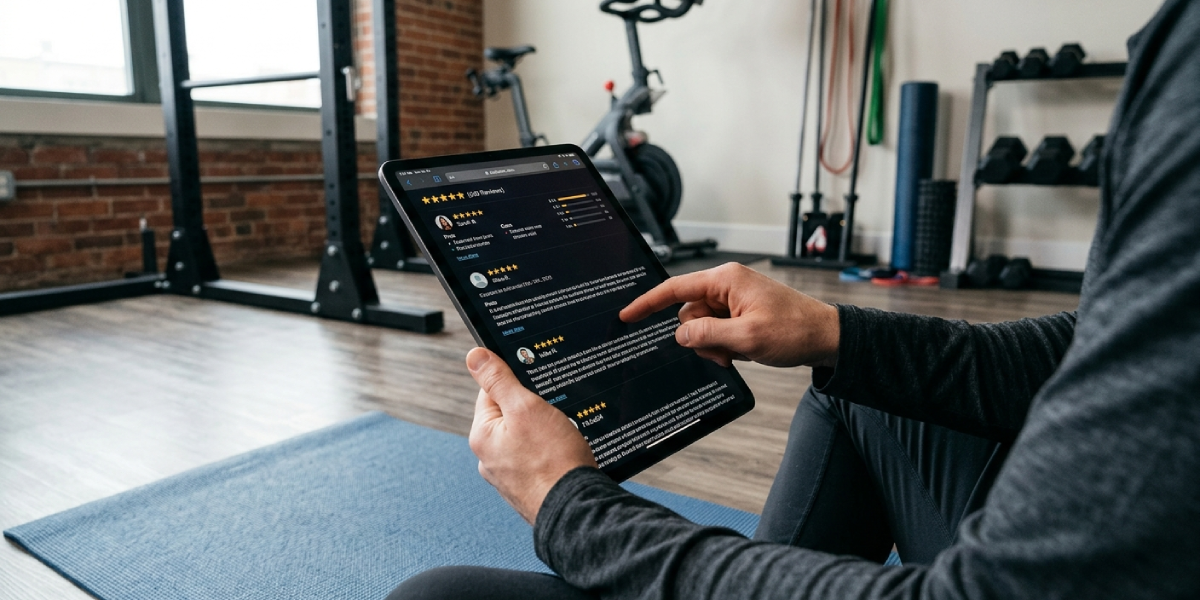
Learning how to read exercise equipment reviews properly can save you hundreds of dollars and prevent you from ending up with a piece of gear that collects dust in your garage. With thousands of products flooding the market every year, not all reviews are created equal, and knowing how to separate genuine insight from paid praise is one of the most valuable skills any fitness shopper can develop.
Whether you are eyeing a new treadmill, a set of adjustable dumbbells, or a full home gym setup, this guide walks you through a practical, expert-backed framework for evaluating reviews the right way, so every purchase you make actually supports your fitness goals.
Why Most Shoppers Read Exercise Equipment Reviews the Wrong Way

The instinct most shoppers follow is simple: scroll to the star rating, glance at a handful of five-star comments, and buy. That approach works fine for a phone case or a pair of socks. It works poorly for exercise equipment, where factors like build quality, motor performance, joint-friendliness, and long-term durability are critical variables that take weeks or even months to surface.
Exercise equipment sits at a unique intersection of health, safety, and financial investment. A treadmill belt that degrades after 90 days or a rowing machine with a faulty resistance mechanism can derail your fitness progress and even cause injury.
This is precisely why you need to read reviews with the same critical eye a fitness professional would bring to an equipment evaluation.
Step 1: Identify Whether the Source Is Trustworthy
The first question to ask about any review is: who wrote it and what is their incentive? Review sources fall into a few broad categories, each with its own level of reliability.
Verified Purchase Reviews on Retail Platforms
Verified purchase badges on platforms like Amazon confirm that a reviewer actually bought the product. These reviews carry more weight than unverified ones. However, verified does not automatically mean unbiased. Many brands run incentive programs where customers receive discount codes or gift cards in exchange for positive reviews, which technically still qualifies as a verified purchase.
Look for reviews that describe specific problems or mention the equipment in the context of a real fitness routine, because these details are hard to fabricate.
Long-Form Expert Reviews on Fitness Websites
Dedicated fitness publications and equipment-focused blogs often provide the most in-depth analysis. The best ones include hands-on testing notes, comparison data across competing products, and information about who a product is and is not suitable for.
When reading these, check whether the reviewer mentions weight capacity, noise levels, footprint dimensions, and warranty terms. A reviewer who covers only surface-level features is not offering much expert insight.
Video Reviews on YouTube
Video reviews can be particularly valuable for exercise equipment because they allow you to see the product in motion. Watch for reviewers who perform actual workouts on the equipment during the review rather than simply assembling it on camera.
Pay attention to noise, vibration, stability, and how the reviewer’s body mechanics look during use. These visual cues tell you things text reviews simply cannot.
Community Forums and Subreddits
Fitness forums and communities like Reddit’s r/homegym offer unfiltered, peer-to-peer opinions from people who have been using equipment for months or years. These communities are excellent for uncovering long-term durability issues that never appear in a 30-day review.
Search the product name plus words like “problems,” “issues,” or “after 6 months” to surface the most relevant threads.
Step 2: Pay Attention to the Review Distribution, Not Just the Average
A product with a 4.2-star average from 3,000 reviews deserves closer inspection than its summary number suggests. Click through to see the full rating breakdown. A healthy review distribution for exercise equipment looks like a bell curve slightly skewed toward five stars.
What should concern you is a bimodal distribution, meaning a high volume of both five-star and one-star reviews with relatively few in the middle.
This pattern often signals one of two things: either the product is polarizing because it performs well for certain body types or fitness levels and poorly for others, or the positive reviews have been artificially inflated. In either case, reading the one and two-star reviews in detail becomes essential.
Look for recurring complaints rather than isolated incidents. If a dozen independent reviewers all mention that the seat post wobbles or the display screen freezes, that is a reliability signal worth taking seriously.
Step 3: Filter Reviews by Reviewer Profile
Not everyone reviewing exercise equipment has needs similar to yours. A beginner looking for a basic elliptical for low-impact cardio and an experienced powerlifter shopping for a squat rack are going to evaluate the same piece of equipment through very different lenses. When reading reviews, look for reviewers who mention details that match your own situation.
- Body weight and height: Treadmills and bikes have weight limits and size constraints that significantly affect comfort and performance. Find reviews from people with a similar build to yours.
- Fitness level: Beginners often rate equipment more positively because they have less to compare it against. Intermediate and advanced users tend to give more nuanced feedback about performance at higher intensities.
- Use frequency: Someone who uses a piece of equipment three times per week for a year has far more insight into long-term durability than someone who bought it two weeks ago.
- Home setup: Look for reviewers who mention flooring type, ceiling height, or available space if those factors are relevant to your situation.
Understanding your own fitness goals makes filtering reviews much easier. If you are working on specific exercise goals, prioritize reviews from people pursuing similar training objectives.
Step 4: Know Which Specifications Reviews Should Address
Genuinely useful exercise equipment reviews go beyond appearance and price. A thorough review should address the following technical considerations, and if one does not, you should treat it as incomplete.
Build Quality and Materials
Look for mentions of frame thickness, weld quality, steel gauge, and plastic component durability. Higher-end equipment uses heavy-gauge steel frames and minimal plastic in load-bearing components. Reviews should tell you whether the equipment feels solid during use or whether it rattles, shifts, or flexes in ways that undermine confidence and safety.
Assembly Difficulty and Instructions
Exercise equipment notoriously ships with poor assembly instructions. Reviews that describe the assembly process give you a realistic expectation of what to expect. If multiple reviewers mention missing hardware, unclear diagrams, or steps that require two people, factor that into your buying decision, especially if you plan to assemble the equipment alone.
Noise Level
Noise is one of the most commonly overlooked factors in online shopping and one of the most impactful in real-world use. If you live in an apartment, share a home with others, or plan to exercise early in the morning or late at night, noise complaints in reviews are a critical filter. Look for specific language like “heard two floors up,” “requires a mat to dampen vibration,” or “motor hum disappears at speed.”
Warranty and Customer Service
A review that covers the after-sale experience is worth its weight in gold. Exercise equipment has a higher probability of requiring service than most consumer goods because it involves mechanical and electrical components under repeated physical stress.
Reviews mentioning responsive customer support, easy parts replacement, and honored warranties are strong positive signals. The reverse, poor customer service responses, is a major red flag regardless of how good the equipment initially seems.
Step 5: Cross-Reference Multiple Review Sources
No single review source should be the sole basis for your decision. A product that earns consistent praise across retail review platforms, independent fitness blogs, and community forums is much more likely to deliver on its promises than one that looks great on a brand’s own website.
When cross-referencing, pay particular attention to whether the criticisms align across sources. Isolated negative reviews are normal and can reflect individual misuse or shipping damage. Repeated criticisms appearing across multiple platforms and reviewer types indicate genuine product weaknesses you should take seriously before buying.
Understanding How Exercise Equipment Fits Your Health Goals

Reading reviews effectively also means understanding what you are actually buying the equipment to achieve. Equipment that supports cardiovascular fitness has different review criteria than equipment designed for strength training, flexibility, or rehabilitation.
A treadmill review that raves about incline range is relevant only if you plan to use incline training. A weight bench review that emphasizes upholstery quality matters most if you are performing exercises that keep your back in contact with the pad for extended periods.
Connecting your equipment choices to broader health and wellness goals helps you filter reviews with much greater precision. If your goal is weight management, for example, reviews that discuss calorie burn estimates and workout program variety are more relevant than reviews focused on aesthetic design.
A Quick Reference: What Good Reviews Include vs. What to Avoid
| Signs of a Reliable Review | Red Flags to Watch For |
|---|---|
| Mentions specific use cases and fitness level | Generic praise without specific details |
| Covers both pros and cons honestly | Only positive observations with no drawbacks |
| References how long the reviewer has owned it | Written within days of receiving the product |
| Discusses assembly, noise, and durability | Focuses only on unboxing and appearance |
| Mentions customer service experience | Brand-sponsored language or promotional tone |
| Compares the product to previous equipment owned | No frame of reference or comparison context |
Using Your Body Metrics to Narrow Your Equipment Search
Before committing to a purchase, it helps to understand where you are starting from physically. Equipment designed for weight loss or cardio improvement will serve someone with a higher body mass index differently than someone close to their ideal range.
Using a BMI calculator can help you understand your baseline and determine which categories of equipment are most appropriate for your current fitness level and health status. Reviews from users in a similar BMI range will typically be more predictive of your own experience than reviews from users at different ends of the fitness spectrum.
Frequently Asked Questions
How do I know if exercise equipment reviews are fake?
Watch for generic language, reviews submitted within the same narrow time window, reviewers with no other purchase history on the platform, and overly enthusiastic tone with no mention of any drawbacks. Tools like Fakespot can analyze review patterns on major retail platforms to flag suspicious activity.
Should I trust exercise equipment reviews on a brand’s own website?
Brand-hosted reviews are the least reliable source because companies control which reviews appear and can filter out negative feedback. Always supplement brand website reviews with third-party sources before making a decision.
How many reviews should I read before buying exercise equipment?
There is no magic number, but reading at least ten to twenty reviews across multiple platforms gives you enough data to identify patterns. Focus on reading all one and two-star reviews in full and sampling five-star reviews to look for specific, credible detail.
What is the most important thing to check in a treadmill review?
For treadmills, prioritize reviews that address motor continuity rating (CHP), belt quality, noise level at running speeds, and the long-term customer service experience. Short-term reviews often miss the motor and belt degradation issues that appear after extended use.
Are professional fitness equipment reviews more trustworthy than user reviews?
Both serve different purposes. Professional reviews offer structured comparisons and testing standards, while user reviews reflect real-world, long-term experience. The most informed buying decisions use both together rather than relying exclusively on one type.
How do I evaluate exercise equipment reviews for home gym use specifically?
Look for reviewers who mention setup in a residential space. Key considerations include footprint dimensions, ceiling clearance requirements, floor protection needs, noise levels in a home environment, and whether the equipment fits through standard doorways during delivery.
What weight capacity information should I look for in reviews?
Look for reviews from users near the upper end of the listed weight capacity, as these users provide the most realistic assessment of how the equipment performs under stress. Reviewers well below the limit may not notice structural weaknesses that only appear under heavier loads.
How soon after purchase should I trust a reviewer’s opinion on durability?
For durability-related claims, reviews written after at least three to six months of regular use are significantly more valuable than those written in the first few weeks. Mechanical and electrical issues in exercise equipment typically surface after sustained use rather than immediately.
Do star ratings alone tell me enough about exercise equipment quality?
Star ratings are a useful starting point but should never be the deciding factor. A product can have a strong average rating while harboring serious long-term flaws that do not appear in short-term reviews. Always read the written content, especially the critical reviews, before drawing conclusions.
What questions should I ask myself before trusting an exercise equipment review?
Ask whether the reviewer shares your fitness goals, body type, and intended use frequency. Ask how long they have owned the product. Ask whether they compare it to other equipment they have used. Ask whether they received any incentive to review it. And ask whether the review covers not just initial impressions but ongoing performance over time.