


If you want to know how to build strength with exercise, you are in the right place. Building genuine physical strength is not about lifting the heaviest weight in the gym on your first visit.
It is a methodical, science-backed process that anyone — from complete beginners to experienced gym-goers — can follow to transform how their body looks, moves, and performs. This guide breaks down every key principle in plain language so you can start building strength the right way from day one.
Understanding What Strength Training Actually Does to Your Body
Before jumping into a program, it helps to understand what is happening beneath the surface when you train for strength. Resistance exercise creates microscopic tears in muscle fibers. During rest, your body repairs those fibers and makes them thicker and more resilient — a process known as muscle hypertrophy and neuromuscular adaptation.
Over time, your nervous system also becomes more efficient at recruiting motor units, which is why strength gains in the first few weeks of training often outpace visible muscle growth.
Your connective tissue — tendons, ligaments, and cartilage — also adapts, though more slowly than muscle. This is one reason why patience and progressive loading are so important. Rushing the process is one of the most common mistakes people make, and it is a leading cause of overuse injuries that can set you back for months.
Setting a Clear and Realistic Strength Goal
Effective strength training starts with a specific target. Vague intentions like “I want to get stronger” are harder to act on and measure than concrete goals such as “I want to deadlift my body weight within four months” or “I want to do ten unassisted pull-ups by the end of the year.”
Clear goals allow you to choose the right program, track progress meaningfully, and stay motivated when training feels difficult.
It also helps to understand where your baseline lies. A simple benchmark assessment — checking your current one-rep max on a squat or push-up variation, or using a BMI calculator to understand your body composition baseline — gives you a reference point to measure improvement against.
This is not about judgment; it is about data-driven training.
The Core Principles of Strength Training
Progressive Overload
Progressive overload is the single most important principle in strength development. It simply means that over time, you must continually challenge your muscles beyond what they are already accustomed to. Without this stimulus, the body has no reason to adapt.
You can apply progressive overload by increasing the weight lifted, adding more repetitions or sets, reducing rest time between sets, or improving the quality and range of motion of each rep.
A practical approach for beginners is to add small increments of weight — as little as 2.5 kg (about 5 lbs) — each week on key compound lifts. This consistent, gradual increase builds strength steadily without overwhelming your recovery capacity.
Specificity
Your body adapts specifically to the demands placed on it. If your goal is to build lower-body strength, you need to prioritize lower-body compound movements like squats and deadlifts. If upper-body pressing strength is the goal, bench press and overhead press variations are essential.
A well-designed strength program targets the muscle groups and movement patterns most relevant to your goal.
Consistency Over Intensity
Many people make the mistake of training extremely hard for two weeks, burning out, then taking extended breaks. Research consistently shows that moderate, sustainable training frequency produces better long-term results than sporadic bouts of intense effort.
Showing up three to four times per week, every week, beats one heroic gym session followed by two weeks of rest.
Recovery Is Part of the Process
Strength is built during rest, not during the workout itself. Sleep, nutrition, and active recovery days are not optional extras — they are integral to the process. Aim for seven to nine hours of quality sleep per night. During sleep, your body releases human growth hormone, repairs tissue, and consolidates motor patterns learned during training.
Choosing the Right Exercises to Build Strength
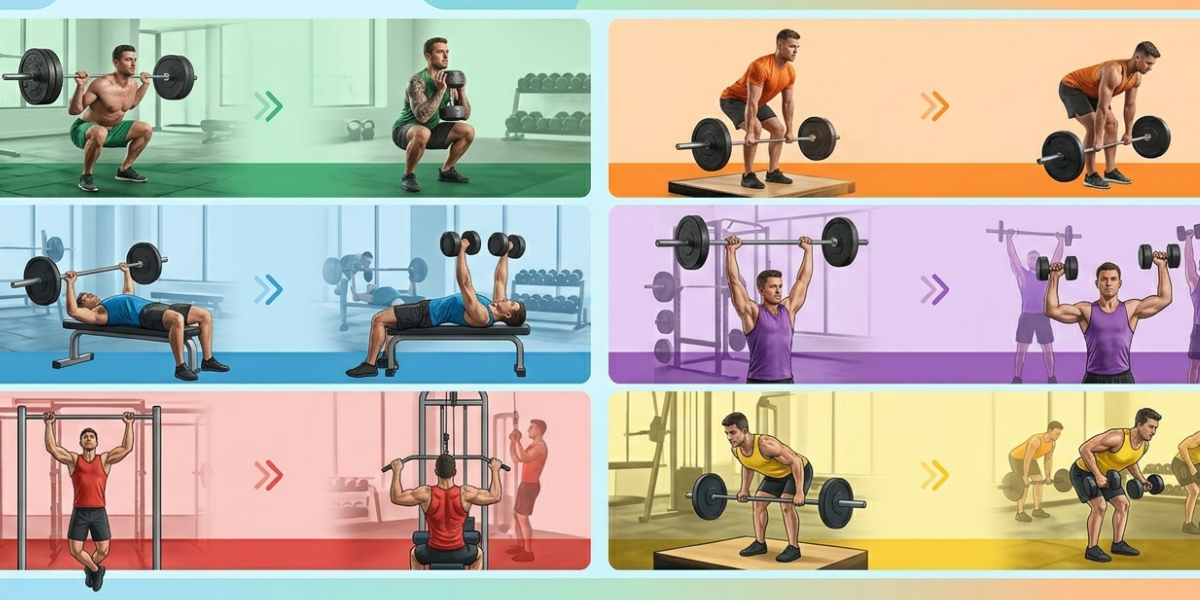
Not all exercises are created equal when strength is the goal. Compound movements — exercises that recruit multiple muscle groups and joints simultaneously — provide the greatest return on training investment. The foundational compound lifts that appear in virtually every evidence-based strength program include:
- Squat: Targets quads, hamstrings, glutes, and core. The back squat and goblet squat are excellent starting points.
- Deadlift: Works the entire posterior chain including hamstrings, glutes, lower back, and traps. The Romanian deadlift is a safer entry point for beginners.
- Bench Press: Develops chest, anterior deltoids, and triceps. Can be performed with a barbell, dumbbells, or even a cable machine.
- Overhead Press: Builds shoulder and upper back strength while engaging the core for stability.
- Pull-Up or Bent-Over Row: Essential for upper back and bicep development and counterbalancing pressing movements.
Isolation exercises — movements that target a single muscle group like bicep curls or leg extensions — play a supporting role. They are useful for addressing weaknesses or adding volume to a specific muscle, but they should supplement, not replace, compound work in a strength-focused program.
For a broader look at well-structured exercise routines and movement guides, exploring categorized resources by movement type can help you find programs matched to your current fitness level.
How to Structure a Strength Training Program
Training Frequency and Split Options
Beginners benefit most from full-body workouts performed three days per week, such as Monday, Wednesday, and Friday. This approach ensures each muscle group is trained with enough frequency to maximize early adaptation.
As training age increases — typically after six to twelve months of consistent work — intermediate lifters can transition to upper/lower splits or push/pull/legs programs that allow for higher volume per session.
Sets, Reps, and Load Guidelines
| Goal | Rep Range | Sets | Rest Between Sets |
|---|---|---|---|
| Maximum Strength | 1–5 reps | 3–6 | 3–5 minutes |
| Strength + Hypertrophy | 6–12 reps | 3–5 | 1.5–3 minutes |
| Muscular Endurance | 13–20+ reps | 2–4 | 30–90 seconds |
For most people beginning a strength journey, training in the six to twelve rep range at 65–80% of their estimated one-rep max is an effective and practical starting point. Loads in this range are heavy enough to drive strength adaptation while still allowing proper technique development.
Warm-Up and Mobility Work
A proper warm-up is not optional. Beginning each session with five to ten minutes of light cardiovascular activity followed by dynamic stretches and movement-specific warm-up sets primes your joints, increases core temperature, and activates key muscle groups before heavy loading.
Cold muscles and stiff joints are significantly more injury-prone. Prioritizing mobility work — particularly for the hips, thoracic spine, and shoulders — pays dividends in both performance and long-term joint health.
Nutrition to Support Strength Gains

You cannot out-train poor nutrition. Muscles need the raw materials to repair and grow, and the most important of these is protein. For individuals engaged in regular resistance training, research supports a protein intake of approximately 1.6 to 2.2 grams per kilogram of body weight per day.
Sources such as chicken breast, eggs, fish, legumes, Greek yogurt, and cottage cheese are all excellent options.
Carbohydrates are equally important as the primary fuel source for high-intensity lifting. Cutting carbohydrates too aggressively while training for strength will compromise your energy levels and reduce workout quality.
Total caloric intake also matters — a slight caloric surplus (roughly 200–300 kcal above maintenance) supports muscle growth most efficiently, while a maintenance or mild deficit is more appropriate if fat loss alongside strength building is the goal.
Hydration is often overlooked but directly impacts performance. Even mild dehydration — as little as two percent of body weight — can impair strength output and coordination. Drink water consistently throughout the day, not just during workouts.
Understanding the relationship between body composition, overall health, and physical performance helps you make smarter choices about how you fuel your training across different phases of your program.
Tracking Progress and Avoiding Plateaus
Keeping a training log is one of the simplest and most effective habits a strength trainee can build. Recording the weight used, reps completed, and how the session felt gives you accurate data to guide future programming decisions.
When progress stalls — a plateau — that data helps you identify whether the issue is insufficient overload, inadequate recovery, nutritional gaps, or a need for program variation.
Deload weeks — planned periods of reduced training volume and intensity — are a powerful tool for preventing accumulated fatigue from undermining progress. Every four to eight weeks, reducing your training volume by about forty percent for one week allows your nervous system and connective tissue to recover fully, often resulting in a noticeable jump in performance the following week.
Common Mistakes to Avoid When Building Strength
- Skipping the basics: Neglecting fundamental movement patterns in favor of flashy exercises leads to imbalances and limits long-term strength potential.
- Ego lifting: Using more weight than your technique can handle is one of the fastest paths to injury. Technique always comes first.
- Inconsistent sleep: Chronic sleep deprivation reduces testosterone, elevates cortisol, and dramatically impairs muscle repair.
- Ignoring pain signals: Discomfort during exertion is normal; sharp, localized, or persistent pain is not. Stop and assess before continuing.
- Changing programs too frequently: Jumping from one program to another every two weeks does not allow for sufficient adaptation. Commit to a program for at least eight to twelve weeks before evaluating its effectiveness.
- Neglecting unilateral training: Single-leg and single-arm movements expose and correct muscle imbalances that bilateral lifts can mask.
Frequently Asked Questions
How long does it take to build noticeable strength?
Most beginners notice meaningful strength gains within four to six weeks of consistent training. This early progress is largely neurological — your brain becomes more efficient at coordinating the muscles involved — before significant muscle tissue is added. Visible changes in muscle size typically emerge after eight to twelve weeks of progressive training.
How many days per week should I train for strength?
Three to four days per week is the sweet spot for most people pursuing strength goals. This allows adequate training stimulus while providing enough recovery time between sessions. Total beginners may do well with three full-body sessions, while more advanced trainees may train four or five days using a structured split.
Can you build strength without a gym or equipment?
Yes. Bodyweight training — using push-up progressions, squat variations, pull-ups, and hinge patterns like the single-leg Romanian deadlift — can build substantial strength, particularly in the early stages of training. As you advance, adding resistance bands, a set of adjustable dumbbells, or a pull-up bar expands your options significantly.
Is cardio bad for strength gains?
Moderate cardiovascular training does not hinder strength gains and offers important benefits for heart health, recovery, and body composition. The issue arises when high-volume endurance training competes directly with strength work for recovery resources — known as the interference effect. Two to three moderate cardio sessions per week are generally compatible with a strength program for most people.
What should I eat before and after a strength training session?
A pre-workout meal containing carbohydrates and moderate protein one to two hours before training provides the energy needed for high-quality effort. Post-workout, a protein-rich meal or shake consumed within two hours of training helps initiate muscle repair. A practical example is oatmeal with eggs before training and a chicken and rice meal or a protein shake with fruit afterward.
Do I need supplements to build strength?
Supplements are not necessary for strength development, but a few have strong research support. Creatine monohydrate is the most evidence-backed supplement available, consistently shown to improve strength and power output across a wide range of training populations. Protein powder is a convenient way to meet daily protein targets. Beyond these, a balanced diet covers the needs of the vast majority of strength trainees.
How do I know if I am overtraining?
Warning signs of overtraining include persistent fatigue that does not improve with rest, declining performance over multiple sessions, disrupted sleep, increased resting heart rate, mood disturbances, and elevated injury frequency. The solution is typically a deload week, improved sleep, and a review of overall training volume relative to recovery capacity.
Should beginners use free weights or machines?
Both have a place in a well-rounded program, but beginners often benefit from starting with machines to develop basic strength and movement patterns with less technical demand. As coordination and confidence improve, gradually incorporating free weights — particularly for compound movements like the squat and deadlift — builds the stabilizing muscles and coordination that machines cannot replicate as effectively.
At what age can someone start strength training?
Strength training is appropriate across a wide age range. Children and adolescents can train safely with proper supervision and age-appropriate programming, and research supports the value of resistance training for healthy bone development and injury prevention in young athletes. Adults of all ages, including older adults, benefit significantly from regular strength training for metabolic health, bone density, and functional independence.
How important is form compared to the weight used?
Form is far more important than the weight on the bar, particularly for beginners and intermediate lifters. Poor technique under heavy load is a primary driver of acute and chronic injury. It also reduces the mechanical tension placed on the target muscle, making the exercise less effective. Developing and maintaining good technique should always take priority over progression in load.