


Starting an exercise routine as an absolute beginner can feel overwhelming, but it does not have to be. This complete guide to exercise for absolute beginners walks you through everything you need to know to begin moving safely, build confidence, and create habits that actually stick for the long term.
Why Exercise Matters More Than You Think
Physical activity is one of the most powerful tools available for improving overall health. The World Health Organization and major health bodies worldwide consistently confirm that regular movement reduces the risk of chronic disease, improves mental health, supports healthy weight management, and extends lifespan.
These are not minor benefits. Regular exercise has been shown to lower the risk of heart disease, type 2 diabetes, certain cancers, and depression, often as effectively as medication for some conditions.
What beginners often miss is that the benefits begin almost immediately. Within weeks of starting a consistent routine, most people report better sleep, more energy during the day, and an improved mood. The physical changes take longer to see in the mirror, but the internal improvements happen fast.
That is why getting started, even imperfectly, matters far more than waiting for the perfect plan.
Understanding the Different Types of Exercise
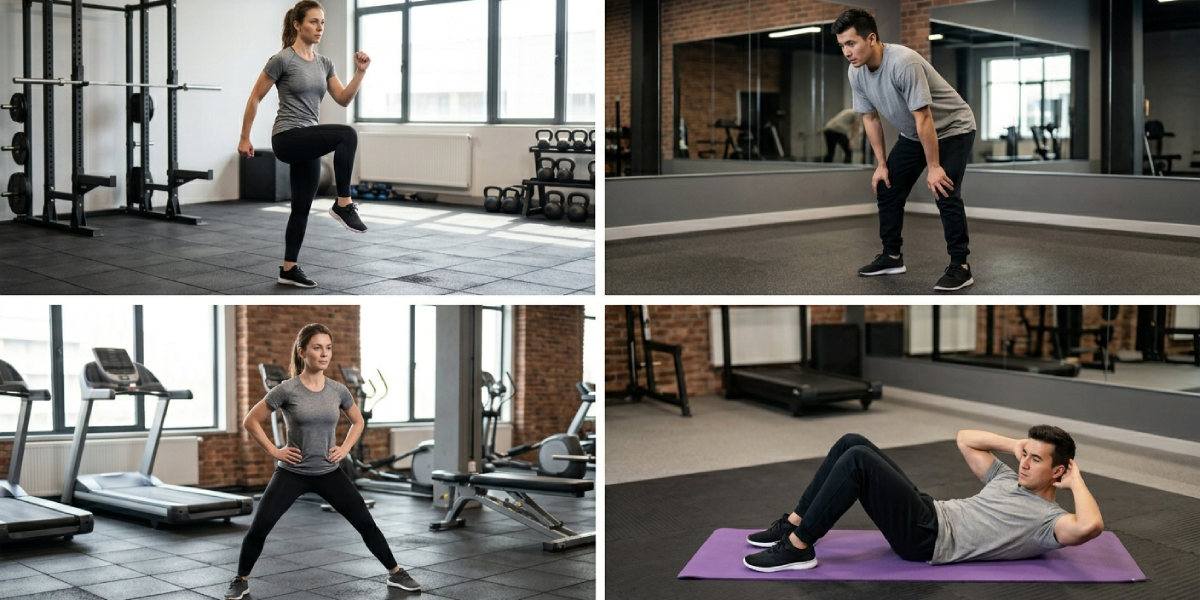
Before diving into routines, it helps to understand the main categories of physical activity. Each type trains your body differently, and a balanced fitness program includes elements from more than one category.
Cardiovascular Exercise
Cardio, short for cardiovascular exercise, refers to any sustained activity that raises your heart rate and keeps it elevated for a period of time. Walking, jogging, cycling, swimming, and dancing all fall into this category. Cardio strengthens your heart and lungs, burns calories, and improves your endurance.
For beginners, brisk walking is one of the safest and most accessible forms of cardiovascular exercise available.
Strength Training
Strength training, also called resistance training, involves working your muscles against a load. That load can be your own bodyweight, free weights, resistance bands, or gym machines. The goal is to progressively challenge your muscles so they grow stronger over time.
Strength training is not just for bodybuilders. It is essential for maintaining muscle mass as you age, supporting bone density, and boosting your metabolism. Beginners can start with simple bodyweight exercises like squats, push-ups, and lunges before adding external resistance.
Flexibility and Mobility Work
Stretching, yoga, and mobility exercises improve your range of motion and reduce the risk of injury. This type of training is frequently overlooked by beginners but becomes increasingly important over time, especially if you spend long hours sitting at a desk.
Incorporating even ten minutes of stretching after each workout makes a meaningful difference in how your body feels and recovers.
Balance and Stability Training
Balance training involves exercises that challenge your ability to control your body’s position. Standing on one leg, using a balance board, or practicing certain yoga poses all develop the stabilizing muscles and neural pathways that keep you safe during everyday movement and other forms of exercise.
How Much Exercise Do Beginners Actually Need
One of the most common questions from beginners is how much they need to do. The Physical Activity Guidelines for Americans, published by the U.S. Department of Health and Human Services, recommend that adults aim for at least 150 minutes of moderate-intensity aerobic activity per week, combined with muscle-strengthening activities on two or more days per week.
For absolute beginners, starting below these targets is completely appropriate. Even 20 to 30 minutes of brisk walking three times a week provides substantial health benefits and is a realistic starting point. The goal is to build a foundation, not to immediately hit advanced benchmarks. Doing too much too soon is one of the most common reasons beginners get injured or burn out.
A sensible beginner schedule might look like this:
- Monday: 20-minute brisk walk or light cardio
- Tuesday: 20-minute beginner bodyweight strength routine
- Wednesday: Rest or gentle stretching
- Thursday: 20-minute brisk walk or light cardio
- Friday: 20-minute beginner bodyweight strength routine
- Saturday: Active rest (gentle walk, yoga, or casual movement)
- Sunday: Full rest
As your fitness improves over weeks and months, you can gradually increase duration, frequency, and intensity.
Essential Beginner Exercises to Start With
You do not need a gym membership or expensive equipment to start. The following exercises are safe, effective, and require nothing more than a small amount of floor space. Each targets major muscle groups and builds functional strength that transfers directly to everyday life.
| Exercise | Muscles Targeted | Beginner Sets and Reps |
|---|---|---|
| Bodyweight Squat | Quadriceps, glutes, hamstrings | 2 sets of 10 reps |
| Push-Up (modified on knees if needed) | Chest, shoulders, triceps | 2 sets of 8 reps |
| Glute Bridge | Glutes, hamstrings, lower back | 2 sets of 12 reps |
| Plank Hold | Core, shoulders, back | 2 holds of 20 to 30 seconds |
| Step-Up (on a low step or stair) | Legs, glutes, balance | 2 sets of 10 per leg |
| Bent-Over Row (using a water bottle or light object) | Upper back, biceps | 2 sets of 10 reps |
Perform these exercises with controlled movements and full range of motion. Speed is not the goal. Proper form prevents injury and ensures the target muscles are actually working. You can explore a wider library of beginner-friendly exercise routines and movement guides to expand your training repertoire as your fitness improves.
The Role of Nutrition in Supporting Your Fitness Journey

Exercise and nutrition are deeply interconnected. You cannot out-train a poor diet, and the fuel you provide your body directly affects your energy levels, recovery, and results. As a beginner, you do not need to obsess over macros or follow a rigid meal plan, but understanding the basics will help you feel better during workouts and recover more efficiently afterward.
Protein is the most important macronutrient for anyone starting an exercise program. It supports muscle repair and growth after strength training sessions. Aim to include a source of lean protein at each meal, such as chicken, eggs, fish, Greek yogurt, legumes, or tofu.
Carbohydrates provide the primary fuel source for most forms of exercise, so cutting them too aggressively while trying to start a fitness routine often leaves beginners feeling fatigued. Healthy fats from sources like avocado, olive oil, and nuts support hormone function and joint health.
Hydration is equally critical. Even mild dehydration impairs physical performance and recovery. Drinking water consistently throughout the day, and especially before, during, and after exercise, is a habit that pays dividends immediately.
Monitoring your overall health status alongside your activity levels is also wise. Tools like the BMI calculator can help you track body composition metrics as part of a broader picture of your health progress.
How to Progress Safely Without Getting Injured
Injury is the single biggest threat to a beginner’s fitness journey. Most beginner injuries are entirely preventable and stem from doing too much too soon, skipping warm-ups, or using poor form. The following principles will keep you safe and progressing consistently.
Always Warm Up Before Training
A five to ten minute warm-up before any workout prepares your joints, raises your body temperature, and activates the muscles you are about to use. Light jogging in place, jumping jacks, leg swings, arm circles, and hip rotations all work well. Never skip this step, especially in the morning or when your body is cold from sitting for extended periods.
Follow the Ten Percent Rule
When increasing the volume or intensity of your training, avoid jumping up by more than roughly ten percent per week. If you walked 60 minutes total this week, aim for no more than 66 minutes next week. This gradual progression allows your connective tissue, joints, and muscles to adapt without being overwhelmed.
Prioritize Sleep and Recovery
Muscles do not grow during workouts. They grow during rest and sleep, when the body repairs micro-tears in muscle fibers caused by exercise. Consistently sleeping seven to nine hours per night is one of the most underrated performance enhancers available. Overtraining without adequate recovery leads to fatigue, increased injury risk, and stalled progress.
Listen to Your Body
There is a meaningful difference between the discomfort of a challenging workout and the pain of a potential injury. Sharp, sudden, or joint-related pain during exercise is a signal to stop immediately. Delayed onset muscle soreness, the aching feeling that typically appears 24 to 48 hours after a new or intense workout, is normal and manageable. However, persistent or worsening pain should always be evaluated by a healthcare professional.
Building Exercise Habits That Last
The most sophisticated workout program in the world is worthless if you do not follow it consistently. Habit formation is arguably the most important fitness skill a beginner can develop. Research in behavioral science shows that habits are formed through repetition and positive reinforcement, not willpower alone.
Start by attaching exercise to an existing daily anchor, such as exercising immediately after waking up, during a lunch break, or right after getting home from work. Consistency in timing reduces decision fatigue and makes it easier to follow through. Prepare your workout clothing and any equipment the night before to remove small friction barriers.
Track your progress in a simple notebook or app. Seeing concrete evidence of improvement, whether that is walking farther, doing more push-ups, or simply showing up more consistently, reinforces the behavior and builds motivation over time. Celebrating small wins is not trivial. It is a proven psychological mechanism for sustaining long-term behavior change.
Finding a community, whether in person at a local gym or class or online through fitness forums and apps, dramatically improves adherence. Accountability to others reduces the likelihood of skipping sessions on hard days.
Common Beginner Mistakes to Avoid
Understanding what not to do is just as valuable as knowing what to do. These are the most frequent mistakes that derail beginners before they have a chance to see results.
- Comparing yourself to advanced exercisers: Everyone starts at a different baseline. Focus entirely on your own progress and avoid using others as your benchmark.
- Expecting rapid results: Visible physical changes typically take six to twelve weeks of consistent effort. The internal health benefits come sooner, but patience is essential.
- Skipping rest days: Rest is productive. It is when adaptation and growth occur. Planning rest days is part of training, not a failure of discipline.
- Focusing only on cardio: Many beginners gravitate exclusively toward cardio and avoid strength training. Both are necessary for optimal health, body composition, and longevity.
- Following overly complicated programs: Simple, consistent execution of basic movements beats complex programming that you cannot sustain. Master the fundamentals first.
- Neglecting nutrition: Exercise creates a stimulus for change, but nutrition provides the raw material. Fueling your workouts properly amplifies every training session.
The Mental and Emotional Benefits of Regular Exercise
The benefits of exercise extend far beyond the physical. Regular physical activity is one of the most well-researched and effective interventions for improving mental health. Exercise triggers the release of endorphins, dopamine, and serotonin, neurotransmitters that regulate mood, motivation, and stress.
Even a single session of moderate exercise can meaningfully reduce anxiety and improve cognitive function for several hours afterward.
For people dealing with mild to moderate depression or chronic stress, consistent aerobic exercise has been shown in multiple clinical studies to be as effective as antidepressant medication in improving mood outcomes. This does not mean exercise replaces medical care when it is needed, but it does highlight how powerfully exercise affects the brain, not just the body.
Beyond the neurochemical effects, exercise builds self-efficacy, your belief in your own ability to accomplish challenging things. Every workout completed, every small milestone reached, reinforces the identity of someone who shows up, does hard things, and follows through.
Over time, that identity shift becomes one of the most meaningful results of a consistent exercise practice. Learning more about how exercise connects to overall health and wellbeing can deepen your understanding and motivation as you progress.
Frequently Asked Questions
How often should an absolute beginner exercise?
Most beginners do well starting with three to four days of exercise per week, alternating between activity days and rest or light movement days. This frequency allows the body to adapt and recover without excessive fatigue or injury risk.
Is it okay to exercise every day as a beginner?
Exercising every day is generally not recommended for absolute beginners. Your body needs rest to repair and grow stronger. However, light activities such as walking or gentle stretching on rest days are perfectly fine and can even support recovery.
What should I eat before a workout?
A small meal or snack containing carbohydrates and some protein consumed one to two hours before exercise works well for most beginners. Examples include a banana with peanut butter, Greek yogurt with fruit, or toast with eggs. Avoid very heavy or high-fat meals right before training.
Do I need a gym membership to start exercising?
No. A gym membership is completely optional, especially when starting out. Bodyweight exercises performed at home, walking or jogging outdoors, and resistance band workouts provide a complete and effective foundation that requires minimal investment.
How long before I start seeing results from exercise?
Most people notice improved energy, mood, and sleep within two to four weeks of consistent exercise. Visible physical changes such as improved muscle definition or weight loss typically become noticeable after six to twelve weeks of consistent training combined with appropriate nutrition.
Is soreness after exercise normal?
Yes. Delayed onset muscle soreness, which peaks around 24 to 48 hours after a new or intense workout, is a normal response to exercise and indicates that your muscles have been challenged and are adapting. It generally diminishes as your fitness improves. Sharp or joint pain, however, is different and should not be ignored.
Can I lose weight through exercise alone?
Exercise contributes meaningfully to weight loss, but research consistently shows that dietary changes produce more significant calorie deficits than exercise alone for most people. The most effective approach combines regular physical activity with a balanced, nutrient-rich diet. Exercise also helps preserve muscle mass during weight loss, which is important for long-term metabolic health.
What is the best time of day to exercise?
The best time to exercise is whenever you can do it consistently. Research shows that morning, afternoon, and evening workouts all deliver comparable health and fitness benefits. Circadian rhythm studies suggest some slight advantages for strength and performance in the late afternoon, but consistency matters far more than timing for beginners.
Should I stretch before or after exercise?
Dynamic stretching, such as leg swings and arm circles, is best performed before exercise as part of a warm-up. Static stretching, where you hold a position for 20 to 30 seconds, is most effective and safest after a workout when your muscles are warm. Stretching cold muscles before exercise can temporarily reduce muscle force output.
How do I stay motivated to keep exercising?
Setting specific, realistic short-term goals, tracking your progress, exercising with a partner or community, and building exercise into a consistent daily routine are the most effective evidence-based strategies for maintaining long-term motivation. Motivation naturally fluctuates, so building a habit and removing friction from your routine matters more than relying on motivation alone.