

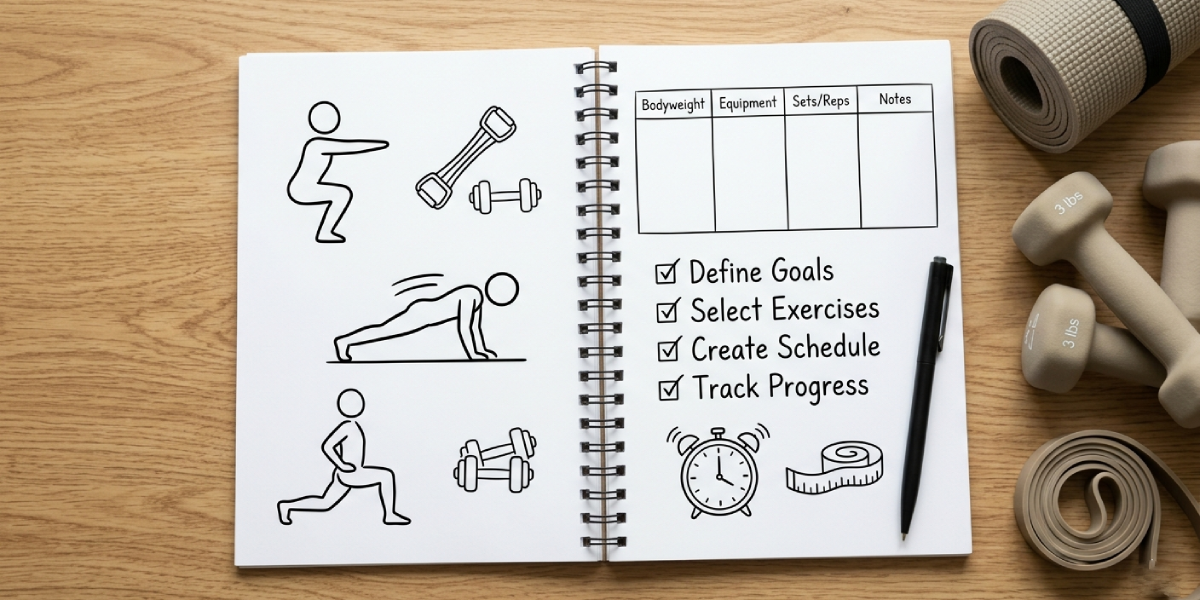
Building a home exercise program from scratch is one of the smartest fitness decisions you can make. Whether you are short on time, working with a tight budget, or simply prefer the privacy of your own space, a well-designed home workout plan delivers real, measurable results without a gym membership.
This guide walks you through every step of the process using practical, science-backed strategies.
Why a Structured Home Exercise Program Works
Many people assume that training at home means compromising on results. The truth is the opposite. Research consistently shows that adherence is the single most important factor in fitness progress, and working out at home removes the most common barriers to consistency: commute time, cost, and scheduling conflicts. When your workout environment is steps away, you remove friction from the equation.
A structured program also outperforms random workouts because it applies the principle of progressive overload, the gradual increase in training demand over time that forces the body to adapt and improve. Without structure, most people plateau quickly or cycle through the same movements without making progress.
Exploring a variety of exercise categories is a great way to understand which movement patterns should form the backbone of your home program before you commit to a routine.
Step 1: Define Your Goals Before You Train
Every effective program begins with clearly defined goals. Vague intentions like “get fit” or “lose weight” do not give you a framework to build around. Instead, use the SMART framework: goals should be Specific, Measurable, Achievable, Relevant, and Time-bound.
Common home training goals include building muscular strength and hypertrophy, improving cardiovascular endurance, losing body fat, increasing mobility and flexibility, or a combination of these. Each goal requires a different training emphasis, frequency, and exercise selection.
Someone focused on fat loss will structure their sessions differently from someone prioritising strength, even if both are training at home with limited equipment.
Take five minutes before you design a single workout to write down exactly what you want to achieve and by when. That decision shapes everything that follows.
Step 2: Assess What You Have to Work With
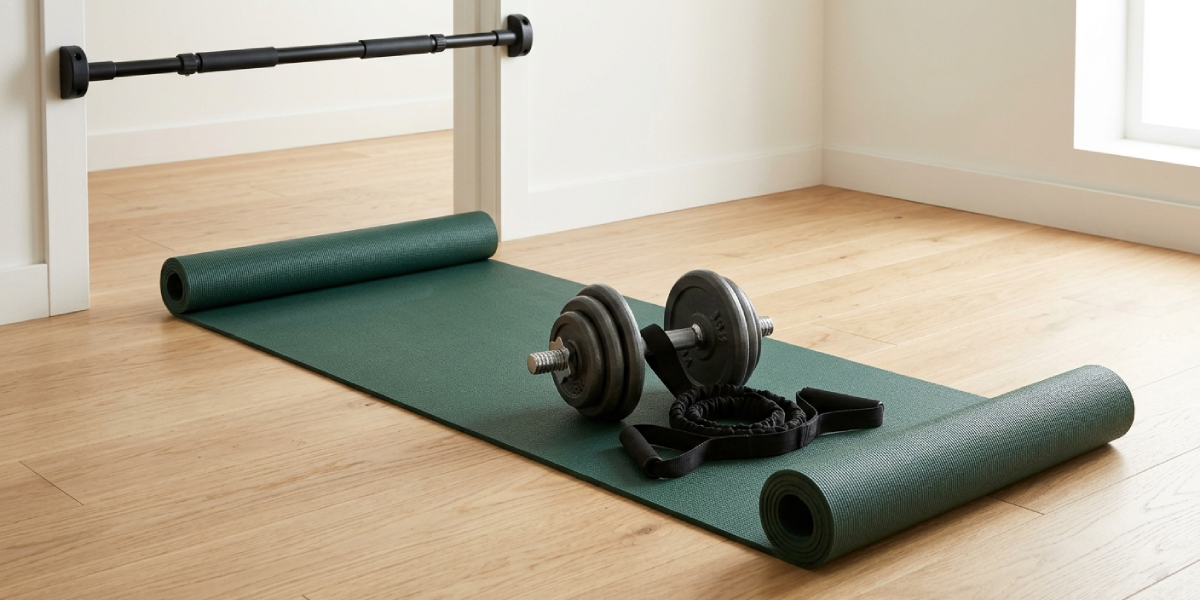
A home exercise program does not require a room full of equipment. Bodyweight training alone can build significant strength, endurance, and muscle when programmed correctly. That said, a small investment in a few key items dramatically expands your options.
Consider the following when taking stock of your space and equipment:
- Space: Even a two-by-two-metre area is enough for most exercises. A yoga mat protects your joints and defines your training zone.
- Bodyweight foundations: Push-ups, squats, lunges, glute bridges, planks, and mountain climbers require nothing beyond a floor.
- Resistance bands: Affordable and versatile, bands add load to bodyweight exercises and are ideal for mobility work.
- Adjustable dumbbells or kettlebells: A single set of adjustable dumbbells can replace an entire rack and provide the progressive resistance needed for long-term muscle development.
- Pull-up bar: A doorframe pull-up bar costs very little and adds a critical upper-body pulling pattern that pure bodyweight programmes often lack.
Step 3: Choose the Right Training Split
A training split determines which muscle groups or movement patterns you train on which days. Choosing the wrong split is one of the most common reasons home programmes stall. Here are the three most practical options for home training:
Full-Body Training (3 Days Per Week)
Full-body sessions work every major muscle group each time you train. This approach is ideal for beginners or anyone training three days per week or fewer. It maximises training frequency for each muscle group and delivers excellent results for both strength and body composition goals.
Upper-Lower Split (4 Days Per Week)
An upper-lower split divides training into upper-body days and lower-body days. This allows greater volume per session than full-body training while still hitting each muscle group twice per week. It suits intermediate trainees who have built a base of strength and want to increase training volume without overtraining.
Push-Pull-Legs (5 to 6 Days Per Week)
Push-pull-legs organises training around movement patterns: pushing movements (chest, shoulders, triceps), pulling movements (back, biceps), and leg movements. This split works well for advanced trainees who can recover from higher frequency. It is less common in home programmes but entirely achievable with moderate equipment.
Step 4: Build Each Session Around Compound Movements
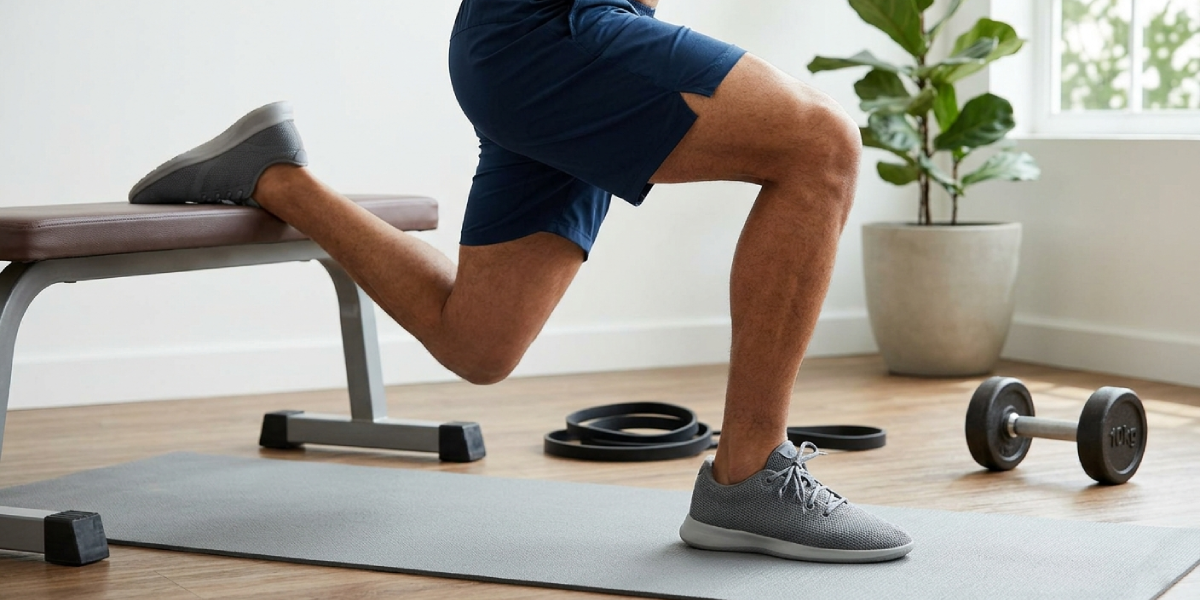
Regardless of the split you choose, every session should be anchored by compound exercises. These are multi-joint movements that recruit large amounts of muscle mass and provide the greatest stimulus for both strength and body composition changes.
The core compound movements for a home programme are:
- Squat pattern: Bodyweight squats, goblet squats, Bulgarian split squats
- Hinge pattern: Glute bridges, hip thrusts, Romanian deadlifts with dumbbells
- Push pattern: Push-up variations, dumbbell press, pike push-ups
- Pull pattern: Pull-ups, band pull-aparts, dumbbell rows
- Carry and core: Plank variations, dead bugs, farmer carries
Isolation exercises such as bicep curls or lateral raises are useful accessories but should not form the foundation of your programme. Build your sessions on compound movements first and use isolation work to address weak points or add variety.
Step 5: Programme Sets, Reps, and Rest Periods
How you organise sets, reps, and rest depends on your primary goal. The following table summarises evidence-based guidelines for the most common home training objectives:
| Goal | Sets Per Exercise | Rep Range | Rest Period |
|---|---|---|---|
| Muscular Strength | 3 to 5 | 3 to 6 | 2 to 4 minutes |
| Hypertrophy (Muscle Size) | 3 to 4 | 8 to 15 | 60 to 90 seconds |
| Muscular Endurance | 2 to 3 | 15 to 25 | 30 to 60 seconds |
| Fat Loss and Conditioning | 3 to 4 | 12 to 20 | 30 to 45 seconds |
These are starting points, not rigid rules. Beginners will benefit from virtually any rep range because the training stimulus is novel to their nervous system. As you advance, precise programming becomes more important.
Step 6: Apply Progressive Overload Consistently
Progressive overload is the non-negotiable principle behind all lasting fitness progress. It means that over time, you must demand more from your body than it is currently accustomed to. Without this principle, your body has no reason to adapt.
In a gym, progressive overload usually means adding weight to the bar. At home, you have several equally effective options:
- Increase repetitions with the same load
- Add sets to an exercise
- Reduce rest periods between sets
- Slow down the eccentric (lowering) phase of a movement
- Progress to a harder exercise variation (for example, from knee push-ups to standard push-ups to archer push-ups)
- Add load via bands, weighted vests, or dumbbells
Track your workouts in a simple notebook or app. If you cannot see whether you are doing more than last week, you cannot apply progressive overload deliberately.
Step 7: Plan Recovery and Rest Days
Rest is not a reward for effort. It is a physiological requirement for progress. Muscle tissue repairs and grows during recovery, not during training. Sleep quality, nutrition, hydration, and active recovery all influence how quickly you can return to training at full capacity.
For most people training three to four days per week, two to three rest days are sufficient. Active recovery sessions on off days, such as a 20-minute walk, light yoga, or gentle stretching, maintain movement quality without adding fatigue.
Pay close attention to sleep, aiming for seven to nine hours per night, as this is when the majority of hormonal recovery processes occur.
Understanding the broader relationship between exercise and health outcomes can help you appreciate why recovery is just as important as the workouts themselves.
Step 8: Track Progress and Adjust Every Four to Six Weeks
A home exercise programme should be reviewed and adjusted every four to six weeks. This is often called a training block, and reviewing each block gives you the data you need to make smart decisions about what comes next.
Progress markers to track include:
- Changes in bodyweight and body measurements
- Improvements in strength (reps or load on key exercises)
- Changes in resting heart rate and cardiovascular fitness
- Subjective energy levels, sleep quality, and mood
- BMI as one broad reference point (use our BMI calculator to track changes over time)
If you are not making progress after six weeks, something needs to change: volume, intensity, exercise selection, nutrition, or recovery. Stagnation is information, not failure.
Sample 3-Day Full-Body Home Programme
The following is a practical starting template. Adjust loads and progressions based on your current fitness level.
Day 1: Strength Focus
Goblet squat: 4 sets of 8 reps. Push-up: 4 sets to two reps short of failure. Dumbbell Romanian deadlift: 3 sets of 10 reps. Dumbbell row: 3 sets of 10 reps per side. Plank hold: 3 sets of 30 to 45 seconds.
Day 2: Hypertrophy and Endurance Focus
Bulgarian split squat: 3 sets of 12 reps per side. Pike push-up: 3 sets of 12 reps. Glute bridge: 3 sets of 15 reps. Band pull-apart: 3 sets of 20 reps. Dead bug: 3 sets of 10 reps per side.
Day 3: Conditioning and Core
Squat to press: 3 sets of 15 reps. Mountain climber: 3 sets of 30 seconds. Single-leg Romanian deadlift: 3 sets of 10 reps per side. Renegade row: 3 sets of 8 reps per side. Hollow body hold: 3 sets of 20 seconds.
Frequently Asked Questions
How many days per week should I exercise at home?
Most people make excellent progress training three to four days per week. Beginners benefit most from three full-body sessions with rest days in between. More advanced trainees can increase frequency to four or five days using an upper-lower or push-pull-legs split. The best frequency is the one you can sustain consistently over months.
Can I build muscle without gym equipment?
Yes. Bodyweight exercises create mechanical tension and metabolic stress, the same primary mechanisms behind muscle growth in weight training. Push-up progressions, squat variations, pull-ups, and hip hinge patterns can build meaningful muscle, especially in the early stages of training. Adding resistance bands or light dumbbells accelerates progress significantly over time.
How long should a home workout session last?
Effective home sessions typically last 30 to 60 minutes. There is no benefit to training beyond 60 to 75 minutes for most goals. Quality of effort and progressive overload matter far more than session length. A focused 35-minute session consistently outperforms a distracted 90-minute one.
What should I eat to support a home exercise program?
Nutrition should be matched to your goal. For fat loss, a moderate calorie deficit supported by high protein intake (1.6 to 2.2 grams per kilogram of bodyweight) preserves muscle while reducing body fat. For muscle gain, a slight calorie surplus with adequate protein supports growth. Prioritise whole foods, sufficient hydration, and consistent meal timing around your training sessions.
Is it necessary to warm up before home workouts?
A warm-up is not optional. A five to ten minute dynamic warm-up increases core body temperature, improves joint mobility, and activates the muscles you are about to train. This reduces injury risk and improves performance. Movements like leg swings, arm circles, hip circles, and bodyweight squats are effective and require no equipment.
How do I know if I am overtraining at home?
Signs of overtraining include persistent fatigue that does not improve with rest, declining performance over several sessions, disrupted sleep, elevated resting heart rate, irritability, and loss of motivation to train. If you experience multiple symptoms simultaneously, reduce training volume by 30 to 50 percent for one to two weeks and prioritise sleep and nutrition before resuming full training.
What is the best home exercise for beginners?
The squat, push-up, and glute bridge are the three most valuable starting exercises for beginners. Together they cover the major movement patterns of the lower body push, upper body push, and posterior chain hinge. Mastering these three with good form before adding complexity gives beginners a strong, injury-resistant foundation to build on.
Do I need to stretch after every home workout?
Post-workout stretching is beneficial for maintaining and improving flexibility and promoting recovery. Hold each stretch for 20 to 45 seconds and focus on the muscle groups most used in your session. Static stretching after exercise is safe and effective. It is less useful before training, where dynamic movements are preferable for preparing the body for load.
How soon will I see results from a home exercise program?
Most people notice improvements in strength and energy within two to three weeks of consistent training. Visible changes in body composition typically appear after four to eight weeks when training is paired with appropriate nutrition. Cardiovascular fitness improves relatively quickly. Significant muscle growth takes three to six months of consistent, progressive training.
Can older adults follow a home exercise program?
Absolutely. Home training is highly adaptable and can be modified for any age or fitness level. Older adults benefit enormously from resistance training, which preserves muscle mass, supports bone density, and reduces fall risk. Lower-impact variations of standard exercises, such as chair-assisted squats, wall push-ups, and resistance band work, make home programming accessible regardless of starting point.