

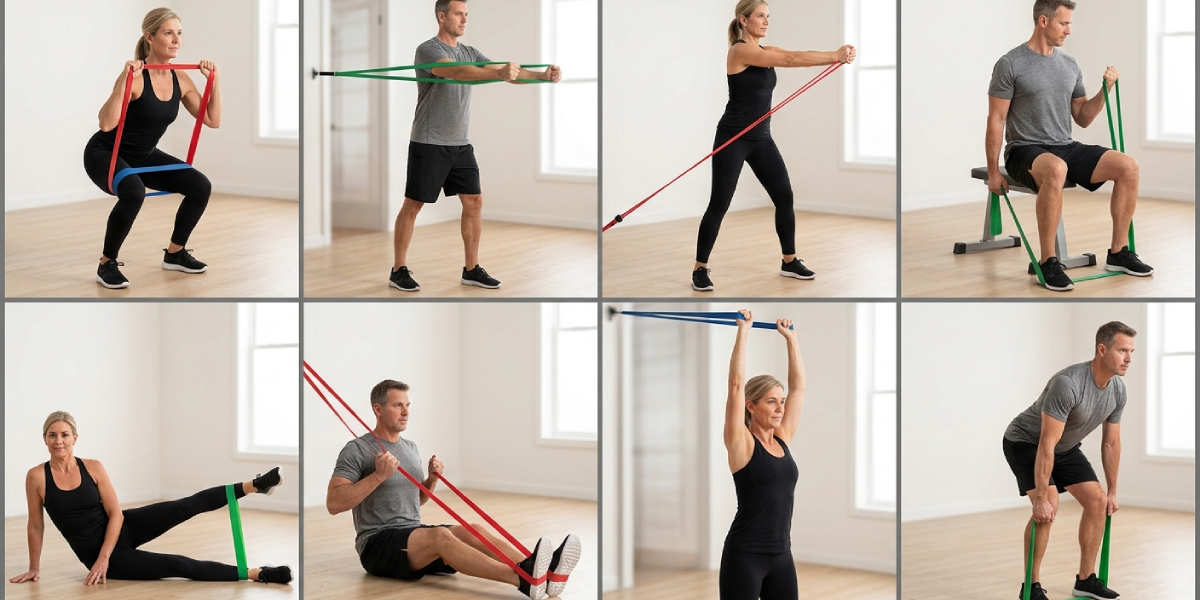
Learning how to use exercise bands for a full body workout is one of the smartest fitness decisions you can make. These lightweight, affordable tools deliver serious strength and conditioning results whether you train at home, in the gym, or on the road.
Resistance bands have moved well beyond the realm of physical therapy. Today, certified trainers, competitive athletes, and everyday fitness enthusiasts rely on them to build muscle, improve mobility, and maintain consistent training without heavy equipment.
In this guide, you will find everything you need to get started, progress safely, and maximize every session.
What Are Exercise Bands and Why Do They Work So Well
Exercise bands, also called resistance bands or workout bands, are elastic tools made from latex rubber or synthetic materials. They come in various forms including loop bands, tube bands with handles, flat therapy bands, and figure-eight bands.
Each style serves a slightly different purpose, but all operate on the same foundational principle: they create tension throughout the entire range of motion, forcing your muscles to work harder than they would against gravity alone.
Unlike free weights, resistance bands provide what exercise scientists call accommodating resistance. As you stretch the band further, the resistance increases. This means your muscles are challenged at both the beginning and end of every movement, promoting greater muscle activation and reducing the risk of injury caused by momentum-based lifting.
Research published in sports science journals has consistently shown that resistance band training produces comparable strength and hypertrophy gains to traditional weight training when applied with proper progressive overload principles. For anyone building a sustainable fitness habit, that finding is significant.
Choosing the Right Resistance Band for Your Goals
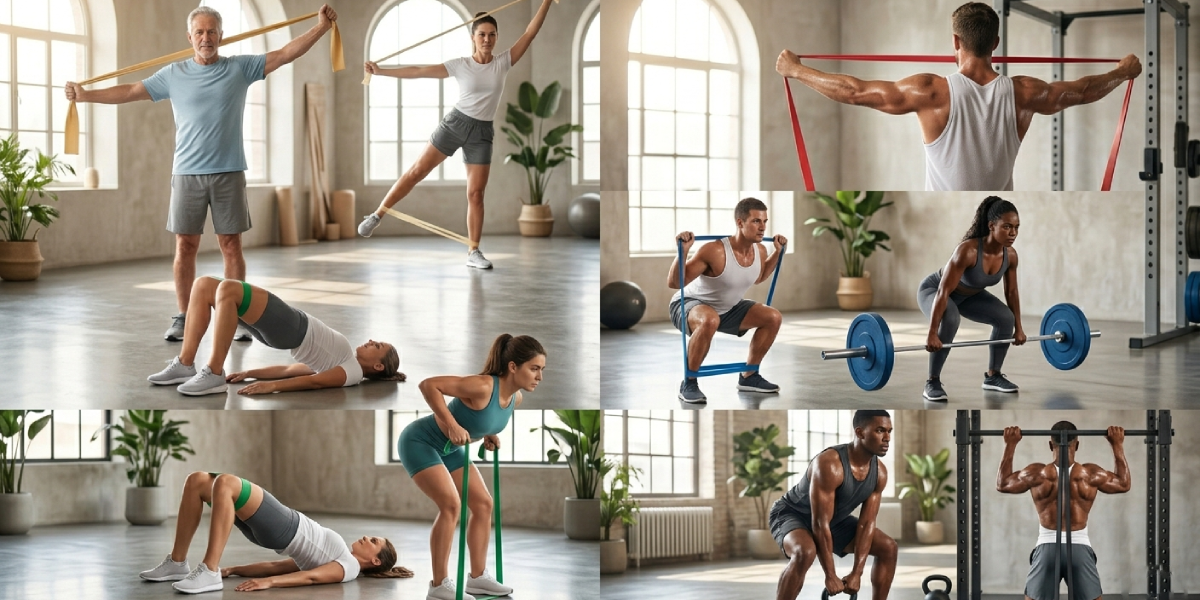
Walking into a store or browsing online, you will find bands labeled by color and resistance level. While color coding varies by brand, most follow a general pattern:
- Yellow or tan bands offer the lightest resistance, typically 5 to 15 pounds, and are ideal for rehabilitation, warm-ups, and beginners working on movement patterns.
- Red or light bands provide 15 to 25 pounds of resistance and work well for upper body exercises like bicep curls and shoulder raises.
- Green or medium bands range from 25 to 50 pounds and suit intermediate lifters targeting chest, back, and leg movements.
- Blue or heavy bands offer 50 to 80 pounds and challenge advanced users in compound exercises like squats, rows, and deadlifts.
- Black or extra-heavy bands exceed 80 pounds and are favored by athletes for assisted pull-ups and power movements.
As a practical rule, start lighter than you think necessary. Proper form and full range of motion matter far more than the resistance level, especially when you are learning new movement patterns.
Essential Safety Guidelines Before You Begin
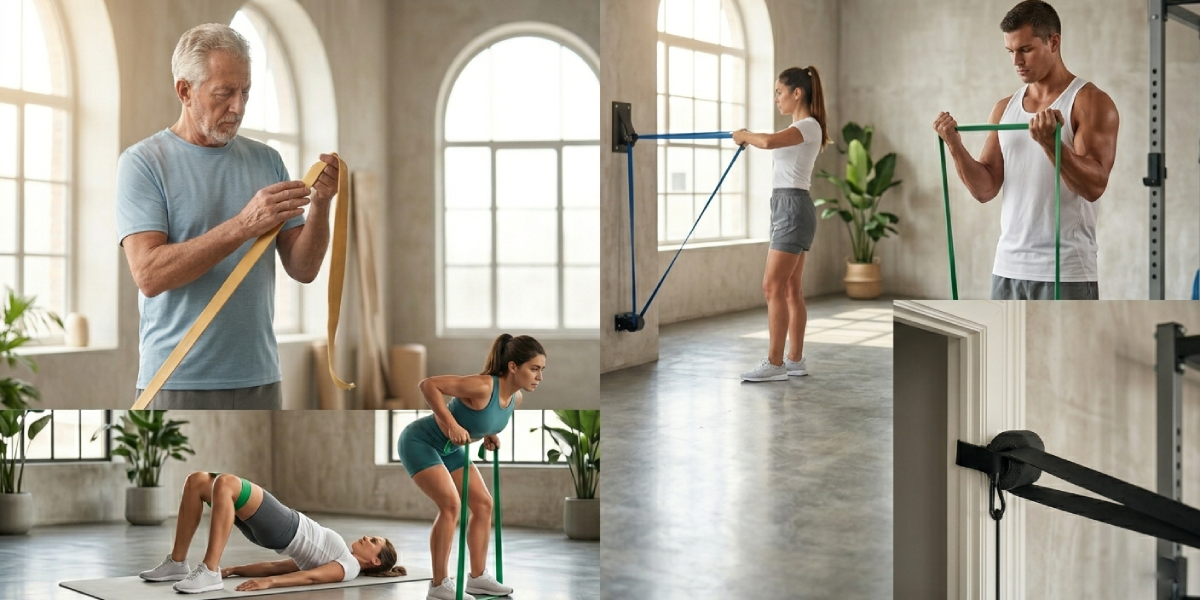
Resistance bands are safer than many training tools, but they require specific precautions to avoid injury and equipment failure.
Inspect Your Bands Before Every Session
Check for small nicks, tears, or areas where the latex looks faded or thin. A band that snaps under tension can cause skin abrasions or eye injuries. Replace any band that shows visible wear immediately.
Secure Your Anchor Points
When attaching a band to a door, pole, or anchor point, confirm the anchor can withstand the force you will apply. A band rated for 60 pounds of resistance will exert that same 60 pounds against whatever it is attached to.
Control Every Repetition
Unlike dumbbells that simply drop if you lose control, a band will snap back toward its resting length. Always lower the band in a slow, controlled manner on every repetition. This eccentric phase also happens to produce significant muscle-building stimulus.
Keep Bands Away From Sharp Edges
Even a small rough surface on a door frame or piece of furniture can cut through a band during a workout. Use protective door anchors or padded anchor points wherever possible.
The Full Body Exercise Band Workout Routine
The following routine is structured to target every major muscle group using only resistance bands. It follows a push-pull-legs organizational logic that ensures balanced development and adequate recovery between movement patterns. Perform this circuit two to three times per week with at least one rest day between sessions.
Warm-Up: Band Pull-Aparts
Hold a light resistance band in front of you with both hands at shoulder width. Pull the band apart by drawing your hands outward until the band touches your chest. Slowly return. Perform 15 repetitions. This activates the rear deltoids, rhomboids, and rotator cuff muscles, preparing your shoulders for pressing and pulling work ahead.
Upper Body Push: Banded Push-Up
Loop a band across your upper back and hold each end firmly in your hands as you assume a push-up position. The band adds resistance to the pressing phase without requiring any anchor point. Perform 3 sets of 10 to 15 repetitions. This exercise targets the pectorals, anterior deltoids, and triceps simultaneously.
Upper Body Push: Banded Overhead Press
Stand on the center of the band with feet at shoulder width. Hold one end in each hand at shoulder height, palms facing forward. Press both hands directly overhead until your arms are fully extended, then lower with control. Perform 3 sets of 10 to 12 repetitions. This builds shoulder strength and scapular stability essential for overhead function in daily life.
Upper Body Pull: Seated Row
Sit on the floor with legs extended. Loop the band around both feet and hold one end in each hand. Sit tall, brace your core, and row both hands toward your lower ribcage while driving your elbows back. Pause for one second at full contraction, then return slowly. Perform 3 sets of 12 repetitions. This movement strengthens the latissimus dorsi, rhomboids, and biceps.
Upper Body Pull: Banded Bicep Curl
Stand on the band with feet hip-width apart. Hold one end in each hand, palms facing forward. Curl both hands toward your shoulders, keeping your elbows pinned to your sides throughout the movement. Lower with a four-second count. Perform 3 sets of 12 to 15 repetitions.
The increasing resistance at the top of the curl uniquely challenges your biceps in the peak-contracted position.
Lower Body: Banded Squat
Stand on the band with feet shoulder-width apart. Hold the top of the band at shoulder height with both hands. Sit back into a squat by hinging at the hips and bending your knees, keeping your chest tall and knees tracking over your toes. Drive through your heels to stand. Perform 3 sets of 15 repetitions.
Squats are among the most effective lower body exercises and integrating bands adds hip flexor and glute activation not present in barbell squats alone.
Lower Body: Romanian Deadlift
Stand on the band with feet hip-width apart, holding the other end in both hands. With a slight bend in the knees and a neutral spine, hinge forward at the hips and lower the band toward mid-shin level. Drive your hips forward to return to standing. Perform 3 sets of 12 repetitions. This targets the hamstrings, glutes, and lower back as a complete posterior chain movement.
Lower Body: Lateral Band Walk
Place a loop band just above your knees. Stand with feet hip-width apart and assume a quarter-squat position. Take 10 controlled steps to your right, then 10 steps back to the left. Repeat for 3 rounds. This exercise directly targets the gluteus medius, a commonly underactive muscle responsible for hip and knee stability during all standing activities.
Core: Pallof Press
Anchor a band at chest height to a stable post. Stand sideways to the anchor, holding the band at your chest with both hands. Press the band straight out from your chest, hold for two seconds, then return. The resistance tries to rotate your torso toward the anchor, making your core resist that rotation.
Perform 10 repetitions per side for 3 sets. This anti-rotation exercise builds deep core stability that transfers directly to athletic performance and injury prevention.
How to Progress Over Time With Resistance Bands
Progressive overload is the cornerstone of any effective training program. With resistance band exercises, you have several methods to increase the challenge as your fitness improves.
First, you can increase band resistance by choosing a heavier band or doubling up two bands on a single movement. Second, you can add repetitions or sets, moving from 3 sets of 10 to 3 sets of 15 before graduating to a heavier band.
Third, you can slow the tempo, particularly on the lowering phase, to increase time under tension without changing resistance. Fourth, you can reduce rest periods between sets to add a cardiovascular challenge while maintaining the same load.
Tracking your workouts in a simple notebook or fitness app allows you to identify when progression is occurring and when you have plateaued. Most healthy adults adapting to band training can expect to increase their working resistance roughly every two to four weeks during the first six months.
Combining Exercise Band Training With Other Health Strategies
Exercise band training produces its best results when embedded within a broader health lifestyle. Recovery quality, nutrition, sleep, and stress management all directly influence how your body responds to training stimulus. Monitoring your overall health and wellness habits alongside your workouts helps you identify patterns and make informed adjustments.
One useful starting point is understanding your body composition context. If you are using exercise bands as part of a weight management strategy, knowing your body mass index provides a baseline for tracking change over time. You can use a reliable BMI calculator to establish your starting point and monitor progress as your fitness improves.
Exercise Band Workout Comparison Table
| Exercise | Primary Muscles | Sets x Reps | Difficulty |
|---|---|---|---|
| Banded Push-Up | Chest, Shoulders, Triceps | 3 x 10-15 | Beginner |
| Overhead Press | Shoulders, Triceps | 3 x 10-12 | Beginner |
| Seated Row | Back, Biceps | 3 x 12 | Beginner |
| Bicep Curl | Biceps, Forearms | 3 x 12-15 | Beginner |
| Banded Squat | Quads, Glutes, Hamstrings | 3 x 15 | Intermediate |
| Romanian Deadlift | Hamstrings, Glutes, Lower Back | 3 x 12 | Intermediate |
| Lateral Band Walk | Gluteus Medius, Hip Abductors | 3 x 10 each side | Beginner |
| Pallof Press | Core, Obliques | 3 x 10 each side | Intermediate |
Common Mistakes to Avoid With Exercise Band Training
Even experienced lifters make avoidable errors when transitioning to band-based training. The most common mistake is using excessive resistance before mastering movement quality. Because bands feel less intimidating than heavy barbells, people often load too heavy too quickly and compensate by shortening range of motion or using momentum. Every repetition should feel deliberate and controlled.
Another frequent error is neglecting band placement. For lower body exercises, placing a loop band at the ankle instead of above the knee dramatically changes the lever arm and can stress the knee joint inappropriately. Always position bands where they create the intended line of resistance for the target muscle.
Finally, many people overlook the importance of stance width and foot positioning when standing on a band. If the band is positioned too far forward under the foot, it may slip during the exercise. Center the band under the midfoot and adopt a stable stance before beginning any movement.
Who Benefits Most From Exercise Band Workouts
While virtually anyone can benefit from resistance band training, certain groups find them especially valuable. Travelers who cannot access a gym can maintain training continuity with a set of bands that fits inside a carry-on bag.
Older adults benefit from the joint-friendly nature of bands, which reduce compressive forces on hips and knees compared to heavy free weights. Beginners appreciate the forgiving learning curve that allows them to build movement confidence before advancing to more complex equipment.
Athletes use bands for warm-up, injury prevention work, and accessory training that complements their primary sport.
People returning from injury, under the guidance of a physical therapist or sports medicine physician, also find resistance bands ideal for rebuilding strength progressively within pain-free ranges of motion.
Frequently Asked Questions
How often should I do a full body exercise band workout?
Two to three times per week with at least one full rest day between sessions is the recommended frequency for most people. This allows adequate muscle recovery while providing enough training stimulus for consistent progress. Beginners may start with two sessions per week and gradually increase frequency as their recovery capacity improves.
Can exercise bands build real muscle mass?
Yes. Research confirms that resistance band training stimulates muscle hypertrophy comparably to free weight training when progressive overload is applied consistently. The key is continuously challenging your muscles by increasing resistance, volume, or training density over time, just as you would with any other training tool.
What is the best resistance band for beginners?
A light to medium resistance tube band with handles is generally the most user-friendly starting point. It allows a natural grip, provides enough resistance to challenge upper and lower body exercises, and is inexpensive and widely available. Adding a loop band for hip and glute work rounds out an excellent beginner set.
Are exercise bands good for weight loss?
Resistance band training contributes to weight loss by building muscle mass, which increases resting metabolic rate, and by burning calories during sessions. Combined with a nutritionally sound dietary approach and adequate cardiovascular activity, exercise band workouts support a sustainable fat-loss strategy without excessive joint stress.
Can I do a full body workout with just one resistance band?
Yes, especially if you choose a versatile medium-to-heavy resistance band. By changing your foot placement, body position, and grip width, a single band can challenge your chest, back, shoulders, arms, legs, and core across dozens of different exercises. A single loop band or tube band is sufficient to perform a complete, effective full body session.
How long does a resistance band workout take?
A well-structured full body resistance band workout typically takes 30 to 45 minutes including a warm-up and cool-down. This makes band training exceptionally time-efficient compared to gym-based programs that involve equipment setup, wait times, and longer rest periods between heavy compound sets.
Do resistance bands wear out over time?
Yes. Latex resistance bands naturally degrade with repeated use, especially when exposed to sunlight, extreme temperatures, sweat, and sharp surfaces. Most high-quality bands last one to two years with regular use. Inspect them before every session and replace any band showing discoloration, thinning, or small cracks in the material.
Can I use exercise bands if I have knee or back pain?
In many cases, yes, but always consult your physician or physical therapist before beginning any exercise program if you have an existing injury or chronic pain condition. Many rehabilitation specialists specifically recommend resistance bands because they allow controlled, low-impact loading that strengthens supporting muscles around painful joints without aggravating inflammation. Your healthcare provider can advise on appropriate exercises and resistance levels for your specific situation.
What is the difference between loop bands and tube bands?
Loop bands are flat, continuous circles of elastic material used primarily for lower body exercises, glute activation, and assisted pull-ups. Tube bands feature a cylindrical elastic tube with handles attached at each end, making them better suited for upper body pressing and pulling movements that require a secure grip. Both types are valuable, and many fitness enthusiasts keep both in their training kit.
How do I store resistance bands properly?
Store resistance bands in a cool, dry place away from direct sunlight and heat sources. Avoid folding them tightly at the same crease point repeatedly, as this can cause premature cracking. Many people store them loosely coiled or hung on a hook in a gym bag or closet. Keeping them clean and dry after use significantly extends their lifespan.