

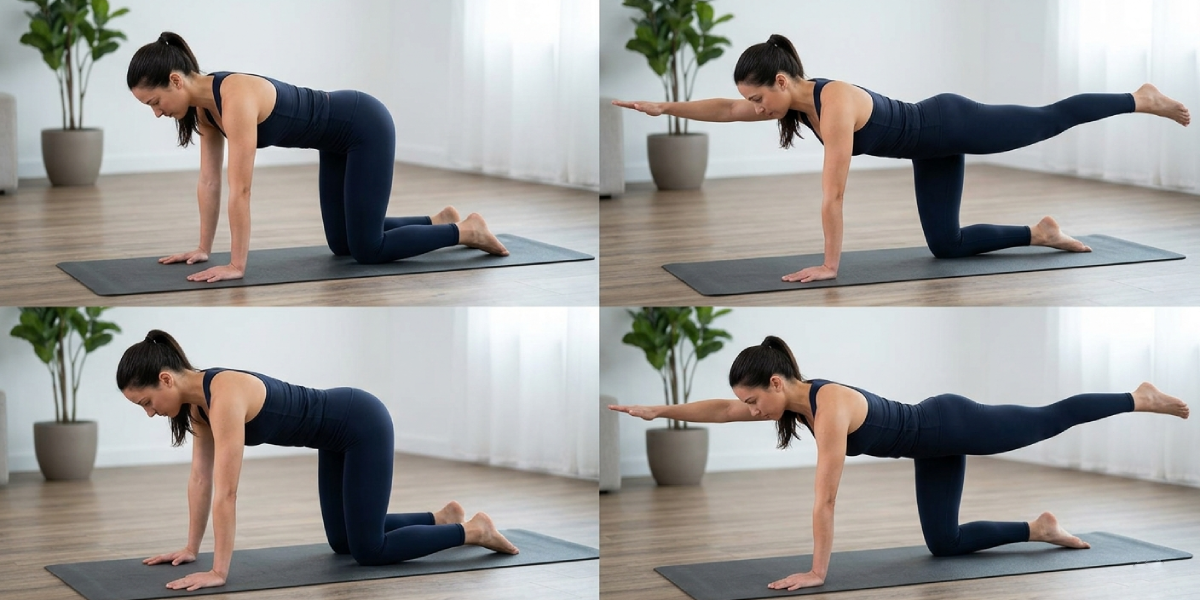
The bird dog exercise is one of the most effective and underrated moves you can add to your fitness routine. Whether you are just starting out or you have been training for years, mastering this foundational movement builds a stronger core, healthier spine, and better overall body control.
In this guide, you will learn exactly how to perform the bird dog exercise with proper form, understand why it works, discover its key benefits, and find out how to program it for long-term results.
What Is the Bird Dog Exercise?
The bird dog is a bodyweight floor exercise that involves extending the opposite arm and leg simultaneously from a quadruped, or hands-and-knees, position.
It was popularized in rehabilitation and strength training circles largely through the work of Dr. Stuart McGill, a leading spine biomechanics researcher whose studies established it as one of the top exercises for building core stability without placing harmful compression forces on the lumbar spine.
The name comes from the movement itself: when performed correctly, your extended arm and leg form a straight, horizontal line resembling a hunting dog pointing toward its target. Despite looking simple, this exercise demands coordination, balance, and deep muscular engagement throughout your entire posterior chain and core complex.
Muscles Worked During the Bird Dog Exercise
Understanding which muscles this movement targets helps you appreciate why so many physical therapists, personal trainers, and strength coaches rely on it as a staple in both rehabilitation and performance programs.
- Erector spinae: The group of muscles running along both sides of your spine. These are the primary stabilizers during the movement and are directly responsible for keeping your back from sagging or rotating.
- Multifidus: Deep spinal stabilizers that play a critical role in segmental spine control. Research consistently shows these muscles are often inhibited in people with chronic low back pain, making bird dogs especially valuable for recovery.
- Gluteus maximus and medius: Your hip extensors and abductors work hard to lift and stabilize the rear leg throughout the movement.
- Transverse abdominis: The deepest layer of the abdominal wall acts as a natural weight belt, bracing your midsection to protect the spine.
- Deltoids and rotator cuff: The shoulder complex stabilizes the extended arm and prevents the upper body from collapsing.
- Hamstrings and hip flexors: Both sides are engaged in opposition, balancing the pelvis and maintaining neutral spinal alignment.
Step-by-Step Instructions: How to Do the Bird Dog Exercise Correctly
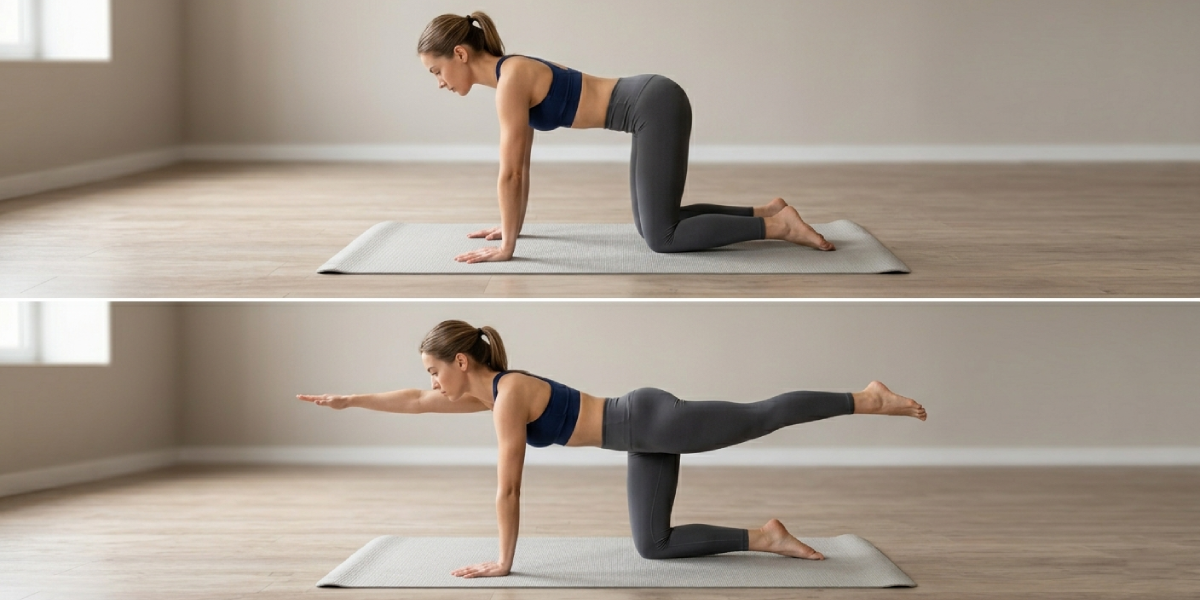
Performing the bird dog exercise with proper technique is essential. Rushing through it or sacrificing form for speed defeats the purpose and can create imbalances rather than correcting them.
Starting Position
Begin on all fours on a yoga mat or comfortable surface. Place your wrists directly under your shoulders and your knees directly under your hips. Your spine should be in a neutral position, meaning the natural curves of your neck, mid back, and lower back are preserved.
Avoid letting your lower back arch dramatically or round upward. Your head should be in line with your spine, gaze directed toward the floor.
Bracing and Engaging the Core
Before you move a single limb, take a moment to brace your core. Think of drawing your navel gently toward your spine without holding your breath. You should be able to breathe naturally and rhythmically throughout the entire exercise.
This abdominal bracing is not a crunch or suck-in; it is a 360-degree pressurization of your midsection that creates the stable foundation the movement requires.
The Extension Phase
Slowly extend your right arm forward until it is parallel to the floor while simultaneously extending your left leg backward to the same height. Your arm, torso, and leg should form one long, straight line. Keep your hips level and square to the floor.
There should be no rotation in the pelvis or torso. Your toes on the extended foot should point downward toward the floor rather than outward to prevent hip rotation.
Hold and Control
Pause at the top of the movement for two to three seconds. This is where the real work happens. Actively squeeze the glute of your extended leg and reach through your fingertips to lengthen through the arm. Maintain your neutral spine. Your lower back should not be arching upward to lift the leg higher. Range of motion is less important than alignment.
The Return Phase
Slowly bring your arm and leg back to the starting position with control. Do not let them crash to the floor. For an added challenge, touch your elbow to your knee beneath your torso before extending again, which increases core demand by introducing a brief flexion moment.
Repetitions and Alternating Sides
Complete the desired number of reps on one side before switching, or alternate sides with each repetition. Both approaches are valid. Beginners often benefit from completing all reps on one side to focus on coordination, while intermediate and advanced trainees can alternate to increase the balance challenge and total body demand.
Common Mistakes and How to Fix Them
Even experienced exercisers fall into a few predictable patterns that reduce the effectiveness of the bird dog and can lead to discomfort. Knowing these mistakes in advance allows you to self-correct from the start.
Lifting the Leg Too High
One of the most frequent errors is raising the rear leg well above hip height in an attempt to feel a bigger range of motion. This almost always causes the lower back to hyperextend and the pelvis to tilt, shifting the load away from the target muscles. Keep your leg parallel to the floor, even if that feels limiting at first.
Rotating the Hips
Hip rotation happens when the rear hip opens upward as the leg extends. To cue yourself out of this, imagine a cup of water sitting on your lower back. Your goal is to keep that cup perfectly still and level throughout the entire movement. If it would tip, your hips are rotating.
Rushing Through Reps
Speed is the enemy of control in the bird dog. Moving quickly removes the stabilization challenge and turns the exercise into a momentum-based drill rather than a true stability exercise. Aim for a two-to-three-second extension hold and a slow, deliberate return.
Holding the Breath
Breath-holding increases intra-abdominal pressure, which is counterproductive. Practice steady nasal inhalations and exhalations throughout each repetition. Breathing naturally while bracing your core is a skill that takes practice but pays significant dividends in overall core function.
Bird Dog Exercise Benefits
The reason the bird dog appears in programs ranging from physical therapy clinics to elite sports training facilities is the breadth of benefits it delivers relative to its low complexity and injury risk.
Reduces and Prevents Low Back Pain
Multiple peer-reviewed studies support the use of motor control exercises, including the bird dog, for managing chronic low back pain. By reactivating deep stabilizing muscles and training the spine to maintain neutral alignment under load, regular bird dog practice can meaningfully reduce pain and recurrence over time.
For anyone looking for broader guidance on movement and health and wellness strategies, integrating this exercise is a strong evidence-based starting point.
Builds True Core Stability
There is an important distinction between core strength and core stability. Strength refers to the ability to produce force. Stability refers to the ability to resist unwanted movement. Daily life and sport demand both, but most people train only one.
The bird dog is fundamentally a stability exercise, training the deep system to keep the spine safe while the limbs move, which carries over directly to lifting, running, and injury prevention.
Improves Balance and Proprioception
Proprioception is your body’s ability to sense its own position in space. Training on one arm and one leg simultaneously challenges the nervous system to coordinate inputs from multiple joints and develop a more refined sense of spatial awareness. Over time, this improves athletic performance and reduces fall risk.
Accessible for All Fitness Levels
The bird dog requires no equipment, no significant flexibility, and no prior training experience. It can be performed in a small space and scaled in numerous ways for beginners through advanced athletes. This accessibility makes it one of the most universally practical core exercises you can add to any program.
Supports Healthy Body Composition
While the bird dog is not a high-calorie-burning exercise on its own, building a stronger, more stable core supports better movement mechanics across all other activities, allowing you to train harder and more consistently.
Pairing good exercise habits with proper nutrition and tracking tools like a BMI calculator gives you a more complete picture of your health progress over time.
Bird Dog Variations and Progressions
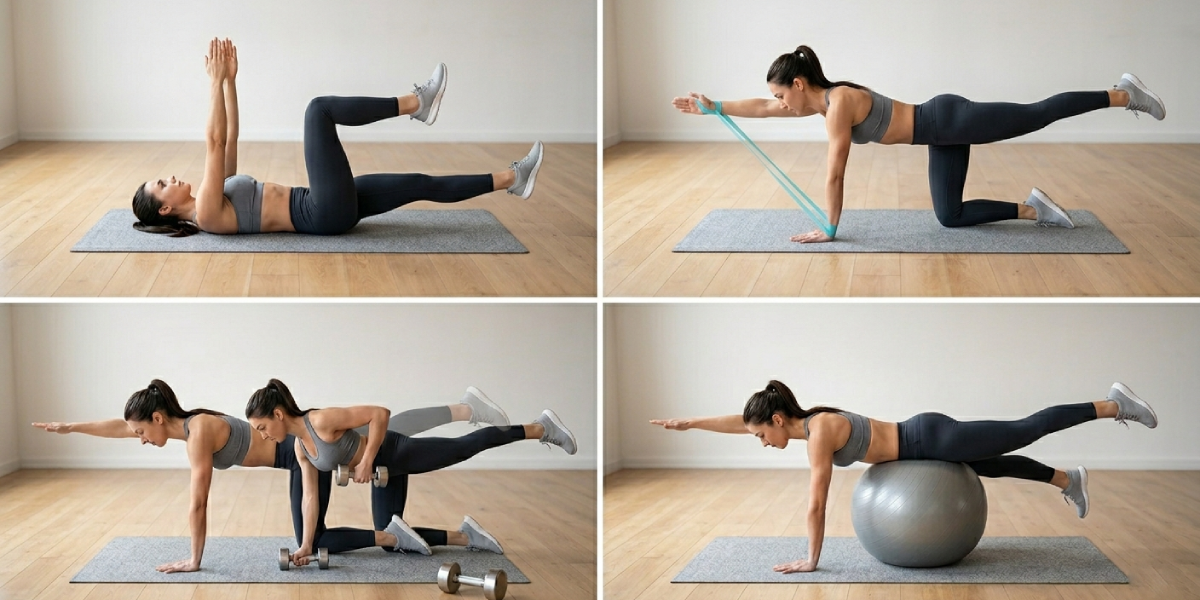
Once you have mastered the foundational movement, there are several progressions that can increase the challenge and target different aspects of stability and strength.
Dead Bug (Supine Variation)
Performed lying on your back, the dead bug mirrors the bird dog but removes the gravitational load from the spine. It is excellent for those who find the quadruped position uncomfortable and is often used earlier in rehabilitation progressions.
Bird Dog with Resistance Band
Attaching a light resistance band around the wrist of the extended arm adds a pulling force the shoulder and core must resist. This increases upper body demand and makes the exercise more specific to athletic or functional training goals.
Bird Dog Row
In this variation, a dumbbell is placed under the supporting hand. As the opposite arm extends, the dumbbell hand performs a single-arm row on the return phase. This combines the stability demand of the bird dog with a pulling strength component, making it highly efficient for strength-focused programs.
Stability Ball Bird Dog
Performing the movement while kneeling on a stability ball dramatically increases the proprioceptive challenge. This variation is best suited to experienced exercisers with a strong foundation in the standard version.
How to Program the Bird Dog Exercise
For general core health and injury prevention, two to three sets of eight to twelve repetitions per side, performed three to four times per week, is a practical and sustainable starting point. Rest thirty to sixty seconds between sets.
In a rehabilitation context, frequency may be higher under the guidance of a physical therapist, often daily. In a strength and conditioning context, the bird dog is best placed at the beginning of a session as part of a movement preparation or activation routine, or at the end as a low-intensity finisher.
| Goal | Sets | Reps per Side | Frequency per Week |
|---|---|---|---|
| Rehabilitation | 2 to 3 | 6 to 8 | 5 to 7 |
| General Fitness | 3 | 10 to 12 | 3 to 4 |
| Athletic Performance | 3 to 4 | 8 to 10 | 3 to 4 |
Who Should Do the Bird Dog Exercise
The bird dog is appropriate for nearly everyone. It is a foundational movement in physical therapy for low back pain, herniated disc recovery, and post-surgical rehabilitation. It is equally valuable for desk workers experiencing chronic tightness, older adults seeking to maintain balance and spinal health, recreational athletes looking to improve performance, and advanced lifters who need to reinforce motor control alongside heavier compound training.
Those with severe wrist pain, acute shoulder injuries, or significant knee pain may need modifications such as performing the movement with fists instead of open palms to reduce wrist extension, or using a folded blanket under the knees for cushioning.
Frequently Asked Questions
How many reps of the bird dog exercise should I do per session?
Most people benefit from two to three sets of eight to twelve repetitions per side per session. Beginners should start at the lower end and prioritize perfect form before increasing volume. The quality of each repetition matters far more than the total number performed.
Is the bird dog exercise good for lower back pain?
Yes. The bird dog is widely used in rehabilitation for lower back pain because it strengthens the deep spinal stabilizers, particularly the multifidus and transverse abdominis, without placing excessive compression or shear forces on the lumbar spine. It is often one of the first exercises prescribed in low back pain recovery programs.
How long should you hold the bird dog position?
A two to three second hold at full extension is sufficient for most purposes. Holding for longer, up to ten seconds, can increase the endurance demand on the stabilizing muscles, but research suggests that multiple shorter holds are often more effective than prolonged static holds for building functional stability.
Can beginners do the bird dog exercise?
Absolutely. The bird dog is one of the most beginner-friendly core exercises available. It requires no equipment, no flexibility prerequisites, and can be regressed if needed by simply lifting one limb at a time rather than the opposite arm and leg simultaneously.
What is the difference between the bird dog and the dead bug?
Both exercises train anti-rotation and anti-extension core stability by moving opposite limbs while keeping the spine neutral. The key difference is position: the bird dog is performed in a quadruped position with gravity loading the spine, while the dead bug is performed supine with the spine fully supported. The dead bug is generally easier and is often used as a stepping stone before progressing to the bird dog.
How often should I do the bird dog exercise?
Three to four times per week is appropriate for most people pursuing general fitness. Because the bird dog is a low-intensity stabilization exercise with minimal muscular damage, it can be performed on consecutive days if needed, particularly in a rehabilitation context where daily practice supports faster neuromuscular reprogramming.
Does the bird dog exercise build visible muscle?
The bird dog primarily trains deep stabilizing muscles and the glutes rather than large superficial muscles. It will not produce dramatic visible muscle growth on its own, but it contributes to better posture, improved glute activation, and the kind of functional strength that enhances performance in exercises that do build visible muscle. Think of it as foundational work that makes everything else more effective.
Can the bird dog exercise help with posture?
Yes. By strengthening the erector spinae, glutes, and deep core, the bird dog directly addresses the muscular imbalances that contribute to slouched posture, anterior pelvic tilt, and forward head position. Regular practice reinforces the neuromuscular patterns needed to maintain upright, aligned posture throughout the day.
Should I feel the bird dog exercise in my lower back?
You may feel mild muscular engagement in your lower back, which is normal. However, you should not feel sharp pain, pinching, or significant discomfort. If you do, reduce your range of motion, focus on maintaining a neutral spine, and consider consulting a physical therapist before continuing.
What should I combine the bird dog exercise with for best results?
The bird dog pairs well with other core stability exercises such as the dead bug, plank variations, and glute bridges for a comprehensive core training circuit. For back health specifically, combining it with hip mobility work, gentle hip flexor stretches, and progressive loading through exercises like deadlifts or Romanian deadlifts creates a well-rounded program for spinal resilience and strength.