

If you are searching for the most effective exercises for shoulder pain relief, you are in the right place. Shoulder discomfort is one of the most common complaints among adults of all ages, affecting everything from daily tasks like reaching overhead to athletic performance.
The good news is that a targeted, consistent exercise routine can dramatically reduce pain, restore lost range of motion, and help you avoid more invasive treatments.
This guide draws on well-established principles in physical therapy and sports medicine to walk you through the best movements for relieving shoulder pain, improving mobility, and building the strength that keeps discomfort from returning.
Whether your pain is the result of a rotator cuff issue, frozen shoulder, poor posture, or general overuse, the exercises below offer a practical, evidence-based starting point.
Why the Shoulder Is So Vulnerable to Pain and Injury
The shoulder is the most mobile joint in the human body. It operates as a ball-and-socket joint, allowing movement in virtually every direction. That incredible range of motion, however, comes at a cost: the shoulder sacrifices stability for flexibility, making it more susceptible to strain, impingement, and muscle imbalances than most other joints.
The rotator cuff — a group of four muscles and their tendons surrounding the shoulder joint — plays a central role in stabilizing every movement your arm makes. When any one of these muscles becomes weak, tight, or inflamed, pain quickly follows.
Poor posture (especially the forward head and rounded shoulders that come from prolonged sitting) further compresses the shoulder joint, limiting space for tendons and increasing friction with every movement.
Understanding this anatomy is important because it shapes the approach to exercise. Effective shoulder exercises need to address both mobility and stability — loosening the muscles and joints that have become restricted while simultaneously building the strength that takes load off vulnerable structures.
Key Principles Before You Start
Before diving into specific movements, keep these practical guidelines in mind to make your routine safe and effective:
- Work within a pain-free range. Mild discomfort during a stretch is acceptable, but sharp or pinching pain is a signal to stop. Pushing through genuine pain can worsen injury.
- Warm up first. Spend five minutes with light movement — arm circles, shoulder rolls, or a brief walk — to increase blood flow to the joint before beginning any exercise.
- Consistency beats intensity. Performing exercises daily at a moderate level produces better long-term results than occasional intense sessions.
- See a professional for severe pain. If your shoulder pain is severe, persistent, or accompanied by weakness or numbness radiating down the arm, consult a physician or licensed physical therapist before beginning any exercise program.
The Best Exercises for Shoulder Pain Relief and Mobility
1. Pendulum Stretch

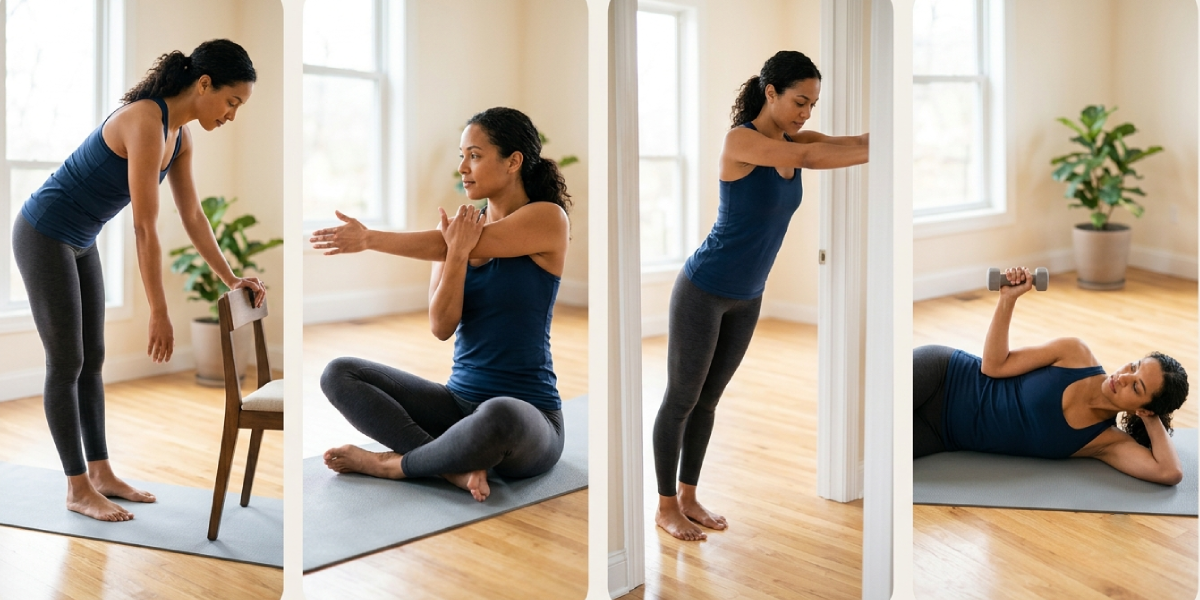
The pendulum stretch is a classic gentle mobility exercise often recommended in the early stages of shoulder recovery, including post-injury and frozen shoulder rehabilitation. Stand next to a table and lean forward, placing your unaffected arm on the surface for support.
Let the affected arm hang freely. Using a slow, controlled motion, swing the arm in small circles — clockwise for 30 seconds, then counterclockwise for 30 seconds. The key is to let gravity do the work; your arm should feel weightless.
This exercise gently decompresses the shoulder joint and encourages synovial fluid circulation, which lubricates the joint and reduces stiffness.
2. Cross-Body Shoulder Stretch
This simple stretch targets the posterior capsule of the shoulder, an area that commonly becomes tight and is associated with rotator cuff pain and internal impingement. Bring your affected arm across your chest at shoulder height.
Use your opposite hand to gently apply pressure just above the elbow, drawing the arm closer to your chest until you feel a stretch in the back of the shoulder. Hold for 20 to 30 seconds and repeat three times on each side. Avoid shrugging your shoulder up toward your ear during this movement — keep it relaxed and depressed.
3. Doorway Chest Stretch
For anyone who spends long hours at a desk, the pectoral muscles and the front of the shoulder tend to shorten and tighten over time, pulling the shoulder forward into a rounded position. This compression reduces the subacromial space and increases the risk of impingement.
Stand in a doorway and place your forearm along the door frame at a 90-degree angle, elbow at shoulder height. Step gently forward with one foot until you feel a stretch across the chest and the front of the shoulder. Hold for 20 to 30 seconds. Perform this stretch two to three times daily to counteract the effects of prolonged sitting.
4. Wall Slides

Wall slides are an excellent exercise for improving shoulder mobility while simultaneously activating the lower trapezius and serratus anterior — two muscles that are critically involved in proper shoulder blade movement. Stand with your back flat against a wall, feet a few inches from the base.
Press your arms against the wall with elbows bent at 90 degrees, palms facing forward. Slowly slide your arms up the wall, straightening them overhead as far as you comfortably can, then bring them back down. Perform 10 to 15 slow, controlled repetitions.
The goal is to keep your lower back and arms in full contact with the wall throughout the movement.
5. External Rotation with a Resistance Band
Weakness in the external rotators — specifically the infraspinatus and teres minor — is one of the most common contributors to rotator cuff pain and shoulder impingement. This exercise directly targets those muscles. Attach a light resistance band to a fixed point at elbow height.
Stand with your affected side facing the anchor point, elbow bent at 90 degrees and tucked against your body. Hold the band and rotate your forearm outward, away from your abdomen, then slowly return to the starting position. Perform 15 repetitions for two to three sets.
Keep the elbow pressed against your side throughout to isolate the rotators properly.
6. Scapular Retraction
Scapular retraction exercises train the mid-trapezius and rhomboids, the muscles responsible for pulling the shoulder blades back and down into their correct position. When these muscles are weak, the shoulder blades wing forward, further destabilizing the shoulder joint.
Sit or stand tall. Squeeze your shoulder blades together as if trying to hold a pencil between them, then hold for five seconds before releasing. Perform 15 repetitions. For added resistance, this movement can be performed with a resistance band or light dumbbells in a rowing motion.
7. Sleeper Stretch
The sleeper stretch is a targeted technique for improving internal rotation in the shoulder, a range of motion that commonly becomes restricted following rotator cuff problems, overuse injuries in throwing athletes, and frozen shoulder. Lie on your affected side with your shoulder directly below your body and your elbow bent at 90 degrees.
Use your top arm to gently press your bottom forearm toward the floor, pausing when you feel a stretch in the back of the shoulder. Hold for 20 to 30 seconds and repeat three times. This stretch should be gentle — overpressure is counterproductive and may cause discomfort.
8. Side-Lying External Rotation
This exercise isolates the posterior rotator cuff muscles more directly than band exercises can for some individuals. Lie on your unaffected side with a light dumbbell (one to three pounds is sufficient) in your top hand. Bend your elbow to 90 degrees, keeping it at your side.
Rotate your forearm upward toward the ceiling as far as comfortably possible, then lower it slowly. Perform 12 to 15 repetitions. The controlled lowering phase (eccentric contraction) is especially valuable for tendon health and recovery.
Exercises to Avoid When You Have Shoulder Pain
Equally important as knowing what to do is knowing what to avoid. Several popular exercises can significantly aggravate shoulder pain, especially during the early stages of recovery:
- Behind-the-neck lat pulldowns and presses — these place the shoulder in an externally rotated, end-range position under load, greatly increasing impingement risk.
- Wide-grip upright rows — this movement compresses the subacromial space and is one of the most frequently cited causes of shoulder impingement in gym settings.
- Overhead pressing with excessive load — when the rotator cuff is weakened or irritated, pressing heavy weight overhead forces surrounding larger muscles to compensate, accelerating imbalance and injury.
- Full push-ups before building a base — while push-ups are a valuable exercise when performed correctly, the wide-arm variation can stress an already compromised shoulder. Modified push-ups or wall push-ups are safer early alternatives.
Shoulder Pain, Posture, and Overall Health
It is worth emphasizing that shoulder pain rarely exists in isolation. Tight hips, a stiff thoracic spine, and poor core stability all contribute to how your body loads the shoulder joint during everyday movement and exercise. Addressing your overall health and physical condition — including posture habits, sleep position, ergonomic setup, and body composition — can meaningfully reduce shoulder symptoms over time.
Body weight also plays a role. Excess body fat contributes to systemic inflammation, which can amplify pain responses throughout the musculoskeletal system. Tracking your body mass index and working toward a healthy weight range is one supportive step.
You can use a free BMI calculator to assess where you currently stand and set meaningful targets.
Sample Weekly Shoulder Mobility and Strengthening Plan
| Day | Focus | Exercises | Sets x Reps |
|---|---|---|---|
| Monday | Mobility | Pendulum, Cross-Body Stretch, Doorway Stretch | 3 x 30 sec each |
| Tuesday | Strength | External Rotation Band, Scapular Retraction, Wall Slides | 3 x 15 |
| Wednesday | Rest or Light Walk | Gentle arm swings only | 5 minutes |
| Thursday | Mobility + Strength | Sleeper Stretch, Side-Lying External Rotation, Wall Slides | 3 x 12–15 |
| Friday | Full Routine | All eight exercises above | 2 x each |
| Saturday | Active Recovery | Pendulum, Doorway Stretch | 2 x 30 sec each |
| Sunday | Rest | Full rest day | — |
When to Seek Medical Attention
Exercise is a powerful tool for managing shoulder pain, but it is not a substitute for professional evaluation in certain situations. Seek medical attention if you experience shoulder pain that is severe and sudden, if you cannot lift your arm at all, if the joint appears visibly deformed, if pain follows a traumatic event such as a fall or collision, or if numbness and tingling extend down your arm.
These symptoms may indicate a rotator cuff tear, labral injury, or nerve impingement that requires imaging and specialized treatment before exercise rehabilitation begins.
Frequently Asked Questions
What are the best exercises for shoulder pain relief at home?
The pendulum stretch, cross-body shoulder stretch, doorway chest stretch, and wall slides are all highly effective and require no equipment. Resistance band exercises add a strengthening component and bands are inexpensive and easy to store at home, making them an ideal addition to any home-based routine.
How long does it take to relieve shoulder pain through exercise?
Most people begin to notice meaningful improvement within two to four weeks of consistent daily exercise. However, the timeline varies depending on the underlying cause, severity, and how long the pain has been present. Chronic or structural issues such as rotator cuff tears or advanced frozen shoulder may take several months of dedicated rehabilitation.
Can I exercise with shoulder pain, or should I rest?
In most cases, gentle, targeted movement is more beneficial than complete rest. Total immobilization can cause further stiffness and muscle atrophy, which often prolongs recovery. The key is to exercise within a pain-free or low-pain range and to avoid movements that clearly aggravate symptoms. Always consult a healthcare provider if you are unsure whether it is safe to exercise.
What causes shoulder pain in people who do not exercise?
Sedentary lifestyles are a very common cause of shoulder pain. Prolonged sitting, especially with poor posture, tightens the chest and front shoulder muscles while weakening the upper back and rotator cuff. This imbalance gradually pulls the shoulder blade forward and compresses the joint, leading to pain even without any specific injury or strenuous activity.
Is the rotator cuff involved in most shoulder pain?
The rotator cuff is involved in a large proportion of shoulder pain cases, but it is not the only structure affected. Other common sources include the acromioclavicular joint, the biceps tendon, the shoulder capsule (as in frozen shoulder), and the cervical spine. A proper diagnosis from a physical therapist or orthopedic specialist helps identify the primary structure involved and tailor the exercise approach accordingly.
Are resistance bands effective for shoulder rehabilitation?
Yes, resistance bands are one of the most effective and widely recommended tools in shoulder rehabilitation. They allow you to perform targeted rotator cuff exercises with precise resistance levels that can be gradually increased as strength improves. Bands also accommodate variable resistance throughout the range of motion, which is better suited to early rehabilitation than fixed-weight equipment.
How does posture affect shoulder pain?
Posture has a direct and significant effect on shoulder health. A forward head posture combined with rounded shoulders reduces the subacromial space — the gap between the top of the humerus and the underside of the acromion bone — which leads to tendon compression and irritation during arm movements. Correcting posture through targeted strengthening of the mid and lower trapezius, rhomboids, and deep neck flexors is a fundamental part of lasting shoulder pain relief.
Can shoulder exercises help with frozen shoulder?
Yes, but the approach must be adapted to the stage of the condition. In the early, painful stage of frozen shoulder (adhesive capsulitis), very gentle pendulum exercises and heat application are generally recommended. In the later, stiff stage, more active stretching and range-of-motion work becomes appropriate. Physical therapy is strongly advised for frozen shoulder, as incorrect exercises at the wrong stage can provoke a significant flare-up.
Should I use heat or ice for shoulder pain before exercising?
Heat is generally preferred before exercise as it relaxes muscle tissue, increases blood flow to the area, and improves the extensibility of connective tissue, making stretching and movement more comfortable. Ice is typically more appropriate after exercise or activity to manage any temporary inflammation or soreness. If your shoulder is visibly swollen or feels hot to the touch, use ice rather than heat.
How do I know if my shoulder pain is serious enough to see a doctor?
See a physician or physical therapist if your shoulder pain is severe, if it is accompanied by weakness you cannot explain, if you cannot move the arm through its normal range of motion, if pain wakes you up at night repeatedly, if it follows an acute injury, or if it has persisted for more than two to three weeks without improvement despite conservative care. These signs suggest a structural issue that requires proper diagnosis before beginning an exercise program.