

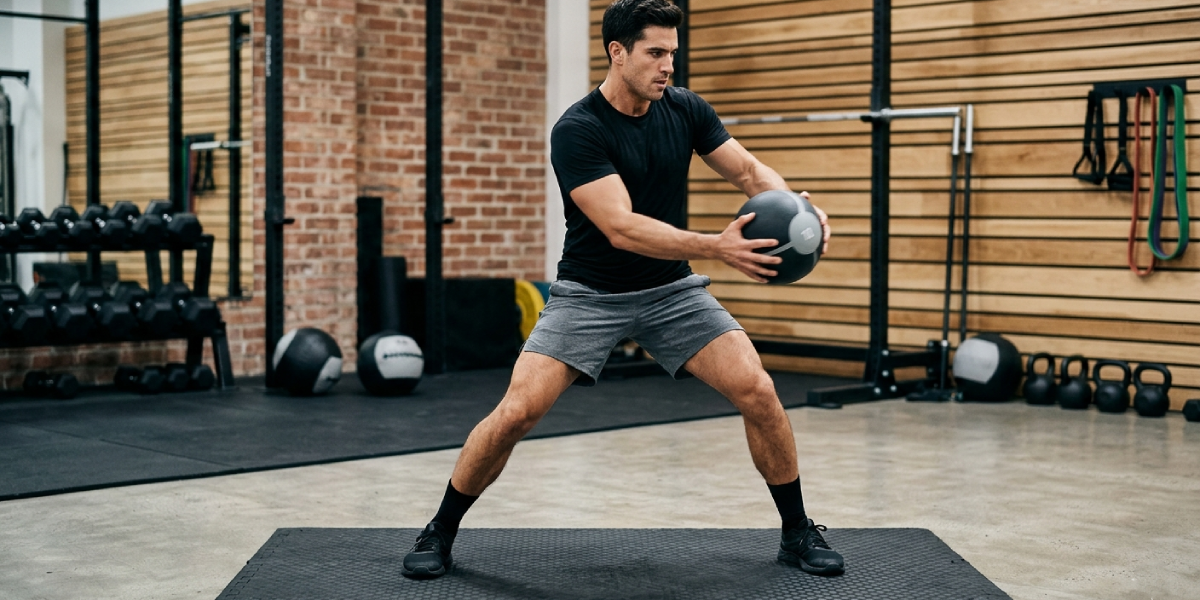
If you want to build a stronger core and develop explosive power, the medicine ball for core and power training is one of the most effective and underrated tools available in any gym or home setup.
Unlike isolation machines or static weight exercises, medicine balls demand that your entire body works together, training the kind of functional strength that carries over directly into sport, daily movement, and injury prevention.
This guide covers everything you need to know, from choosing the right ball weight and understanding the biomechanics behind each movement, to programming your sessions for consistent, measurable progress.
Whether you are a beginner or an experienced lifter looking to add a dynamic training element, this article gives you a practical, evidence-informed framework to get real results.
What Makes Medicine Ball Training So Effective

Medicine balls have been used in athletic conditioning for well over a century. Ancient Greek physicians reportedly used sand-filled animal bladders for rehabilitation and physical conditioning, and today’s weighted balls are grounded in the same principle: resistance plus movement equals adaptation.
What separates medicine ball training from conventional strength work is the integration of the kinetic chain. When you throw, slam, or rotate a medicine ball, you are not just using one muscle group in isolation. You are recruiting muscles across your hips, core, shoulders, and limbs simultaneously, firing them in coordinated sequences.
This is exactly what your body needs to do in athletic performance, daily lifting, and reactive movements.
From a physiological standpoint, medicine ball exercises train both the contractile and reactive properties of muscle. Explosive throws and slams challenge fast-twitch muscle fibers, the ones responsible for speed and power output.
Controlled rotational work and holds build the deep stabilizing muscles of the core, including the transverse abdominis, multifidus, and internal obliques. This combination is difficult to replicate with any single piece of equipment.
Choosing the Right Medicine Ball Weight and Type
Before diving into exercises, it is important to match your equipment to your goals and current fitness level. Medicine balls come in several types, and choosing the wrong one can limit your results or increase injury risk.
Slam Balls vs. Wall Balls vs. Rubber Medicine Balls
Slam balls are designed to absorb impact without bouncing, making them ideal for high-force overhead slams. Wall balls are larger and softer, intended to be thrown against a wall from a squat position, which makes them popular in functional fitness training.
Traditional rubber medicine balls bounce and are more versatile for partner drills, rotational passes, and plyometric exercises.
For most beginners focused on core work and power development, a non-bounce slam ball in the 6 to 10 kilogram range is a practical starting point. More advanced athletes working on explosive power may benefit from heavier loads, but technique should always come before load.
How to Select the Right Load
A common guideline used by strength and conditioning coaches is that the ball should be heavy enough to slow down your movement slightly compared to an unloaded version, but not so heavy that it compromises your range of motion or causes you to lose control at the end of a throw or slam.
If your mechanics break down before you reach peak acceleration, the ball is too heavy.
Core Medicine Ball Exercises You Should Master
These exercises form the foundation of any effective medicine ball for core and power training program. Each one targets a different quality of movement: rotational power, anti-rotation stability, overhead force production, and explosive hip extension.
Medicine Ball Slam
The medicine ball slam is one of the most complete full-body power exercises available. Stand with your feet shoulder-width apart, raise the ball overhead with arms nearly fully extended, and drive it downward into the floor as hard as possible using your entire body, initiating the movement from your hips and core rather than your arms alone. The key coaching cue is to think of the arms as a whip, not the primary driver of force.
Slams develop posterior chain power, core stiffness under load, and shoulder girdle stability. They are also an excellent outlet for high-intensity intervals and mental focus training.
Rotational Wall Throw
Stand perpendicular to a wall at roughly arm’s length, hold the ball at hip height, rotate away from the wall to load your obliques and hip, then explosively rotate back and throw the ball into the wall. Catch the rebound and repeat. This movement trains the rotational power sequence that underlies nearly every sport-specific action, from a golf swing to a defensive tackle to a tennis forehand.
Medicine Ball Russian Twist
Sit on the floor with your knees slightly bent and feet either flat or elevated for added difficulty. Hold the ball at chest height and rotate from side to side, maintaining a strong brace through your core throughout. This movement targets the obliques directly and builds rotational endurance, which is critical for maintaining core integrity during prolonged activity.
Overhead Squat to Press
Hold the ball at chest height, descend into a full squat, and as you drive out of the hole, press the ball overhead and finish on your toes. This compound movement integrates lower body power with core bracing and shoulder stability, making it one of the more demanding exercises in any functional training program.
Kneeling Chest Pass Throw
Kneeling on both knees removes the contribution of the legs and forces your core and upper body to generate all the power. Hold the ball at chest height and explosively drive it into a wall or to a partner. This exercise isolates chest and shoulder power while demanding significant trunk stability to prevent backward lean.
Dead Bug with Medicine Ball
Lie on your back, press the ball between your hands and knees, extend one leg and the opposite arm toward the floor simultaneously while maintaining lower back contact with the ground, then return and repeat on the other side. This classic anti-extension core drill becomes considerably more challenging with the added resistance and proprioceptive demand of the ball.
Programming Medicine Ball Training for Consistent Progress
The way you structure your training matters as much as the exercises you choose. Medicine ball work can be incorporated as a primary training stimulus, as an activation component before heavier strength work, or as a conditioning finisher at the end of a session.
Power-Focused Programming
For athletes and individuals whose primary goal is power development, medicine ball throws and slams are best performed early in the session when the nervous system is fresh. Work in sets of 3 to 5 repetitions with full recovery between sets, typically 90 seconds to 2 minutes. Volume should be moderate, with quality of each rep prioritized above rep count.
Core Endurance Programming
For core endurance and stability, exercises like the Russian twist, dead bug variations, and plank-based medicine ball rolls can be programmed in circuit format with shorter rest periods. A practical approach is three to four rounds of four to five exercises with 30 to 45 seconds of work and 15 to 20 seconds of rest between movements.
Combined Strength and Power Sessions
One of the most effective training formats is to pair a heavy compound lift with a complementary medicine ball exercise in a contrast set. For example, a heavy trap bar deadlift followed immediately by four medicine ball slams uses the post-activation potentiation effect to amplify power output in the explosive movement.
This approach is well-supported by research in strength and conditioning science.
Sample Weekly Medicine Ball Training Schedule
| Day | Focus | Key Exercises | Volume |
|---|---|---|---|
| Monday | Power and Explosiveness | Slams, Rotational Throws, Chest Pass | 4 sets x 4 reps each |
| Wednesday | Core Stability and Endurance | Dead Bug, Russian Twist, Plank Rolls | 3 rounds x 40 seconds each |
| Friday | Full Body Integration | Squat to Press, Slam, Wall Throw | 3 sets x 5 reps each |
| Saturday | Active Recovery or Conditioning | Light partner passes, mobility work | 2 rounds, low intensity |
Common Mistakes That Limit Your Results
Even with the right exercises and a solid program, a few common errors can significantly reduce your training outcomes or increase your injury risk.
- Using too much arm and not enough hip: Power in nearly every medicine ball exercise should originate from the hips and core. If your arms are doing most of the work, you are limiting force output and missing the primary training stimulus.
- Skipping the deceleration phase: In rotational exercises especially, the muscles responsible for decelerating the movement are just as important as those that accelerate it. Rushing through the catch or finish position reduces the training effect and increases joint stress.
- Neglecting breathing mechanics: Bracing your core means taking a breath in before a high-effort repetition and exhaling sharply on exertion. This intra-abdominal pressure technique is fundamental to both performance and spinal protection.
- Progressing load before mastering mechanics: The medicine ball is forgiving compared to a barbell, but poor technique at heavier loads still creates compensatory movement patterns that limit long-term progress.
The Connection Between Core Strength and Overall Health
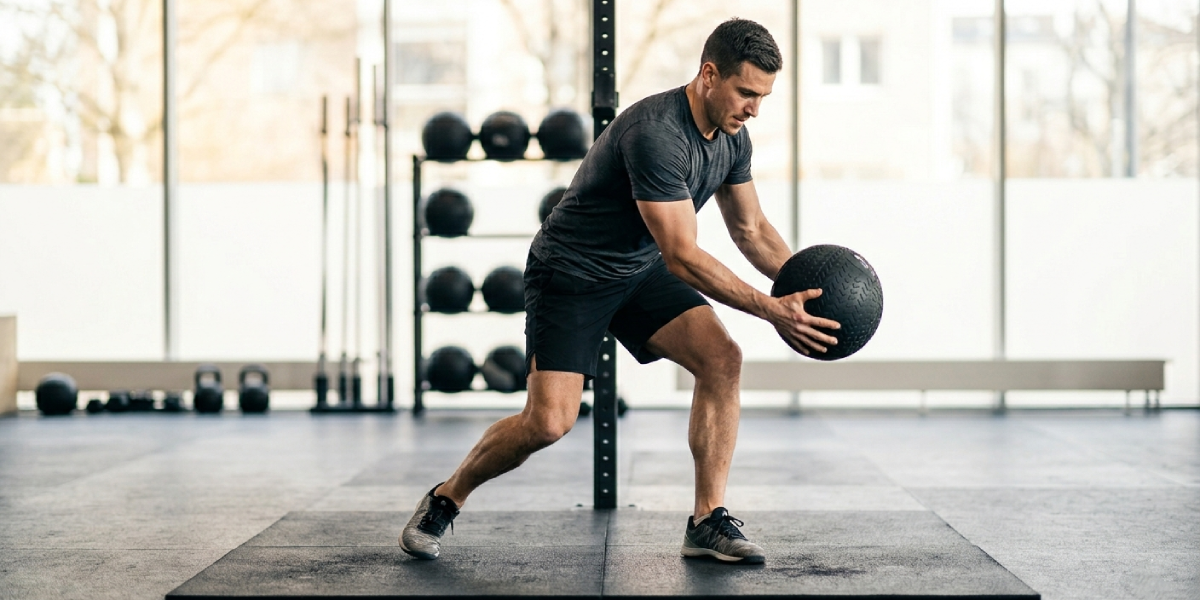
It would be a mistake to think of medicine ball training as purely an athletic endeavor. A well-developed core and the ability to generate and control power through movement is foundational to long-term physical health at every age.
Research consistently links poor core function and reduced lower body power to increased falls risk in older adults, chronic lower back pain, and reduced functional independence over time.
Incorporating medicine ball training as part of a broader movement practice, rather than treating it as a niche tool for athletes, is one of the most practical investments you can make in your physical longevity. Even two sessions per week at appropriate intensity is enough to drive meaningful adaptation over a training cycle of eight to twelve weeks.
If you are unsure where your baseline fitness level sits before starting a new training program, it can be helpful to assess your body composition and metabolic health. Using a reliable BMI calculator alongside a structured fitness protocol gives you a clearer picture of where you are starting from and allows you to track meaningful progress over time.
Safety, Warm-Up, and Recovery Considerations
Medicine ball training, particularly explosive variants like slams and rotational throws, places significant demand on the joints, connective tissue, and nervous system. A proper warm-up is not optional. Spend at least eight to ten minutes preparing the body with dynamic movements that mirror the session’s demands.
Hip circles, thoracic rotations, shoulder CARs, and light loaded carries are all effective pre-session preparations.
Allow at least 48 hours of recovery between high-intensity medicine ball sessions targeting the same movement patterns. This is particularly relevant for rotational power work, which taxes the obliques, hip rotators, and thoracic extensors in ways that accumulate fatigue quickly.
If you experience sharp joint pain, pinching sensations, or persistent soreness that does not resolve within 72 hours, reduce training load and consult a qualified sports medicine professional before continuing. Progress in medicine ball training, as in all physical training, is built through consistent moderate effort over time, not through occasional maximal sessions.
Frequently Asked Questions
What weight medicine ball should a beginner start with?
Most beginners do well starting with a 4 to 6 kilogram ball for rotational and overhead work, and a 6 to 8 kilogram slam ball for floor slams. The priority is maintaining full range of motion and controlled mechanics before increasing load.
How often should I do medicine ball training per week?
Two to three sessions per week is sufficient for most people. This frequency allows adequate recovery while providing enough stimulus for progressive adaptation in both power output and core strength.
Can medicine ball training replace traditional core exercises like planks and crunches?
Medicine ball training can complement and in many cases surpass traditional core exercises in terms of functional carryover. However, a balanced program may still benefit from including isometric holds and anti-extension work alongside dynamic medicine ball movements.
Is medicine ball training safe for people with lower back pain?
It depends on the cause and severity of the back pain. Many medicine ball exercises, such as the dead bug and controlled rotational holds, are actually prescribed in rehabilitation settings to improve spinal stability. High-force slams and rotational throws should be introduced gradually and only under guidance if lower back issues are present.
What is the difference between a medicine ball and a slam ball?
A traditional medicine ball has a harder shell and may bounce on impact, making it suited for wall throws and partner drills. A slam ball has a thick, non-bounce outer casing designed specifically to absorb the impact of overhead slams without rebounding, which makes it safer for solo floor slam exercises.
Do medicine ball exercises burn calories effectively?
Yes. High-intensity medicine ball circuits can elevate heart rate significantly and produce a substantial caloric expenditure per session. The combination of muscular recruitment and cardiovascular demand makes them effective for conditioning and body composition goals alongside their primary strength and power benefits.
Can I use a medicine ball to train at home?
Absolutely. Many of the most effective medicine ball exercises require only a ball and a small amount of floor space. Rotational holds, dead bugs, Russian twists, squats to press, and even slams on a rubber mat can all be performed in a home setting without a wall or special equipment.
How long does it take to see results from medicine ball training?
With consistent training two to three times per week, most people notice measurable improvements in core stability and explosive power within four to six weeks. More significant changes in athletic performance and body composition typically emerge over a sustained eight to twelve week program combined with appropriate nutrition and recovery practices.
Should medicine ball training come before or after weightlifting in a session?
For power development, explosive medicine ball work is best performed early in the session before fatigue accumulates. For conditioning and core endurance, it can follow the main strength work. Contrast sets, where a heavy lift is immediately followed by a ballistic medicine ball exercise, are effective when power transfer is the goal.
Are medicine ball exercises suitable for older adults?
Yes, and they are particularly valuable for this population. Controlled medicine ball exercises improve reactive balance, rotational mobility, and the fast-twitch muscle fiber activity that tends to decline most rapidly with age. Load and intensity should be scaled appropriately, and technique guidance from a qualified trainer is recommended when starting out.