

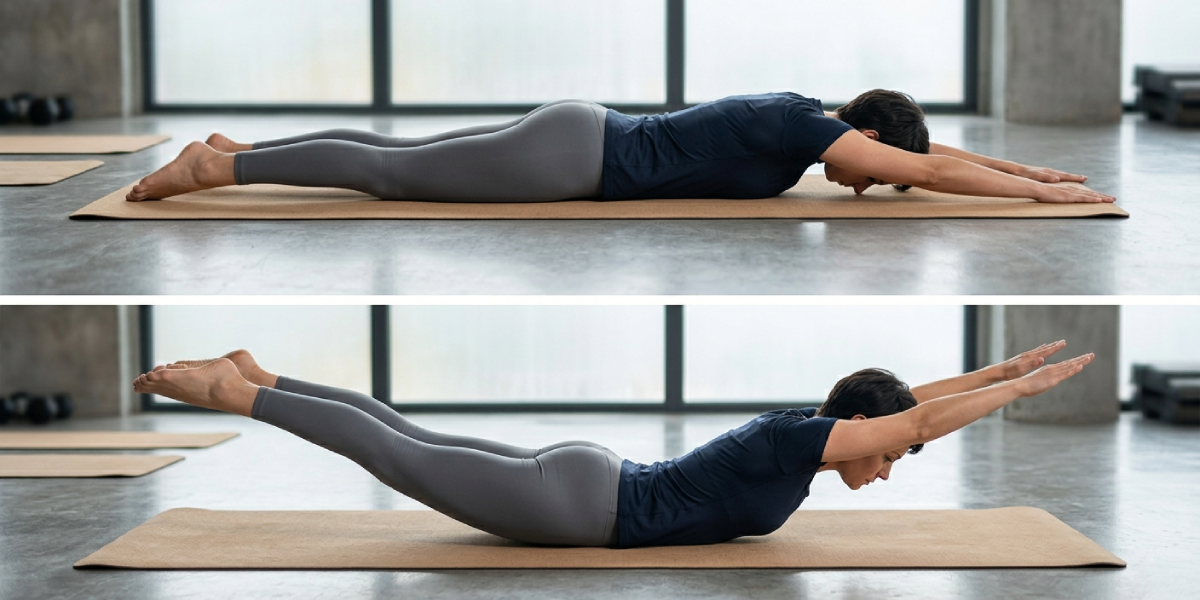
The Superman exercise for a stronger lower back is one of the most accessible, equipment-free movements you can add to your fitness routine today. Whether you spend long hours at a desk, struggle with nagging lower back discomfort, or simply want to build a more resilient posterior chain, this bodyweight exercise delivers real, measurable results.
In the sections below, you will learn exactly how to perform the Superman correctly, why it works, which muscles it targets, and how to progress it safely over time.
What Is the Superman Exercise?
The Superman exercise gets its name from the iconic pose of the superhero in flight: lying face down with arms and legs extended and lifted off the ground simultaneously. It is a spinal extension movement that strengthens the muscles running along the back of the body, collectively known as the posterior chain.
Unlike many back-strengthening exercises that require machines or barbells, the Superman requires nothing more than a flat surface and a few feet of space.
This exercise has long been recommended by physical therapists, personal trainers, and sports medicine professionals as a foundational movement for lumbar spine health. It is particularly effective for individuals who are new to strength training, recovering from mild lower back issues under medical supervision, or looking to complement heavier lifts like deadlifts and squats with targeted accessory work.
Muscles Worked During the Superman Exercise
Understanding which muscles the Superman engages helps you train with intention and recognize why proper form matters so much. Here is a breakdown of the primary and secondary muscles involved:
| Muscle Group | Role in the Superman |
|---|---|
| Erector Spinae | Primary mover; extends and stabilizes the lumbar and thoracic spine |
| Gluteus Maximus | Extends and stabilizes the hips as the legs lift |
| Hamstrings | Assists hip extension and leg elevation |
| Multifidus | Deep spinal stabilizer critical for vertebral support |
| Trapezius and Rhomboids | Retracts and stabilizes the shoulder blades during arm lift |
| Rear Deltoids | Assists shoulder extension as arms reach forward |
| Glute Medius | Stabilizes the pelvis and hips throughout the movement |
The multifidus deserves special attention. This deep stabilizer muscle runs along the vertebrae and plays a central role in protecting the lumbar spine from injury. Research in spinal rehabilitation consistently highlights multifidus weakness as a contributing factor in chronic low back pain, making exercises like the Superman particularly valuable for long-term spinal health.
Step-by-Step Guide to Performing the Superman Exercise Correctly
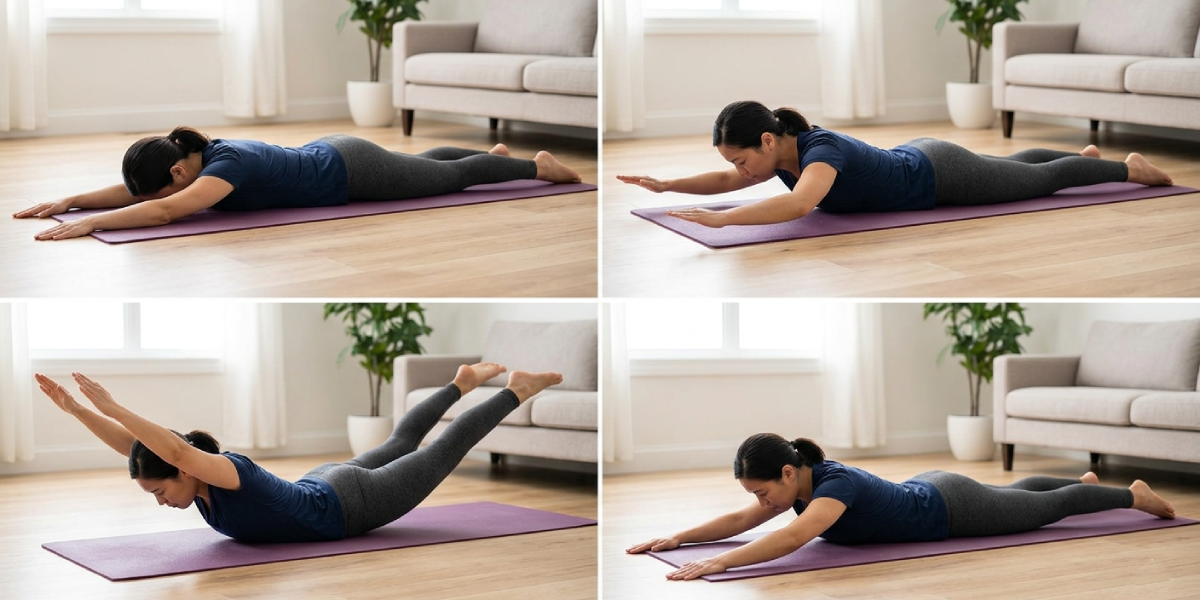
Proper technique is the difference between an exercise that builds strength and one that creates unnecessary strain. Follow these steps carefully each time you perform the movement.
Starting Position
- Lie face down on an exercise mat or carpeted surface with your body fully extended.
- Extend your arms straight overhead, roughly shoulder-width apart, with palms facing down or inward toward each other.
- Keep your legs straight and together or slightly apart, with your toes pointing gently away from your body.
- Rest your forehead lightly on the mat so your cervical spine stays in a neutral position. Avoid turning your head to one side.
- Take a breath and engage your core gently before beginning the lift. Think about drawing your navel slightly toward your spine without holding your breath.
The Lifting Phase
- On your exhale, simultaneously lift your arms, chest, and legs off the mat as one coordinated movement.
- Focus on squeezing your glutes as your legs rise. This protects the lumbar spine by co-contracting the muscles around the hip joint.
- Lift your arms and legs to a height where you feel a strong contraction in your lower back and glutes, but without any sharp discomfort or pain.
- Your gaze should remain neutral, directed toward the mat rather than craning upward. Keep the back of your neck long.
- At the top of the movement, your body should form a gentle curve, similar to a banana shape, rather than a severe arch.
The Hold
- Hold the top position for two to three seconds as a beginner. As you gain strength, work toward holds of five seconds or more.
- Maintain steady breathing throughout the hold. Do not hold your breath, as this increases intra-abdominal pressure unnecessarily.
- Keep your core engaged and avoid letting your hips sink to one side.
The Lowering Phase
- On your inhale, slowly and with control lower your arms and legs back to the starting position.
- Avoid letting your limbs drop to the mat. A controlled descent increases time under tension and reinforces motor control.
- Briefly relax before initiating the next repetition to allow the muscles to reset without becoming overly fatigued between reps.
Recommended Sets, Reps, and Frequency
How often and how much you perform the Superman exercise depends on your current fitness level and training goals. Below are general guidelines organized by experience level:
- Beginners: 2 to 3 sets of 8 to 10 repetitions, two to three times per week, with at least one rest day between sessions. Hold each rep for two seconds at the top.
- Intermediate: 3 to 4 sets of 12 to 15 repetitions, three times per week. Extend holds to four to five seconds and reduce rest between sets gradually.
- Advanced: 3 to 4 sets of 15 to 20 repetitions or incorporate weighted versions, three to four times per week. Focus on isometric holds of five to eight seconds for maximum muscle recruitment.
Allow at least 48 hours between Superman sessions if you are training the lower back intensively. The erector spinae and multifidus, like all muscles, require adequate recovery time to adapt and grow stronger.
If you are incorporating the Superman into a broader exercise routine, it works well as a warm-up activation movement before deadlifts or squats, or as a cool-down finishing exercise at the end of a session.
Common Mistakes to Avoid
Even experienced exercisers make form errors with the Superman. Recognizing and correcting these mistakes will protect your spine and maximize results.
Overextending the Neck
One of the most frequent errors is craning the head upward in an attempt to lift higher. This compresses the cervical vertebrae and can cause neck strain. Always keep your neck in line with your spine, with your gaze directed toward the floor.
Using Momentum Instead of Muscle
Swinging your arms and legs up quickly uses momentum rather than muscular effort, which defeats the purpose of the exercise. Move deliberately and slowly, especially during the lowering phase. A two-second lift, a three-second hold, and a two-second lower is an effective tempo for most people.
Holding the Breath
Breath-holding during exertion can spike blood pressure and reduce the quality of your muscular contraction. Exhale as you lift, breathe naturally during the hold, and inhale as you lower.
Lifting Too High
A common misconception is that higher is better. Excessive spinal extension loads the facet joints of the lumbar vertebrae unnecessarily. Lift to the point where you feel a strong, comfortable contraction, not to the maximum range your body can achieve at the cost of joint stress.
Neglecting Glute Activation
Performing the Superman primarily with the lower back muscles rather than co-contracting the glutes places excessive load on the lumbar erectors. Consciously squeeze the glutes at the start of every lift to distribute the workload appropriately.
Superman Exercise Variations and Progressions
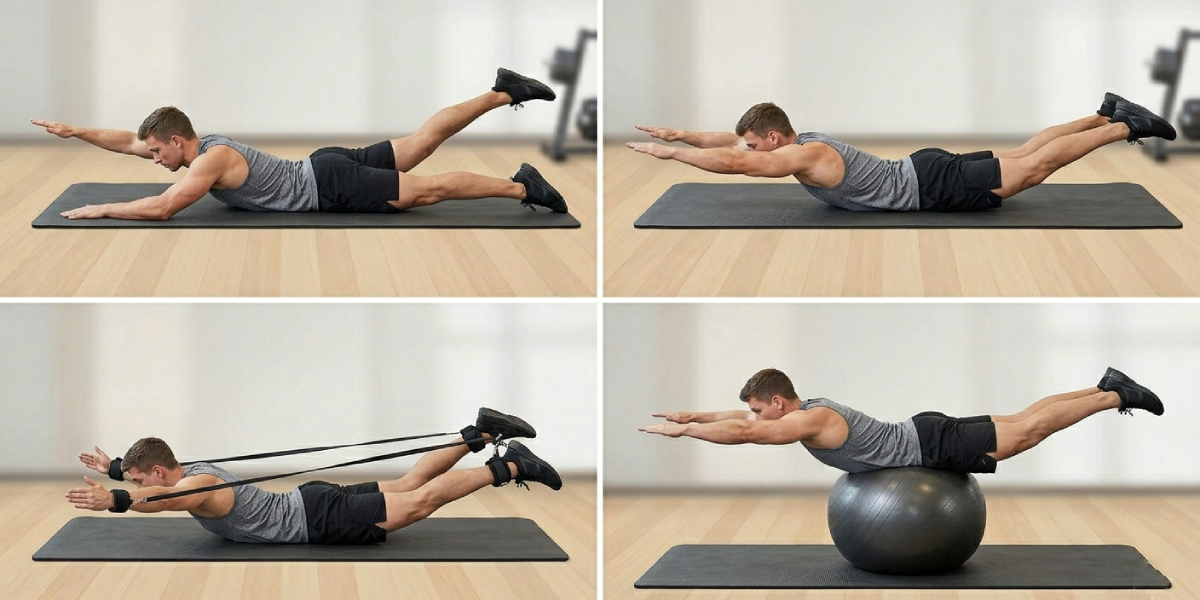
Once you have mastered the standard Superman with good form, these variations allow you to continue progressing and target the posterior chain from slightly different angles.
Alternating Superman
Instead of lifting both arms and both legs simultaneously, lift your right arm and left leg together, then alternate to your left arm and right leg. This unilateral variation is excellent for identifying and correcting left-right imbalances and adds a rotational stability challenge for the core.
Isometric Superman Hold
Lift into the Superman position and hold for 10 to 30 seconds rather than performing repetitions. This extended isometric contraction is highly effective for building endurance in the stabilizer muscles of the spine, which is especially beneficial for anyone who stands or sits for extended periods professionally.
Banded Superman
Loop a light resistance band around your wrists or ankles before performing the standard movement. The added resistance increases the challenge for the erectors, glutes, and hamstrings without requiring additional equipment beyond a simple resistance band.
Swiss Ball Superman
Lie prone over a Swiss ball positioned under your hips and lower abdomen. With your feet anchored against a wall, perform the Superman movement. The unstable surface of the ball increases demand on the deep stabilizer muscles of the spine and challenges proprioception, making this an excellent progression for those with good foundational strength.
Benefits of Adding the Superman Exercise to Your Routine
The Superman exercise offers a range of benefits that extend well beyond simple lower back strengthening, making it a valuable addition to almost any training program.
- Improves postural alignment: Strengthening the posterior chain counterbalances the forward-pulling forces created by prolonged sitting, rounded shoulders, and anterior pelvic tilt.
- Reduces risk of lower back injury: A stronger multifidus and erector spinae better support the lumbar vertebrae during daily activities, lifting, and sport.
- Enhances athletic performance: The posterior chain is the engine behind sprinting, jumping, and lifting. A stronger back translates directly to improved power output in these activities.
- Accessible and equipment-free: No gym membership required. The Superman can be performed at home, in a hotel room, or outdoors, making it easy to maintain consistency.
- Complements overall health goals: Back strength and stability are foundational to staying active and injury-free as you age. Incorporating targeted exercises like the Superman fits naturally within a broader approach to health and wellness.
Safety Considerations and Who Should Be Cautious
The Superman exercise is generally safe for healthy individuals, but certain conditions warrant extra caution or a conversation with a healthcare provider before beginning.
If you have been diagnosed with spinal stenosis, spondylolisthesis, herniated discs, or any condition involving the lumbar vertebrae, consult a physical therapist or physician before incorporating spinal extension exercises into your routine. In some cases, a modified version with reduced range of motion may be appropriate; in others, a different exercise may serve you better.
Pregnant individuals, particularly in the second and third trimester, should avoid lying face down for extended periods. Alternative posterior chain exercises performed in other positions are available and should be discussed with a prenatal fitness specialist or obstetrician.
If you experience any sharp, radiating, or shooting pain during the Superman exercise, stop immediately and seek professional evaluation. Mild muscle fatigue and a burning sensation in the lower back from exertion are normal; pain that radiates into the legs, buttocks, or down the arms is not.
How the Superman Fits Into a Balanced Back-Health Program
The Superman exercise is highly effective, but it works best as part of a comprehensive approach to spinal health rather than a standalone solution. Pairing it with core-strengthening movements such as the bird-dog, dead bug, and plank creates a well-rounded program that addresses all the muscles supporting the lumbar spine.
Consider your body weight and body composition as additional context for back health. Excess body weight, particularly around the abdomen, increases the mechanical load placed on the lumbar spine.
Using a BMI calculator to understand where you stand and working toward a healthy body weight in combination with a targeted exercise program is one of the most evidence-based approaches to managing and preventing lower back pain.
Mobility work for the hip flexors and thoracic spine also plays a critical supporting role. Tight hip flexors pull the pelvis into anterior tilt, increasing compressive forces on the lumbar vertebrae.
Regularly stretching the hip flexors and mobilizing the thoracic spine ensures that the strength you build through the Superman can express itself fully during movement.
Frequently Asked Questions
How many Supermans should I do per day?
For most people, two to three sets of 10 to 15 repetitions performed two to three times per week is sufficient to build meaningful lower back strength. Daily training of the lower back muscles without adequate rest can impair recovery. Start conservatively and progress gradually based on how your body responds.
Is the Superman exercise good for lower back pain?
For many people with mild, non-specific lower back pain, the Superman can be a helpful strengthening exercise. However, it is important to get a proper diagnosis before using exercise as a treatment strategy. Always consult a healthcare provider or physical therapist if you are experiencing back pain, as certain conditions may require modified or alternative exercises.
Can beginners do the Superman exercise?
Yes, the Superman is beginner-friendly. Start with the alternating arm-and-leg variation, which is less demanding than the full bilateral Superman, and hold each repetition for just one to two seconds. Focus on technique before increasing duration or repetitions. Most beginners can progress to the standard Superman within two to four weeks of consistent practice.
How long should I hold the Superman position?
Beginners should aim for a two-second hold at the top of each repetition. As you gain strength, gradually increase the hold to five seconds and eventually to eight to ten seconds. Extended isometric holds of twenty to thirty seconds are an advanced variation that significantly increases the endurance demand on the spinal stabilizers.
Does the Superman exercise build glutes?
The Superman does activate and strengthen the gluteus maximus as a secondary mover, but it is not as targeted for glute development as exercises like hip thrusts, glute bridges, or deadlifts. It is best viewed as a complementary exercise that contributes to overall posterior chain development alongside more glute-dominant movements.
Can I do the Superman exercise every day?
Training the same muscle group every day without rest is generally not recommended for optimal strength development. The erector spinae and supporting muscles of the lower back benefit from 48 hours of recovery between intense sessions. Light, low-repetition versions performed as part of a warm-up can be done more frequently without issue.
What is the difference between the Superman and the bird-dog exercise?
Both exercises target the posterior chain, but they work differently. The Superman is performed lying prone and simultaneously lifts both arms and both legs, placing primary load on the erector spinae. The bird-dog is performed on all fours and extends one arm and the opposite leg alternately, with a stronger emphasis on rotational stability and the deep core muscles including the multifidus and transverse abdominis. Both are valuable and complement each other well.
Is the Superman exercise safe for people with herniated discs?
Spinal extension exercises like the Superman may aggravate symptoms in some individuals with herniated discs, particularly posterior herniations. This varies based on the location, severity, and direction of the herniation. Anyone with a confirmed herniated disc should work with a physical therapist to determine whether the Superman is appropriate for their specific situation and, if so, what modifications are needed.
What surface is best for doing the Superman exercise?
A firm exercise mat provides the ideal balance of cushioning and support for the Superman. A surface that is too soft, such as a thick mattress, makes it difficult to maintain a stable base and can compromise your form. A carpeted floor is also acceptable. Avoid performing the Superman on a slippery hard floor without a mat, as this can create discomfort on the hip bones and reduce your ability to stabilize effectively.
How do I make the Superman exercise harder?
There are several effective ways to increase the difficulty of the Superman as your strength improves. You can extend the isometric hold at the top of each repetition, slow down the tempo of each phase, add light resistance bands around the wrists and ankles, transition to the Swiss ball variation for an unstable surface challenge, or reduce the rest time between sets. Progress systematically rather than making multiple changes at once so you can track what is working.