

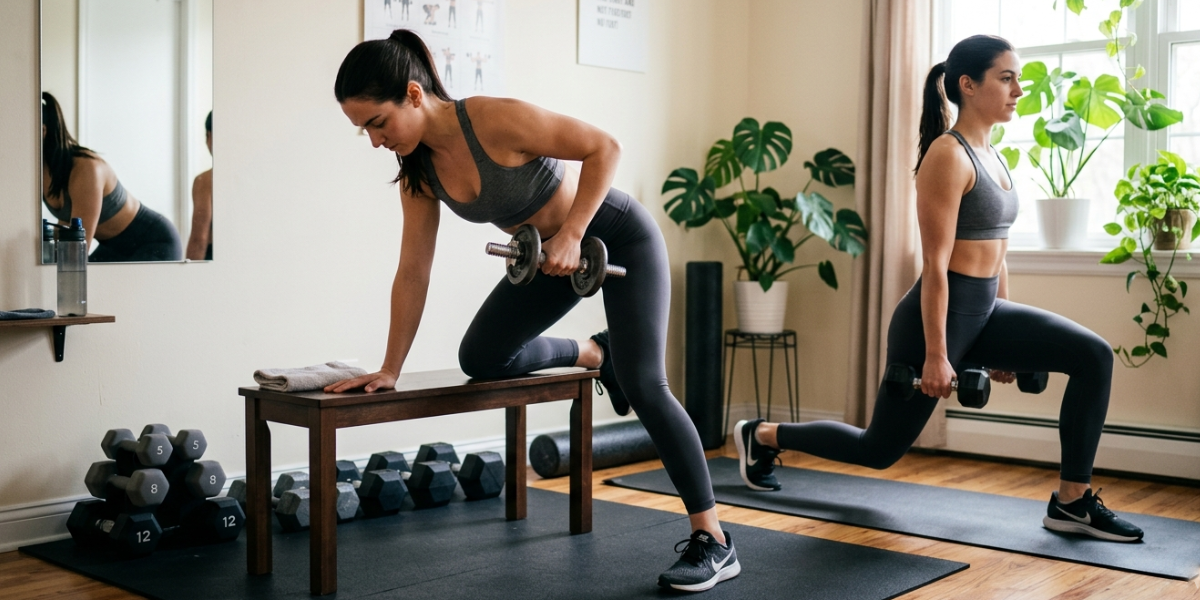
When it comes to dumbbell exercises for home workout routines, nothing beats the simplicity, versatility, and proven effectiveness of a good pair of dumbbells. Whether you are a complete beginner or a seasoned fitness enthusiast, dumbbells give you the freedom to train every major muscle group without expensive gym equipment or a monthly membership.
This guide walks you through the most effective moves, proper form cues, and smart programming strategies to help you get real results from home.
Why Dumbbells Are One of the Best Tools for Home Training
Dumbbells have been a staple in strength and conditioning programs for well over a century, and for good reason. Unlike barbells or weight machines, dumbbells allow each limb to move independently, which helps correct muscular imbalances and engages stabilizing muscles throughout every repetition.
They also require a relatively small footprint, making them ideal for apartment living, spare bedrooms, or garage setups.
From a scientific standpoint, resistance training with free weights like dumbbells stimulates muscle protein synthesis, improves bone density, enhances metabolic rate, and supports cardiovascular health when performed in circuit or superset formats.
The American College of Sports Medicine recommends resistance training at least two days per week for all healthy adults, and a basic dumbbell set is one of the most accessible ways to meet that standard.
For those tracking their overall wellness journey, pairing a consistent exercise routine with body composition awareness is important. You can use our BMI calculator to get a baseline measurement and monitor how your fitness program influences your body composition over time.
Foundational Dumbbell Exercises for the Upper Body
Dumbbell Bench Press
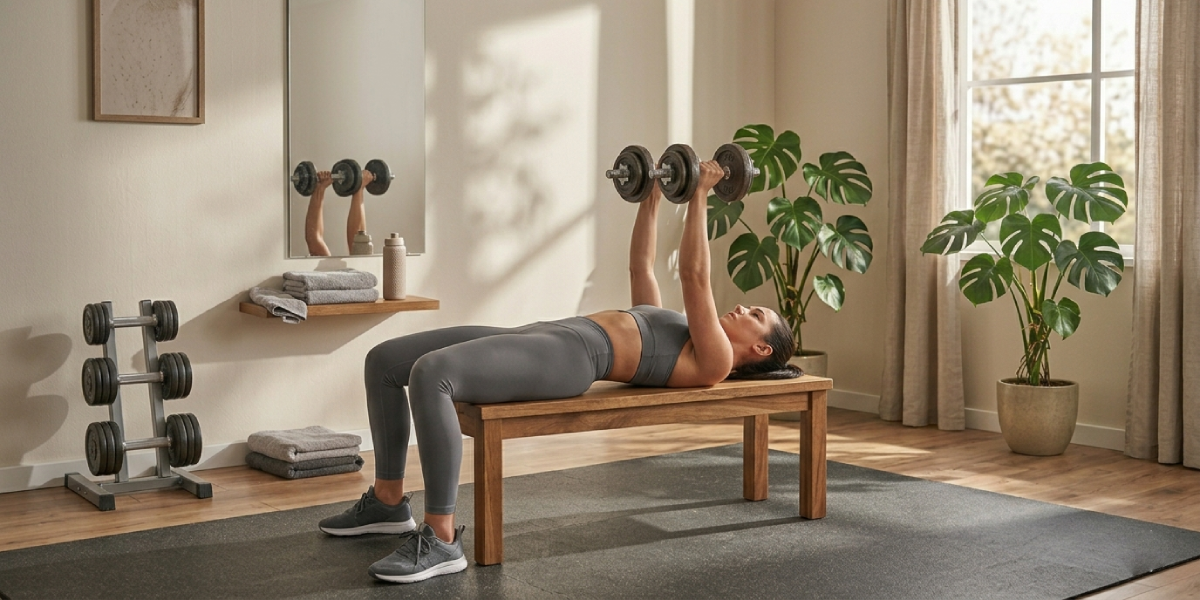
The dumbbell bench press is one of the most effective chest-building exercises available for home training. Lying on a flat bench or the floor, hold a dumbbell in each hand at chest level with palms facing forward. Press both dumbbells upward until your arms are fully extended, then lower them slowly back to the starting position.
The floor press variation is a perfectly valid substitute if you do not own a bench, and it actually places less stress on the shoulder joint at the bottom of the movement.
Aim for three to four sets of eight to twelve repetitions. Focus on controlled lowering, squeezing the chest at the top, and keeping your shoulder blades retracted throughout the movement.
Dumbbell Bent-Over Row
Rows are essential for building a strong back and counteracting the forward-rounded posture that comes from prolonged sitting. With a dumbbell in each hand, hinge forward at the hips until your torso is roughly parallel to the floor. Pull both dumbbells toward your hips, leading with your elbows and squeezing your shoulder blades together at the top. Lower with control and repeat.
This exercise targets the latissimus dorsi, rhomboids, rear deltoids, and biceps simultaneously, making it one of the most efficient upper-body pulling movements in any home workout program.
Dumbbell Shoulder Press
Seated or standing, hold a dumbbell in each hand at shoulder height with palms facing forward. Press the weights overhead until your arms are fully extended, then return to the starting position. The shoulder press develops the deltoids and triceps while also requiring core stability to maintain an upright posture under load.
Dumbbell Bicep Curl and Tricep Overhead Extension
No arm workout is complete without dedicated work for both the biceps and triceps. The standard dumbbell curl, performed with palms supinated throughout the movement, effectively isolates the bicep brachii. For triceps, the overhead extension, in which you hold one dumbbell with both hands and lower it behind your head before pressing back up, stretches the long head of the tricep under load for maximum development.
Essential Dumbbell Exercises for the Lower Body
Dumbbell Goblet Squat
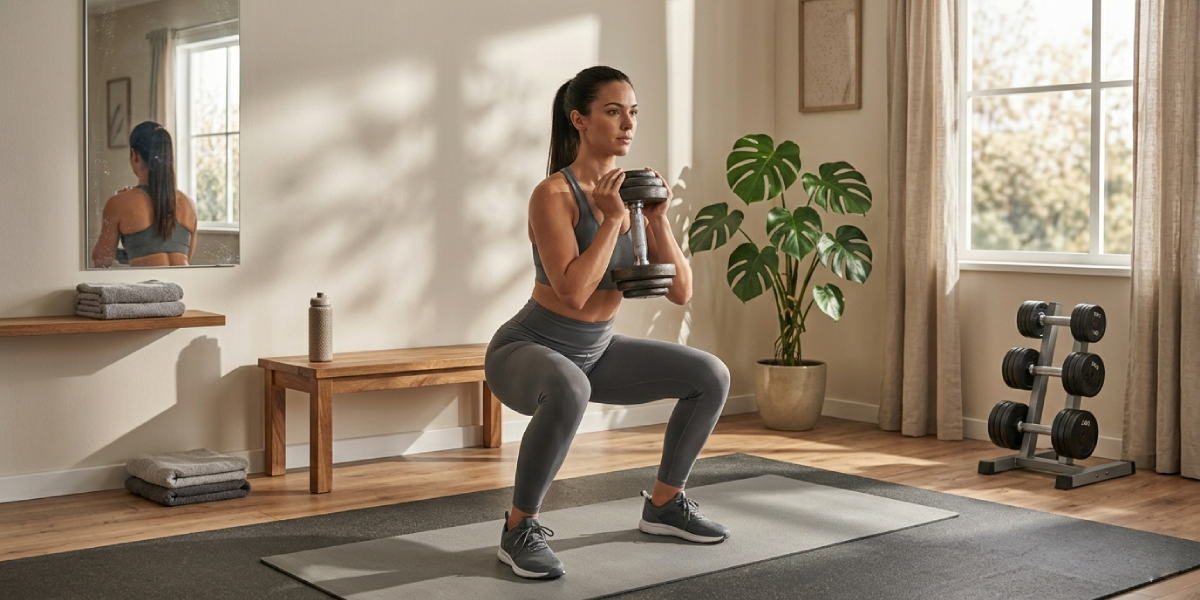
The goblet squat is widely considered one of the best teaching tools for squat mechanics and remains a highly effective lower-body exercise even for advanced lifters. Hold a single dumbbell vertically at chest height with both hands cupped underneath the top plate.
Squat down until your thighs are parallel to the floor, keeping your chest tall, your knees tracking over your toes, and your heels flat on the ground. Drive through your heels to return to standing.
This movement builds the quadriceps, glutes, hamstrings, and core simultaneously. It also reinforces proper depth and upright torso mechanics that carry over to more advanced lower body work. For more structured lower body exercises, including step-by-step tutorials and programming advice, explore our full exercise library.
Dumbbell Romanian Deadlift
The Romanian deadlift is the single best dumbbell movement for developing the hamstrings and glutes while also teaching the hip hinge pattern. Stand with a dumbbell in each hand in front of your thighs. Keeping your back flat and a slight bend in your knees, push your hips backward and lower the dumbbells along your legs until you feel a deep stretch in your hamstrings. Drive your hips forward to return to standing, squeezing your glutes at the top.
Dumbbell Reverse Lunge
Lunges are a fundamental unilateral lower-body movement that challenges balance and builds leg strength through a full range of motion. The reverse lunge is generally preferred over forward lunges for beginners because it places less shear force on the knee joint.
Holding a dumbbell in each hand, step one foot backward, lowering your rear knee toward the floor, then push off the front foot to return to standing. Alternate legs for the prescribed number of repetitions.
Core and Full-Body Dumbbell Exercises
Dumbbell Renegade Row
The renegade row combines a high plank position with a unilateral rowing movement, making it one of the most demanding core and upper-body exercises in a home training arsenal. Place two dumbbells on the floor shoulder-width apart and assume a push-up position with each hand gripping a dumbbell.
Row one dumbbell toward your hip while stabilizing your body with the opposite arm, resisting any rotation of the hips. Lower and repeat on the other side.
Dumbbell Farmer’s Carry
Often overlooked in conventional programming, the farmer’s carry is a full-body functional exercise that builds grip strength, core stability, shoulder integrity, and cardiovascular endurance simultaneously. Simply pick up a heavy dumbbell in each hand and walk for a set distance or time while standing tall, keeping your shoulders packed down and back, and breathing steadily. It is deceptively challenging and transferable to everyday physical tasks.
Dumbbell Thruster
The thruster combines a front squat with an overhead press into one fluid movement, making it a powerful metabolic conditioning exercise. Hold a dumbbell in each hand at shoulder height, palms facing inward. Squat down to parallel, then explosively drive through your heels and use that momentum to press the dumbbells overhead as you stand.
This exercise elevates the heart rate quickly and is excellent for circuit training finishers or cardio-strength hybrid sessions.
How to Structure an Effective Dumbbell Home Workout
For general fitness and muscle development, a three to four day per week full-body or upper-lower split works well for most people training at home. A sample full-body session might include a compound lower-body movement such as the goblet squat, a horizontal push like the floor press, a horizontal pull like the bent-over row, a hip hinge like the Romanian deadlift, and a carry or core exercise.
Performing two to four sets of each movement with adequate rest between sets covers all major muscle groups efficiently in about 45 to 60 minutes.
Progressive overload is the cornerstone of any effective resistance training program. This means gradually increasing the challenge over time, whether by adding weight, increasing repetitions, reducing rest intervals, or adding sets. Without progressive overload, the body adapts and results plateau.
Track your workouts in a simple notebook or app so you always know what you lifted last session and can aim to improve it.
Recovery is equally important as training. Adequate sleep, sufficient protein intake, and at least 48 hours of rest between training the same muscle group are the three pillars of sustainable progress.
For evidence-based guidance on how exercise interacts with your overall health and wellbeing, including nutrition and lifestyle factors, our health content library provides a reliable starting point.
Choosing the Right Dumbbell for Home Use
| Type | Best For | Pros | Cons |
|---|---|---|---|
| Fixed Hex Dumbbells | Beginners and general use | Durable, affordable, easy to use | Requires multiple pairs for variety |
| Adjustable Dumbbells | Space-limited home gyms | One set covers many weights | Higher upfront cost |
| Selectorized Dumbbells | Intermediate to advanced lifters | Fast weight changes, compact | Expensive, less durable under drops |
| Neoprene Coated | Light cardio and rehab work | Comfortable grip, colorful | Not suitable for heavy training |
For most home trainers, a pair of adjustable dumbbells ranging from 5 to 52.5 pounds provides enough resistance for the vast majority of exercises at an entry-level to intermediate training stage. As strength increases, adding heavier fixed dumbbells for compound movements like deadlifts and squats is a worthwhile investment.
Safety Tips for Dumbbell Training at Home
- Always warm up with five to ten minutes of light cardio and dynamic stretching before lifting
- Use a full range of motion on every exercise to maximize muscle activation and joint health
- Avoid using momentum to swing dumbbells, which reduces muscle engagement and increases injury risk
- Train on a non-slip surface and ensure you have enough space to move freely in all directions
- Start with lighter weights than you think you need until you have mastered proper form
- If you feel sharp joint pain rather than muscular fatigue during any exercise, stop and assess before continuing
Frequently Asked Questions
How many days per week should I do dumbbell exercises at home?
Most adults benefit from two to four days of dumbbell training per week. Full-body workouts three days per week with rest days in between is a practical and effective structure for the majority of home trainees. Allowing at least 48 hours of recovery before training the same muscle groups again is essential for muscle repair and growth.
Can I build significant muscle with just dumbbells at home?
Yes. Dumbbells provide sufficient resistance to stimulate meaningful muscle hypertrophy, particularly for beginners and intermediate lifters. As long as you progressively increase the load over time, maintain proper form, eat adequate protein, and recover well, you can build a strong and well-developed physique using only dumbbells.
What weight dumbbells should a beginner start with?
Beginners should typically start with light weights that allow them to complete the target repetitions with correct form but still feel challenging by the final two reps. For most women, this means starting in the 5 to 15 pound range for most exercises. For most men, the 10 to 25 pound range is a common starting point, though individual strength levels vary widely.
Are dumbbell exercises safe for people with lower back pain?
Many dumbbell exercises are safe and even therapeutic for people with lower back pain when performed correctly. However, some movements like bent-over rows and Romanian deadlifts require careful attention to spinal position under load. It is advisable to consult a qualified healthcare provider or physical therapist before starting a strength program if you have an existing back condition.
How long should a dumbbell home workout session last?
A well-structured dumbbell session typically lasts between 30 and 60 minutes, including a warm-up and cool-down. Sessions beyond 60 to 75 minutes are generally not necessary for the average person and may even be counterproductive if they lead to fatigue-related form breakdown. Quality of effort matters more than duration.
Can dumbbell exercises help with weight loss?
Yes. Resistance training with dumbbells increases lean muscle mass, which in turn elevates resting metabolic rate, meaning you burn more calories throughout the day even at rest. When combined with a calorie-controlled diet and consistent cardiovascular activity, dumbbell training is a powerful tool for sustainable fat loss and body composition improvement.
Do I need a bench for an effective dumbbell workout at home?
A bench is helpful but not necessary. Most dumbbell exercises can be modified for floor-based training. The floor press substitutes for the flat bench press, and exercises like rows and curls require no bench at all. A sturdy chair or even a low couch can substitute for incline work in a pinch, though a basic adjustable bench is a worthwhile purchase as your training advances.
How do I avoid hitting a plateau with home dumbbell workouts?
The most reliable way to avoid a plateau is to practice progressive overload consistently. This means tracking your workouts and incrementally increasing weight, sets, or repetitions over time. Varying your exercise selection, adjusting rep ranges between strength-focused work and higher-rep metabolic work, and prioritizing sleep and nutrition are additional strategies that keep progress moving forward.
Is it better to do high reps with light weight or low reps with heavy weight?
Both approaches have merit and can produce results. Heavy loads in the three to six rep range are most effective for maximal strength development. Moderate loads in the eight to twelve rep range are well-supported for muscle hypertrophy. Higher rep ranges of 15 to 20 or more build muscular endurance and can also contribute to hypertrophy when sets are taken close to failure. Incorporating a variety of rep ranges across your weekly training is optimal for well-rounded fitness.