


If you spend hours at a desk, drive long distances, or constantly look down at your phone, your upper back is paying the price. Upper back exercises for better posture are no longer optional for most people — they are a genuine health necessity.
Weak upper back muscles lead to rounded shoulders, forward head position, chronic neck stiffness, and that nagging ache between the shoulder blades that never fully goes away. The good news is that targeted, consistent training can reverse these patterns, restore alignment, and help you feel and move better every single day.
This guide covers the most effective exercises you can add to your routine right now, explains the muscles involved, and gives you practical programming advice rooted in exercise science and real-world application. Whether you are a complete beginner or someone returning to training after an injury, there is something here for you.
Why Upper Back Strength Is Essential for Good Posture
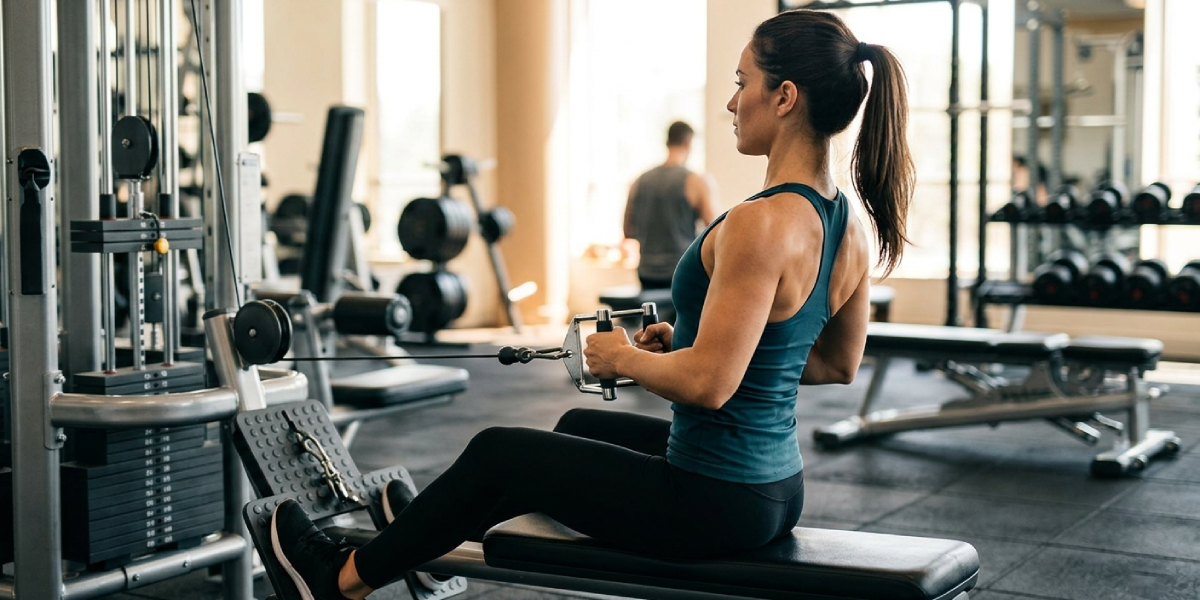
Posture is not simply about standing straight — it is a reflection of the balance of strength and flexibility throughout your entire musculoskeletal system. The upper back, specifically the thoracic spine region, is where most postural problems originate or show up first.
Modern lifestyles keep us in a position of thoracic flexion — hunched forward with the chest caved in. Over time, the muscles responsible for pulling the shoulder blades together and keeping the spine upright become elongated and weak.
These include the rhomboids, middle and lower trapezius, rear deltoids, and the erector spinae group in the thoracic region. Meanwhile, the chest and front shoulder muscles become shorter and overactive, which pulls the body further into that rounded posture.
Strengthening the upper back directly counteracts this imbalance. It also supports the cervical spine, reducing the risk of tension headaches and neck pain. A strong upper back improves breathing mechanics, athletic performance, and even confidence.
For those tracking general wellness markers, pairing your exercise plan with regular BMI monitoring can also give you a broader picture of how your fitness journey is progressing.
The Key Muscles Targeted by Upper Back Exercises
Understanding which muscles are involved helps you train them more intentionally. Here is a breakdown of the primary muscles targeted by upper back exercises:
- Trapezius (middle and lower fibers): These portions of the trapezius retract and depress the shoulder blades. They are chronically underactivated in people with poor posture.
- Rhomboids (major and minor): Located between the spine and the shoulder blades, the rhomboids draw the scapulae toward the midline of the body. Strong rhomboids are critical for a flat, open upper back.
- Rear Deltoids: These sit at the back of the shoulder and assist in pulling the arms back. They work closely with the rhomboids and middle traps.
- Infraspinatus and Teres Minor: Part of the rotator cuff, these muscles externally rotate the shoulder and are vital for shoulder health and posture.
- Erector Spinae (thoracic segment): These deep back muscles run along the spine and help maintain an upright thoracic curve under load.
- Serratus Anterior: While located on the sides of the ribs, this muscle keeps the shoulder blades flat against the ribcage and is often overlooked in posture training.
The Best Upper Back Exercises for Better Posture
1. Face Pulls
Face pulls are arguably the single best exercise for postural correction. Using a cable machine or resistance band anchored at head height, you pull the rope or band toward your face while keeping your elbows high and flaring outward.
This movement simultaneously trains the rear deltoids, middle trapezius, rhomboids, and external rotators of the shoulder — exactly the muscles that modern life weakens most.
Perform 3 sets of 15 to 20 repetitions. Use a lighter load and focus on the external rotation at the peak of the movement. Pause at the end range for one to two seconds to maximize muscle activation.
2. Prone Y-T-W Raises
This bodyweight drill can be done on the floor or on an incline bench and is an excellent starting point for beginners. Lie face down and raise your arms into the shape of a Y, then a T, then a W, holding each position for two seconds. This sequence targets the lower traps, middle traps, and rear deltoids in a low-load, high-control manner that is also therapeutic for injured or unstable shoulders.
Perform 2 to 3 sets of 10 repetitions per letter. No equipment is needed, making this perfect for home training.
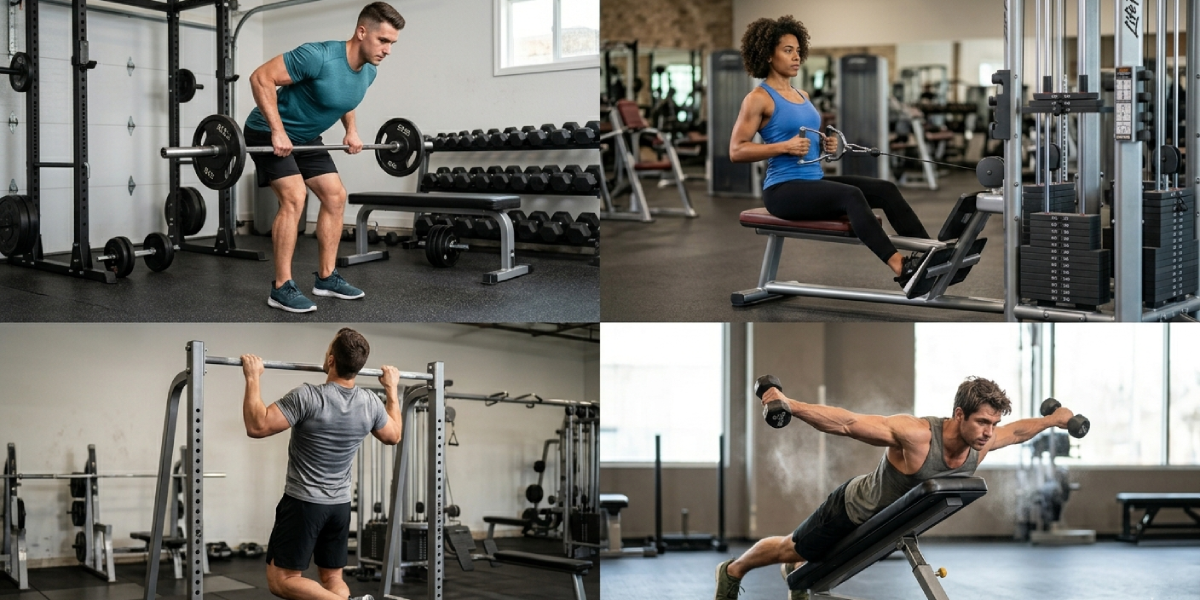
3. Seated Cable Rows
The seated cable row is a cornerstone compound exercise for upper and mid-back development. With a neutral grip and a straight torso, you pull a cable handle toward the lower chest while driving the elbows back and squeezing the shoulder blades together at the end of each rep.
The key postural benefit comes from what happens at the top of the movement: a full scapular retraction that trains your body to hold that position automatically. Avoid letting the shoulders roll forward on the way back — control the eccentric (return) phase over two to three seconds. Aim for 3 to 4 sets of 10 to 12 repetitions.
4. Dumbbell Bent-Over Rows
Bent-over rows are a staple of any serious upper back program. Hinge at the hips, keep the spine neutral, and row a dumbbell from a hanging position to your hip, leading with the elbow and finishing with a scapular squeeze. Single-arm rows are especially useful because they allow each side to be trained independently, which helps identify and correct left-to-right imbalances.
Perform 3 sets of 10 to 12 repetitions per arm. Keep the core braced throughout to protect the lumbar spine.
5. Band Pull-Aparts
This simple but powerful movement uses a resistance band held at chest height with arms extended. You pull the band apart horizontally until your arms are fully extended to the sides and the band touches your chest. Band pull-aparts directly activate the rear deltoids and rhomboids and can be used as a warm-up, a filler movement between sets, or a corrective drill on rest days.
Aim for 3 sets of 20 repetitions. As strength improves, use a thicker band or increase the volume.
6. Pull-Ups and Lat Pulldowns
Pull-ups and their machine-assisted equivalent, the lat pulldown, primarily target the latissimus dorsi but also heavily recruit the lower traps and rhomboids when performed with proper shoulder blade engagement. Starting the movement by depressing and retracting the shoulder blades before bending the elbows is the key coaching cue that makes these exercises posture-friendly rather than posture-neutral.
If you cannot yet perform a bodyweight pull-up, the lat pulldown machine or an assisted pull-up machine is an ideal substitute. Perform 3 sets of 6 to 10 pull-ups or 10 to 12 pulldown repetitions.
7. Thoracic Extensions Over a Foam Roller
While not a strength exercise in the traditional sense, thoracic extension over a foam roller directly addresses the stiffness that limits posture. Place the foam roller perpendicular to your spine at the mid-back level, support your head with your hands, and gently extend over the roller. Slowly work the roller up and down the thoracic spine, pausing at stiff segments.
Spend 60 to 90 seconds on this before upper back training sessions. A mobile thoracic spine allows you to reach better positions during rowing and pulling exercises, which multiplies the postural benefit of every other exercise on this list.
8. Reverse Dumbbell Flies
Also called rear delt flies, this exercise is performed bent over at the hip or chest-supported on an incline bench. With a slight bend in the elbows, you raise both arms out to the sides in a controlled arc until they are roughly parallel to the floor. The movement isolates the rear deltoids and the middle trapezius with minimal involvement from larger, dominant muscle groups.
Use a weight light enough to maintain form throughout. Perform 3 sets of 12 to 15 repetitions.
How to Structure Your Upper Back Training
Frequency matters as much as exercise selection when training for posture. Because the upper back muscles are primarily composed of slow-twitch postural fibers that respond well to moderate volume and frequency, training them two to three times per week yields better results than a single high-volume session.
A practical weekly structure might look like this: two full-body or push-pull sessions per week, each including at least two upper back movements from the list above. On non-training days, band pull-aparts and prone Y-T-W raises can be performed as light corrective work without significant recovery cost.
For those exploring a broader approach to structured exercise programming, pairing upper back work with core stability training and hip flexor stretching creates a complete postural correction program that addresses the body as a connected system rather than in isolated parts.
Common Mistakes That Undermine Postural Progress
Training the upper back without attention to technique often reinforces the very compensation patterns you are trying to fix. Here are the most common errors to avoid:
- Using too much weight: Heavy loads on rowing movements cause the lower back to take over and the shoulder blades to lose their retracted position. Start lighter than you think you need to.
- Neglecting the retraction cue: Pulling with only the arms and not finishing with a scapular squeeze eliminates most of the postural benefit of any row or pull movement.
- Ignoring the chest: Stretching the pectorals and anterior deltoids is just as important as strengthening the upper back. Without flexibility on the front side, the back will struggle to hold a better position.
- Inconsistency: Doing three sessions one week and none the next produces little adaptation. Consistency over months is what changes posture.
- Skipping mobility work: Foam rolling and thoracic mobilizations are not optional extras — they are prerequisites for getting the most out of strength work.
Nutrition and Recovery in Support of Postural Training
Muscles need adequate protein to recover and grow. For most active adults, a target of 1.6 to 2.2 grams of protein per kilogram of bodyweight per day supports muscle repair and development. Prioritize whole food protein sources such as lean meats, eggs, legumes, dairy, and fish.
Hydration also plays a role in joint lubrication and tissue health, particularly for the intervertebral discs that support spinal alignment.
Sleep is when much of the structural repair from training actually occurs. Aiming for seven to nine hours of quality sleep per night gives the body the time it needs to adapt to training stimuli. For those interested in a deeper understanding of how nutrition, weight management, and overall health interact with exercise outcomes, building a baseline of nutritional knowledge is a worthwhile investment alongside any physical training program.
How Long Before You See Postural Improvement
This is one of the most common questions, and the honest answer is that meaningful postural change typically requires consistent effort over eight to sixteen weeks. That said, many people notice a reduction in upper back tension and improved awareness of their own posture within the first two to three weeks simply from beginning to activate muscles that have been dormant for years.
The long-term structural changes — such as improved thoracic mobility, stronger scapular stabilizers, and more natural resting alignment of the shoulders — take longer to solidify but are durable once established. Think of postural correction as a training outcome, not a quick fix.
Frequently Asked Questions
What are the most effective upper back exercises for better posture?
The most effective exercises include face pulls, band pull-aparts, seated cable rows, prone Y-T-W raises, and reverse dumbbell flies. These movements directly target the rhomboids, middle and lower trapezius, and rear deltoids — the muscles most responsible for holding an upright, open posture.
How often should I train my upper back for posture correction?
Training the upper back two to three times per week is the most effective frequency for postural correction. The postural muscles respond well to consistent, moderate-volume training rather than infrequent high-volume sessions. Light corrective work such as band pull-aparts can also be done daily without significant recovery cost.
Can upper back exercises fix rounded shoulders?
Yes, targeted upper back exercises can significantly reduce and in many cases reverse rounded shoulder posture. However, they must be combined with chest and anterior shoulder stretching. Strengthening the back without addressing the tightness in the front simply creates a tug-of-war that limits overall improvement.
Do I need gym equipment to train my upper back for posture?
No. Several highly effective postural exercises require no equipment at all. Prone Y-T-W raises, bodyweight pull-ups, and thoracic foam roller extensions can be done at home. A resistance band adds variety and increases the number of options available, and bands are inexpensive and easy to store.
What causes poor upper back posture in the first place?
The primary causes are prolonged sitting, forward head posture from device use, and an imbalance between dominant pushing muscles and weaker pulling muscles. Most people perform far more pressing-type movements in daily life and training than pulling movements, which leads to the muscular imbalance that drives rounded posture over time.
Is it safe to do upper back exercises if I have back pain?
In most cases, light upper back strengthening exercises are not only safe but therapeutic for people with mild to moderate back pain. However, if your pain is acute, severe, or associated with numbness and tingling in the arms, you should consult a healthcare professional before beginning any exercise program. Exercises like prone Y-T-W raises and band pull-aparts are very low risk and are commonly used in physiotherapy settings.
How long does it take for upper back exercises to improve posture?
Most people notice reduced muscle tension and greater postural awareness within two to three weeks of consistent training. Visible and structural improvements in posture typically become apparent between eight and sixteen weeks of regular practice. Long-term, durable postural change requires ongoing maintenance training even after initial goals are met.
Should I stretch my upper back or strengthen it for better posture?
Both are necessary, and they work best when combined. The upper back muscles typically need strengthening because they are weak and overstretched from constant forward-rounded positioning. The chest and front shoulder muscles typically need stretching because they are short and overactive. Addressing both sides of the equation produces faster and more lasting results than focusing on one alone.
Are face pulls better than rows for posture?
Face pulls and rows are complementary rather than interchangeable. Face pulls uniquely target the rear deltoids and external rotators of the shoulder, which are critical for shoulder alignment and health. Rows develop the rhomboids, middle traps, and lats more thoroughly. A complete upper back posture program includes both types of movement across the week.
Can bad posture cause headaches and neck pain?
Yes. Forward head posture increases the effective weight the cervical spine must support, placing excessive strain on the neck muscles and joints. This commonly leads to tension headaches, neck stiffness, and pain that radiates into the shoulders and upper back. Correcting upper back posture through targeted exercise often reduces these symptoms significantly over time.