

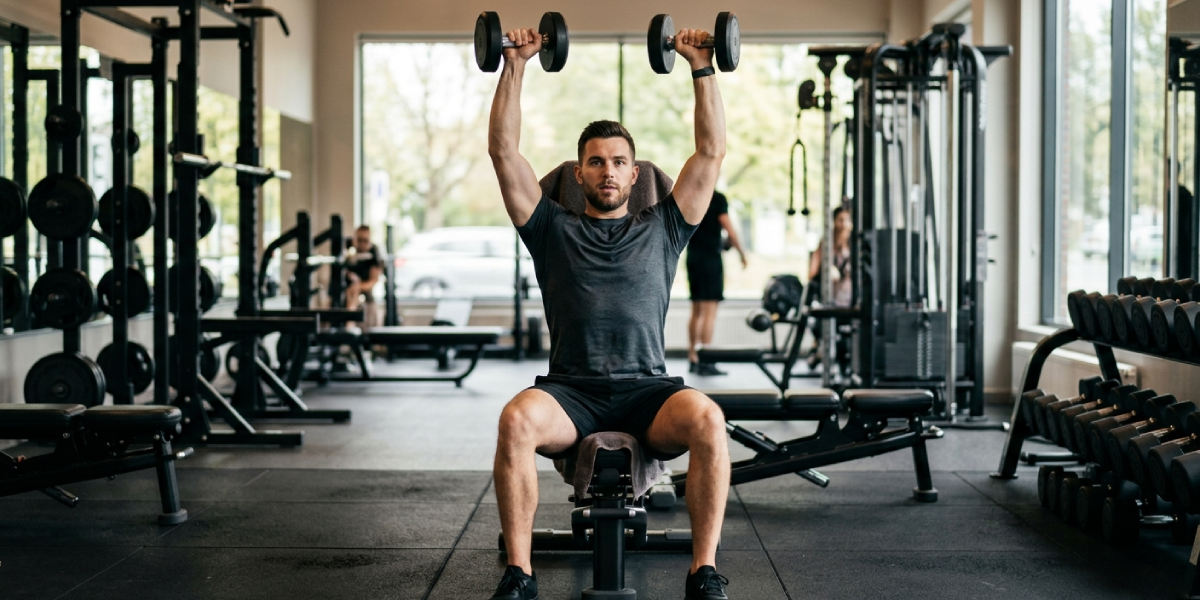
The shoulder press exercise is one of the most effective upper-body movements you can add to your training routine. Whether you are a beginner stepping into the gym for the first time or an experienced lifter looking to refine your technique, mastering this exercise will help you build broader, stronger shoulders and improve overall upper-body pressing power.
In this comprehensive guide, you will learn the correct form, the muscles targeted, the most effective variations, common mistakes to avoid, and programming tips to help you get the most out of every set. The information here is grounded in established exercise science and real-world coaching practice so you can train with confidence and without unnecessary risk of injury.
What Is the Shoulder Press Exercise?
The shoulder press exercise, also widely known as the overhead press or military press, is a compound pushing movement in which you press a weight directly overhead from shoulder height until your arms are fully extended. It can be performed seated or standing, with a barbell, dumbbells, a kettlebell, or even a resistance band.
Because it involves multiple joints and muscle groups working together, it is classified as a compound exercise. This makes it highly efficient for building functional strength that carries over to everyday activities and athletic performance alike.
For anyone serious about upper-body strength training exercises, the shoulder press is a foundational movement that deserves a place at the center of your program.
Muscles Worked During the Shoulder Press Exercise
Understanding which muscles the shoulder press targets helps you appreciate why it is such a powerful exercise. While the deltoids are the primary movers, several other muscles contribute significantly to the lift.
Primary Muscles
- Anterior deltoid – The front head of the shoulder muscle does the most work during any overhead pressing movement.
- Medial deltoid – The middle head of the deltoid is activated as your arms push outward and upward through the range of motion.
- Triceps brachii – The three-headed muscle on the back of your upper arm locks out the elbow at the top of each rep.
Secondary and Stabilizing Muscles
- Upper trapezius – Assists with upward rotation of the scapula, which is essential for safe overhead movement.
- Serratus anterior – Helps protract and stabilize the shoulder blade throughout the press.
- Rotator cuff muscles – Act as dynamic stabilizers of the glenohumeral joint to keep the head of the humerus centered.
- Core muscles – When performing a standing press, the abdominals, obliques, and lumbar extensors create a stable base to transfer force from the lower body through the spine and into the bar.
How to Do the Barbell Shoulder Press Exercise with Proper Form
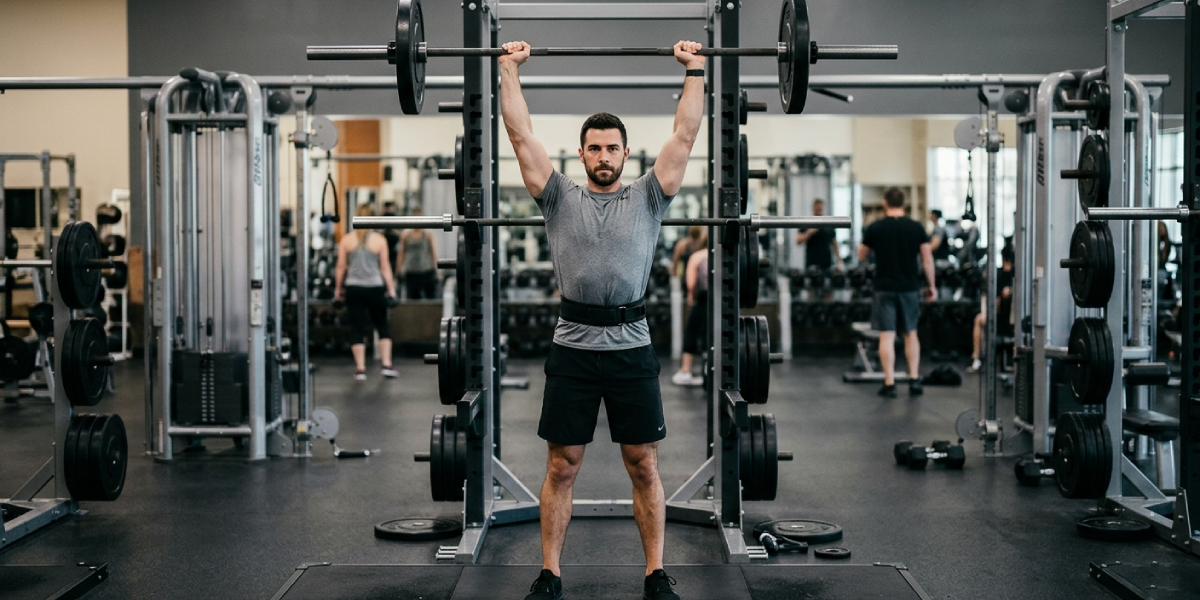
The standing barbell overhead press is widely considered the gold standard variation because it demands total-body coordination and core stability. Follow these step-by-step instructions to execute it safely and effectively.
Step 1: Set Up the Bar at the Right Height
Place the barbell on a squat rack or shoulder-height pins at approximately collarbone level. Choose a weight that allows you to complete your target repetitions with full control. Beginners should start with just the empty bar to learn the movement pattern before adding load.
Step 2: Grip the Bar Correctly
Grip the bar just outside shoulder width with your palms facing forward. Wrap your thumbs around the bar for security. Your wrists should be stacked directly over your elbows, not bent backward. A neutral or slightly pronated wrist position reduces stress on the wrist joint and puts you in the strongest mechanical position for pressing.
Step 3: Establish Your Starting Position
Unrack the bar and step back, planting your feet about hip-width apart. Brace your core firmly as if you are about to take a punch. Squeeze your glutes, keep your knees slightly soft, and make sure your rib cage is down rather than flared. The bar should rest on the front of your shoulders and upper chest, just below your chin. Your elbows should be slightly in front of the bar, not pointing straight out to the sides.
Step 4: Press the Bar Overhead
Take a deep breath in and brace your core. As you exhale, drive the bar upward in a straight vertical path. To clear your face, you will naturally need to move your head very slightly back and then immediately forward again once the bar passes your forehead. At the top, your arms should be fully extended and the bar should be directly over the center of your foot, not in front of your body. Your biceps should be in line with or slightly behind your ears.
Step 5: Lower the Bar Under Control
Inhale as you reverse the path and lower the bar back to the starting position at the top of your chest with control. Do not let the bar crash down. Maintain tension in your core and upper back throughout the eccentric phase. That is one complete repetition.
Dumbbell Shoulder Press: A Versatile Alternative

The dumbbell shoulder press exercise is an excellent option that offers a greater range of motion than the barbell version and allows each arm to work independently. This makes it especially useful for identifying and correcting left-to-right strength imbalances.
To perform it, sit on a bench with back support set at 90 degrees or stand upright. Hold a dumbbell in each hand at shoulder height with your palms facing forward. Press both dumbbells straight up until your arms are fully extended, then lower them back to the starting position with control.
The movement should feel smooth, not jerky, and both arms should travel at the same speed and through the same arc.
Seated vs. Standing Shoulder Press: Which Should You Choose?
Both variations are effective, and each has distinct advantages depending on your goals and physical condition.
| Feature | Standing Press | Seated Press |
|---|---|---|
| Core Demand | High – requires significant core stability | Lower – back support reduces core involvement |
| Shoulder Load | Slightly lower due to whole-body involvement | Higher – more isolated shoulder effort |
| Lower Back Stress | Higher if form breaks down | Lower due to back support |
| Functional Carry-over | Very high | Moderate |
| Best For | Athletes and those building general strength | Beginners, those with lower back issues |
If you are new to the shoulder press exercise, the seated dumbbell press is a great place to start because the back support helps you focus on learning the movement before adding core stability demands.
Common Mistakes to Avoid
Even experienced lifters fall into bad habits over time. Being aware of these common errors will help you train more safely and effectively.
Arching the Lower Back Excessively
One of the most frequent mistakes in the shoulder press is allowing the lower back to hyperextend under load, especially as fatigue sets in. This increases lumbar stress and shifts work away from the shoulders. To prevent it, brace your core before every rep and keep your glutes engaged throughout the set.
Using Momentum or Leg Drive
Dipping at the knees to bounce the weight up is a technique used in the push press, which is a different exercise with different goals. If you are doing a strict shoulder press, the legs should remain still. Using leg drive to compensate for too much weight is a sign to reduce the load.
Pressing the Bar in Front of Your Body
The bar should travel in a near-vertical line directly above the center of your base of support. Pressing forward puts the shoulder joint in a mechanically disadvantaged position and increases the risk of impingement. Focus on keeping the bar stacked over your midfoot from start to finish.
Flaring the Elbows Too Wide
While the elbows do flare out during the press, an exaggerated flare places excessive stress on the rotator cuff. Aim for an elbow angle of roughly 45 to 75 degrees from your torso at the starting position rather than 90 degrees straight out to the sides.
Not Locking Out at the Top
Stopping just short of full arm extension may feel safer, but it actually reduces deltoid activation and prevents you from training the triceps through their full range. Unless you have a specific medical reason to avoid full lockout, completing the rep by fully extending your elbows at the top is best practice.
Shoulder Press Variations Worth Adding to Your Routine
Once you have mastered the standard shoulder press exercise, incorporating variations keeps your program fresh, prevents adaptation, and challenges your shoulders from different angles.
Arnold Press
Named after bodybuilding legend Arnold Schwarzenegger, this dumbbell variation begins with your palms facing your body and involves rotating your hands outward as you press up so that your palms face forward at the top. This rotation increases the range of motion and recruits more of the medial and posterior deltoid compared to a standard dumbbell press.
Push Press
The push press uses a shallow knee dip and explosive leg drive to initiate the movement, allowing you to press 20 to 30 percent more weight than in a strict press. It is an excellent tool for developing power and overloading the top range of the movement where the shoulders are most active.
Landmine Press
The landmine press is performed by pressing one end of a barbell that is anchored at the other end. The arc of the movement is more shoulder-friendly than a strict vertical press, making it an excellent option for those with shoulder impingement or mobility limitations who still want to train the overhead pattern.
Single-Arm Dumbbell Press
Pressing one dumbbell at a time dramatically increases the anti-rotation demand on your core and challenges each shoulder independently. It is a powerful tool for addressing asymmetries and building unilateral strength.
How to Program the Shoulder Press Exercise
How you program the shoulder press depends on your training age, goals, and how it fits within your overall workout structure. Here are practical guidelines to use as a starting point.
For Strength
Use heavier loads at lower rep ranges, typically 3 to 6 repetitions per set, for 3 to 5 sets. Rest 2 to 4 minutes between sets to allow full neural recovery. Prioritize progressive overload by adding small amounts of weight week over week.
For Hypertrophy (Muscle Size)
Work in the 8 to 15 repetition range across 3 to 4 sets with 60 to 90 seconds of rest. Include both a barbell compound variation and an isolation movement like a dumbbell lateral raise to develop all three deltoid heads fully.
For Beginners
Start with the seated dumbbell press for 3 sets of 10 to 12 reps using a moderate weight that challenges you by the final few reps but allows clean form throughout. Train the shoulder press two times per week to develop the motor pattern quickly.
Tracking your body weight alongside your pressing progress using tools like a body mass index calculator can help you understand how your overall body composition is changing as you build muscle.
Shoulder Health and Injury Prevention Tips
The shoulder is one of the most mobile joints in the body, which also makes it one of the most vulnerable. Protecting it during pressing work is essential for long-term training longevity.
Always warm up thoroughly before heavy pressing. This should include dynamic shoulder circles, band pull-aparts, face pulls, and a few warm-up sets at progressively increasing loads before your working weight. Maintaining a balanced training program that includes enough pulling volume, rows, face pulls, and rear delt work is critical for maintaining healthy shoulder posture and reducing impingement risk.
If you experience sharp pain or clicking in the shoulder joint during pressing, stop the exercise and consult a qualified physical therapist or sports medicine professional before continuing. Understanding how your overall health and physical condition connects to your exercise performance is part of being a smart, informed athlete.
Learning more about health and wellness fundamentals can give you the broader context you need to train sustainably for years to come.
Frequently Asked Questions
What muscles does the shoulder press exercise target?
The shoulder press primarily targets the anterior and medial deltoids along with the triceps brachii. It also engages the upper trapezius, serratus anterior, and the rotator cuff muscles as stabilizers. When performed standing, the core muscles work hard to maintain a stable base.
Is the seated or standing shoulder press better for building muscle?
Both variations are effective for building muscle. The seated press isolates the shoulders more because the back support eliminates lower-body involvement, which can be advantageous for pure hypertrophy. The standing press develops more functional strength and core stability. For most people, including both in a well-rounded program produces the best results.
How much weight should a beginner use for the shoulder press?
Beginners should start with a weight that allows them to complete 10 to 12 repetitions with complete control and perfect form. For most people, this means starting with the empty barbell (20 kg or 45 lbs) or a pair of light dumbbells (5 to 15 lbs each). Form always takes priority over load, especially in the early weeks of training.
How often should I do the shoulder press exercise per week?
For most people, training the shoulder press two to three times per week is sufficient for consistent strength and size gains. This allows enough frequency to build the motor pattern and stimulus for muscle growth while also providing adequate recovery between sessions. Advanced lifters may press more frequently, but beginners and intermediates typically respond well to twice-weekly exposure.
Can the shoulder press exercise cause shoulder injury?
When performed with proper technique and appropriate loads, the shoulder press is generally a safe and beneficial exercise. Injury risk increases when form breaks down, weight is too heavy, the elbow angle is too wide, or when there is a pre-existing shoulder condition such as impingement or rotator cuff damage. A thorough warm-up, progressive loading, and balanced pulling work in your program dramatically reduce risk.
What is the difference between the shoulder press and the push press?
The strict shoulder press is performed without any leg assistance, relying entirely on upper-body and core strength to move the weight. The push press uses a shallow knee dip and explosive leg drive to initiate the movement, allowing for heavier loads to be pressed overhead. Both are valuable exercises, but they train slightly different qualities: the strict press emphasizes raw shoulder strength while the push press develops power and allows overload of the overhead pattern.
Should I press in front of my head or behind it?
Pressing in front of the head (the standard overhead press) is strongly recommended over the behind-the-neck press for most people. The behind-the-neck press places the shoulder in extreme external rotation and the cervical spine under compressive load, significantly increasing the risk of injury. The benefits of the standard overhead press far outweigh any perceived advantage of the behind-the-neck variation for the vast majority of trainees.
How do I know if I am using too much weight on the shoulder press?
Signs that your weight is too heavy include excessive lower back arching, using momentum or leg drive in a strict press variation, the bar traveling forward rather than straight up, losing your brace before completing the rep, or being unable to complete the full range of motion. If any of these occur, reduce the load and rebuild with lighter weights until your form is consistently clean across all reps and sets.