

If you are looking for effective resistance band exercises for strength training, you have come to the right place. Resistance bands are one of the most versatile, affordable, and practical tools available to anyone serious about building muscle, improving functional fitness, and staying consistent with their workouts.
Whether you train at home, travel frequently, or simply want to add variety to your gym routine, resistance bands deliver real, measurable results.
Unlike bulky free weights or machine-based equipment, resistance bands provide constant tension throughout the full range of motion of an exercise. This means your muscles are working harder across every phase of a movement, not just at the peak contraction.
The result is greater time under tension, improved muscle activation, and a lower risk of injury compared to loading a barbell beyond your current capability.
This guide covers the most effective resistance band exercises for building strength, explains the science behind why they work, and gives you practical guidance on sets, reps, and progression so you can get the most out of every session.
Why Resistance Bands Are Effective for Strength Training
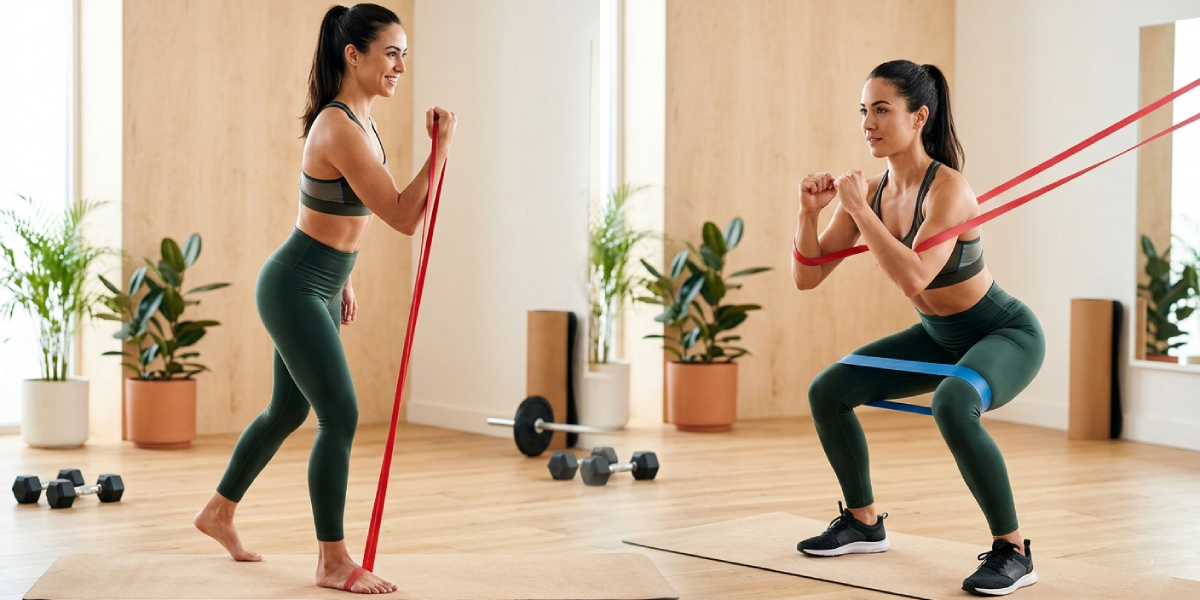
Resistance bands work by creating elastic tension that increases as the band is stretched. This progressive resistance mirrors the natural strength curve of many compound movements, making exercises feel more challenging where your muscles are strongest and better able to handle load.
This is one of the reasons strength and conditioning coaches increasingly incorporate band work into programs for athletes of all levels.
Research consistently supports the use of elastic resistance for building muscular strength and endurance. A 2019 meta-analysis published in the journal SAGE Open Medicine found that resistance band training produces comparable strength gains to conventional resistance training using free weights or machines.
This evidence gives resistance bands a legitimate place in any well-structured training plan.
Bands are available in several resistance levels, typically ranging from light (around 5 to 10 pounds of tension) to extra heavy (up to 150 pounds or more for thick loop bands). By combining bands or choosing the appropriate resistance level, you can progressively overload your muscles just as you would with traditional weights.
Types of Resistance Bands You Should Know
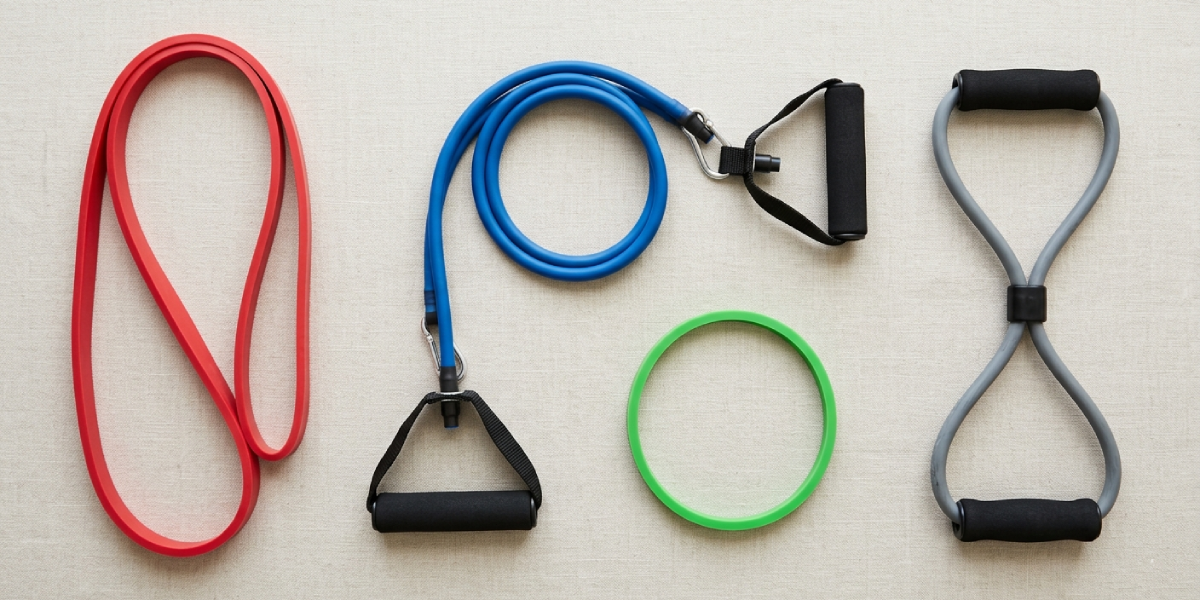
Before diving into exercises, it helps to understand which bands suit different movements:
- Loop bands (flat or tube): Long circular bands that work well for lower body exercises like squats, glute bridges, and lateral walks. They can also be anchored for upper body pulling movements.
- Tube bands with handles: These resemble cables at the gym and are ideal for presses, rows, curls, and tricep pushdowns.
- Mini loop bands: Short, flat bands used primarily for glute activation, hip abduction, and warming up the lower body.
- Figure-eight bands: Designed for specific isolation exercises and physical therapy movements.
For a comprehensive home strength training setup, a set of tube bands with handles, two or three mini loop bands, and one long loop band will cover almost every exercise in this guide.
The Best Resistance Band Exercises for Upper Body Strength
Resistance Band Chest Press
Anchor a tube band behind you at chest height, hold one handle in each hand, and press forward while extending your arms fully. This movement targets the pectorals, anterior deltoids, and triceps in the same pattern as a flat bench press. Because the tension increases as you extend, the lockout phase becomes more demanding, helping build full-range pressing strength.
Aim for 3 to 4 sets of 10 to 15 repetitions. To increase difficulty, step further from the anchor point or use a heavier resistance band.
Resistance Band Bent-Over Row
Stand on the center of a tube band or long loop band, hinge at the hips with a neutral spine, and pull both handles up toward your lower ribs. This exercise directly targets the latissimus dorsi, rhomboids, rear deltoids, and biceps. Strong pulling muscles are essential for posture, shoulder health, and overall upper body balance.
Perform 3 to 4 sets of 10 to 12 reps, focusing on retracting your shoulder blades at the top of each pull.
Resistance Band Overhead Press
Stand on the band with feet shoulder-width apart, hold the handles at shoulder height with palms facing forward, and press overhead until your arms are fully extended. The overhead press strengthens the deltoids, upper trapezius, and triceps, and also challenges core stability as you resist the band pulling your torso forward.
Resistance Band Bicep Curl
Stand on the center of a band, hold the handles with palms facing up, and curl toward your shoulders without swinging your elbows. Bands are particularly effective for bicep curls because peak tension occurs at the top of the movement, exactly where the bicep is at peak contraction. This is a mechanical advantage that dumbbells do not offer to the same degree.
Resistance Band Tricep Pushdown
Anchor a band overhead, grip the handle or loop with both hands, and extend your arms downward while keeping your elbows tucked at your sides. This isolation movement targets the triceps brachii across all three heads and is a direct substitute for the cable pushdown commonly performed in commercial gyms.
The Best Resistance Band Exercises for Lower Body Strength
Resistance Band Squat
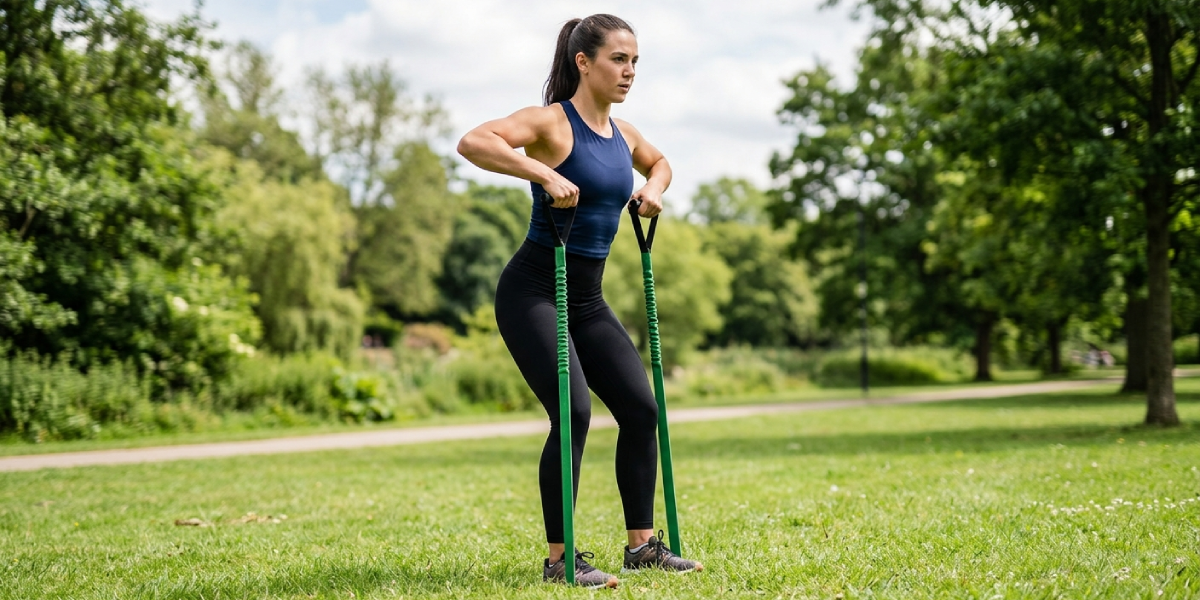
Step both feet onto a long loop band or tube band, hold the handles at shoulder height, and squat to parallel or below. The band adds resistance to the upward phase of the squat, where the glutes and quadriceps are working hardest.
This exercise is a foundational movement for building lower body strength and is one of the most important lower body exercises you can perform with minimal equipment.
To increase difficulty, use a heavier band or pause for two seconds at the bottom of each repetition to maximize time under tension.
Resistance Band Romanian Deadlift
Stand on the band, hold both handles with an overhand grip, and hinge at the hips while maintaining a flat back until you feel a deep stretch in your hamstrings. Drive your hips forward to return to standing. This movement is exceptional for developing hamstring and glute strength, improving hip hinge mechanics, and reducing injury risk in the posterior chain.
Resistance Band Glute Bridge
Lie on your back with a mini loop band placed just above your knees, feet flat on the floor, and drive your hips upward while pressing your knees outward against the band. Squeeze your glutes firmly at the top of each repetition. This exercise activates the gluteus maximus, medius, and minimus in a way that standing movements sometimes fail to reach adequately, making it an excellent complement to squats and deadlifts.
Resistance Band Lateral Walk
Place a mini loop band around your ankles or just above your knees, adopt a partial squat position, and step laterally in a controlled manner. This targets the gluteus medius and hip abductors, muscles that are critical for knee stability, hip alignment, and injury prevention. Coaches and physiotherapists frequently prescribe lateral band walks as part of ACL injury prevention programs.
Resistance Band Hip Thrust
Sit with your upper back against a bench or sturdy chair, place a loop band across your hips and under your hands for stability, then drive your hips upward to a full extension. The hip thrust is one of the highest-activation exercises for the gluteus maximus and translates directly to improved performance in running, jumping, and lifting movements.
The Best Resistance Band Exercises for Core Strength
Resistance Band Pallof Press
Anchor a band at chest height to your side, hold it with both hands at your sternum, and press forward while resisting rotation. The Pallof press is an anti-rotation core exercise that trains the obliques, transverse abdominis, and deep stabilizers in a functional, spine-friendly manner. It is widely used by strength coaches for developing core stability under load.
Resistance Band Pull-Through
Anchor a band low behind you, stand facing away from the anchor, reach between your legs to grasp the band, and drive your hips forward to stand tall. This movement challenges the glutes, hamstrings, and erector spinae while keeping spinal loading minimal, making it an excellent option for those who need to limit axial compression on the lower back.
Programming Resistance Band Strength Training
To build genuine strength with resistance bands, progressive overload remains the foundational principle. Each week, aim to either increase the number of repetitions, reduce rest periods, use a heavier band, or increase the range of motion. These small, consistent adjustments accumulate into significant strength gains over time.
A practical starting template for three training days per week might look like this:
| Day | Focus | Key Exercises |
|---|---|---|
| Day 1 | Upper Body Push and Pull | Chest Press, Overhead Press, Bent-Over Row, Bicep Curl, Tricep Pushdown |
| Day 2 | Lower Body and Glutes | Squat, Romanian Deadlift, Glute Bridge, Lateral Walk, Hip Thrust |
| Day 3 | Full Body and Core | Pallof Press, Pull-Through, Squat, Row, Overhead Press |
Rest 48 hours between sessions that target the same muscle groups. Most people see meaningful strength improvements within four to six weeks of consistent band training when they apply progressive overload and prioritize proper form over speed.
Tracking Your Progress and Health
Resistance band training contributes not only to muscular strength but also to overall health and wellness. Regular strength training improves bone density, supports healthy body composition, enhances metabolic function, and reduces the risk of chronic conditions including type 2 diabetes and cardiovascular disease.
Monitoring your body composition alongside your training progress gives you a more complete picture of your results. Using a reliable BMI calculator can serve as one reference point in understanding how your body is responding to consistent exercise over time.
Track your workouts in a simple log or app, noting the band resistance used, the number of sets and reps completed, and how the session felt. This data helps you make informed decisions about when to progress and when to deload for recovery.
Safety and Common Mistakes to Avoid
Resistance bands are generally safer than free weights for beginners, but a few important practices will protect you from injury and help you get better results:
- Inspect bands before use: Check for nicks, tears, or signs of wear. A snapping band can cause injury. Replace bands that show visible damage.
- Secure your anchor points: When attaching bands to a door anchor or fixed object, confirm the anchor is stable before applying full tension.
- Control the eccentric phase: Resist the urge to let the band snap back. The slow return phase, known as the eccentric contraction, is equally important for building strength and muscle.
- Start with lighter resistance: Learn the movement pattern with a light band before progressing to heavier resistance. Form should always come before load.
- Warm up properly: Five to ten minutes of light cardio and dynamic movement prepares your joints and muscles for resistance work and reduces injury risk.
Frequently Asked Questions
Can resistance bands build real muscle and strength?
Yes. Scientific research confirms that resistance band training produces muscle hypertrophy and strength gains comparable to free weight training when performed with sufficient intensity and progressive overload. The constant tension provided by bands is highly effective for stimulating muscle growth.
How many times per week should I train with resistance bands for strength?
For strength development, three to four sessions per week with at least 48 hours of rest between sessions targeting the same muscle groups is an effective and sustainable frequency for most adults.
What resistance band should a beginner start with?
Beginners should start with a light to medium resistance band, typically between 10 and 30 pounds of tension for upper body exercises and medium to heavy resistance for lower body movements. Prioritize learning correct form before progressing to heavier bands.
Are resistance band exercises safe for people with joint problems?
Resistance bands are generally considered joint-friendly because they do not compress the spine or place sudden impact forces on the joints. However, anyone with an existing injury or chronic joint condition should consult a qualified healthcare professional or physical therapist before beginning a new exercise program.
Can I replace dumbbells and barbells entirely with resistance bands?
For most fitness goals including general strength, muscle tone, endurance, and fat loss, resistance bands can serve as a complete substitute for traditional weights. Competitive powerlifters or those training for maximum strength may still benefit from barbell training, but bands are sufficient for the majority of exercisers.
How do I make resistance band exercises harder over time?
You can increase difficulty by using a heavier resistance band, standing further from an anchor point to increase tension, reducing rest periods, adding repetitions, slowing down the eccentric phase of each movement, or combining multiple bands for greater resistance.
Do resistance bands help with flexibility as well as strength?
Yes. Many resistance band exercises involve moving through a full range of motion, which can improve functional flexibility over time. Bands are also used as flexibility tools in their own right, such as banded hamstring stretches or shoulder mobility drills.
What is the difference between resistance band training and weight training for muscle activation?
Resistance bands provide ascending resistance, meaning tension increases as you stretch the band further. This challenges muscles through a different stimulus than constant-load free weights. Research shows bands can produce high levels of muscle activation, particularly in movements like curls and rows, due to peak tension occurring at the point of maximum contraction.
How long does it take to see results from resistance band strength training?
Most people notice measurable improvements in strength, muscle endurance, and body composition within four to six weeks of consistent training three to four times per week, provided they apply progressive overload and maintain adequate protein intake and sleep.