

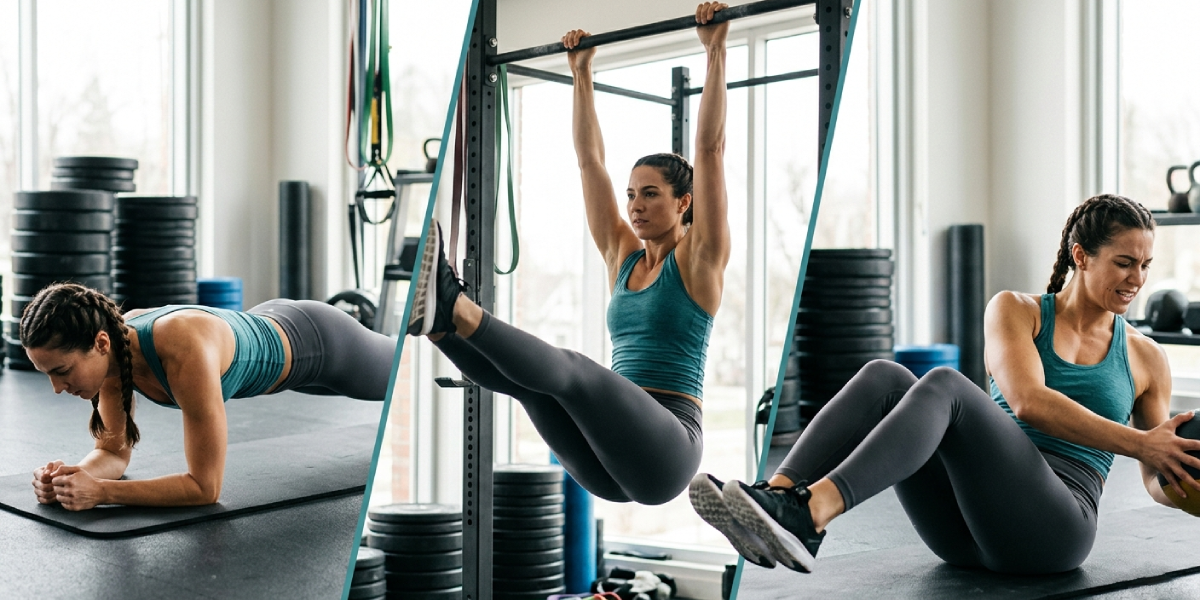
If you are searching for the best ab exercises to build a stronger, more resilient core, you are in the right place. Core strength is not just about visible muscles — it underpins every movement you make, from lifting groceries to holding perfect posture at a desk.
This guide covers the most effective, research-supported abdominal exercises, explains how they work, and shows you how to structure them into a smart training routine.
Why Core Strength Matters More Than You Think
The core is not simply a six-pack. It is a complex system of muscles that includes the rectus abdominis, transverse abdominis, internal and external obliques, and the muscles of the lower back and hips. Together, these muscles stabilize your spine, transfer force between your upper and lower body, and protect you from injury during both athletic activity and everyday movement.
Research consistently shows that a strong, well-trained core reduces the risk of lower back pain, improves athletic performance, and enhances balance and coordination. When you explore a broad range of exercises for strength and conditioning, you will find that core work is woven into virtually every movement pattern that matters.
The exercises below are selected based on their ability to activate multiple core muscles simultaneously, provide progressive challenge, and deliver functional carry-over to real-world strength.
The Best Ab Exercises Ranked by Effectiveness
1. The Plank
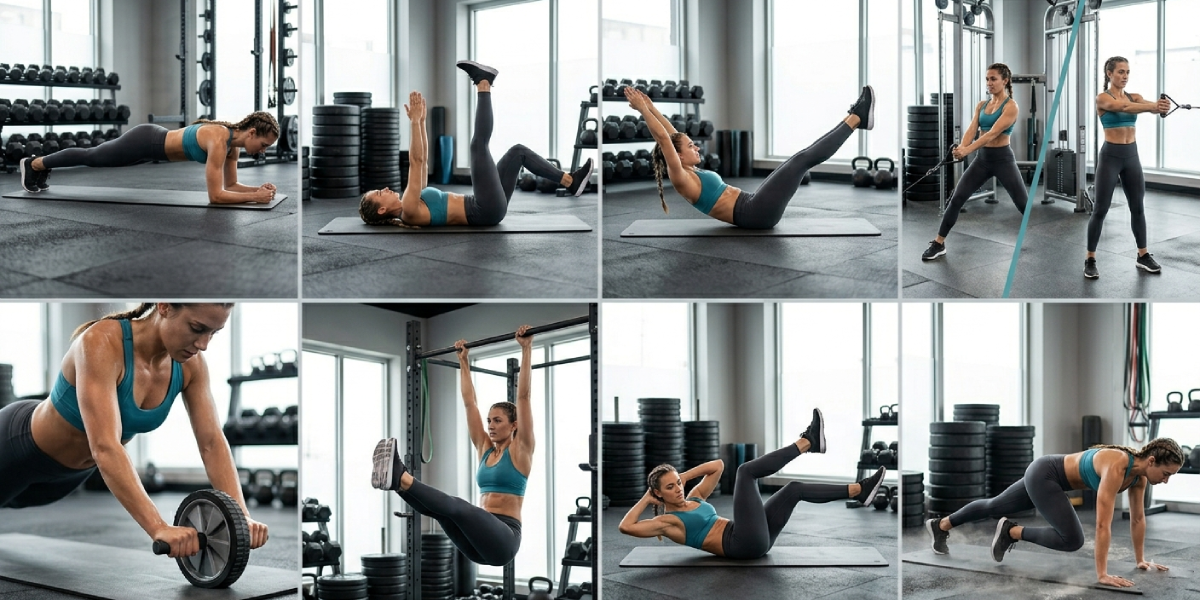
The plank is one of the most effective isometric core exercises available. Unlike crunches, which isolate the rectus abdominis through a limited range of motion, the plank demands bracing across the entire anterior core simultaneously, including the transverse abdominis and obliques.
To perform a standard plank, place your forearms on the floor with elbows directly beneath your shoulders. Extend your legs behind you and rise onto your toes, forming a straight line from head to heel. Squeeze your glutes, brace your abs as if bracing for a punch, and breathe steadily. Hold for 20 to 60 seconds, focusing on keeping the hips level rather than letting them sag or rise.
Progressions include the long-lever plank, where you shift your elbows slightly forward to increase demand, and the plank with shoulder taps, which introduces anti-rotation challenge.
2. Dead Bug
The dead bug is widely used by physical therapists and strength coaches as a foundational anti-extension drill. It teaches the core to resist lumbar extension while the limbs move — a critical skill for injury prevention and athletic performance.
Lie on your back with arms extended toward the ceiling and knees bent at 90 degrees above your hips. Press your lower back firmly into the floor and maintain that pressure throughout. Slowly lower your right arm overhead and extend your left leg simultaneously, stopping just before your lower back lifts away from the floor. Return to start and alternate sides. Perform 5 to 8 repetitions per side.
The dead bug is particularly useful for people with lower back sensitivity because it keeps the spine in a neutral, supported position throughout the movement.
3. Hollow Body Hold
Borrowed from gymnastics, the hollow body hold is an advanced isometric that builds exceptional core tension. Lie on your back and press your lower back into the floor. Extend your arms overhead and straighten your legs, then lift everything off the ground simultaneously until only your lower back remains in contact with the floor. Your body should form a slight banana shape.
Beginners can modify by bending the knees or keeping the arms at the sides. Advanced practitioners can add slow rocking motions. This exercise builds the kind of deep, interconnected core strength that transfers directly to compound lifts like squats and deadlifts.
4. Cable Woodchop and Pallof Press
Rotational and anti-rotational exercises are often underrepresented in conventional ab training. The cable woodchop trains the obliques through a functional diagonal movement pattern, mimicking throwing, swinging, and reaching motions the body performs naturally.
Stand sideways to a cable machine with the pulley set high. Grip the handle with both hands and rotate diagonally downward across your body, keeping arms relatively straight and generating power from the torso rather than the arms. Perform 10 to 12 repetitions per side.
The Pallof press is the anti-rotation counterpart. Stand perpendicular to a cable stack, grip the handle at chest height, and press it directly forward while resisting the urge to rotate. This exercise is outstanding for building lateral core stability.
5. Ab Wheel Rollout
The ab wheel rollout is one of the most demanding anti-extension exercises you can perform. From a kneeling position, grip the ab wheel with both hands and roll forward slowly, allowing your hips to extend as your arms reach out. Stop before your lower back arches, then contract the core to roll back to the starting position.
This exercise demands tremendous eccentric control of the rectus abdominis and is unsuitable for beginners without first mastering the plank and dead bug. When performed correctly, it produces rapid improvements in core strength and midline stiffness.
6. Hanging Leg Raise
The hanging leg raise is a compound core movement that challenges the hip flexors, lower rectus abdominis, and grip simultaneously. Hang from a pull-up bar with an overhand grip. Keeping your legs straight, raise them until they are parallel to the floor or higher. Lower them slowly under control, avoiding swinging.
For beginners, bending the knees reduces the lever arm and makes the movement more accessible. For advanced trainees, a full toes-to-bar or L-sit progression provides an extraordinary challenge.
7. Bicycle Crunch
Among traditional crunch variations, the bicycle crunch has consistently demonstrated high levels of oblique and rectus abdominis activation in electromyographic studies. Lie on your back with hands lightly behind your head. Lift your shoulder blades off the floor, draw one knee toward the chest, and rotate the opposite elbow toward that knee while extending the other leg. Alternate in a slow, controlled pedaling motion.
The key is to avoid pulling on the neck and to focus on genuine thoracic rotation rather than just elbow movement. Performed slowly with full rotation, this exercise is far more effective than its reputation suggests.
8. Mountain Climbers
Mountain climbers bring a cardiovascular element to core training while demanding constant anti-extension bracing. Begin in a high plank position with hands directly beneath the shoulders. Drive one knee toward the chest, then quickly switch legs in a running motion while keeping the hips level and the core braced throughout.
Slowing the movement down turns mountain climbers into a controlled core drill. Speeding them up elevates heart rate and turns the exercise into a metabolic conditioning tool, making them flexible enough to appear in both strength-focused and health-focused fitness routines.
How to Structure an Effective Ab Training Routine
The most common mistake in core training is isolating the abs with endless repetitions of crunches and ignoring the full spectrum of core function. An effective ab routine should address four movement categories: anti-extension, anti-rotation, anti-lateral-flexion, and dynamic flexion or rotation.
| Core Function | Example Exercises | Sets and Reps |
|---|---|---|
| Anti-Extension | Plank, Dead Bug, Ab Wheel Rollout | 3 sets of 20 to 40 seconds or 8 to 10 reps |
| Anti-Rotation | Pallof Press, Single-Arm Carries | 3 sets of 8 to 12 reps per side |
| Anti-Lateral Flexion | Suitcase Carry, Side Plank | 3 sets of 20 to 40 seconds per side |
| Dynamic Flexion or Rotation | Bicycle Crunch, Hanging Leg Raise, Cable Woodchop | 3 sets of 10 to 15 reps |
Training the core two to four times per week is generally sufficient for most people. Because the core muscles recover relatively quickly, frequency matters more than volume within any single session. Prioritize quality of movement over quantity of repetitions.
Core Training and Body Composition
It is worth addressing one of the most persistent myths in fitness: spot reduction. No amount of ab exercises will selectively burn fat from the midsection. Visible abdominal definition is primarily a result of overall body fat percentage, which is influenced by total energy balance, diet quality, and systemic exercise habits.
If your goal includes improving how your midsection looks, core training must be paired with a sustainable nutrition approach and regular cardiovascular activity. Using a tool like the BMI calculator can help you understand your current body composition and set realistic, health-focused goals alongside your training program.
Common Mistakes That Limit Core Gains
Training to fatigue without maintaining form is one of the fastest ways to stall progress and invite injury. Here are the most frequent errors and how to correct them.
- Holding the breath: Bracing and breathing are not the same thing. Exhale on exertion and inhale on recovery to maintain consistent intra-abdominal pressure without breath-holding.
- Neglecting the lower back: Core training that only addresses the front of the body creates muscular imbalance. Include bird-dog rows, back extensions, and good mornings to develop the posterior chain equally.
- Rushing through repetitions: Faster is rarely better in core training. Slower, controlled repetitions increase time under tension and produce more robust muscular adaptations.
- Skipping progressive overload: The core adapts like any other muscle group. Once a plank hold becomes easy at 60 seconds, progress to a harder variation rather than simply holding longer.
- Overtraining: Daily high-volume core sessions with inadequate recovery will impair progress. Rest is when strength actually develops.
Breathing and Bracing for Maximum Core Activation
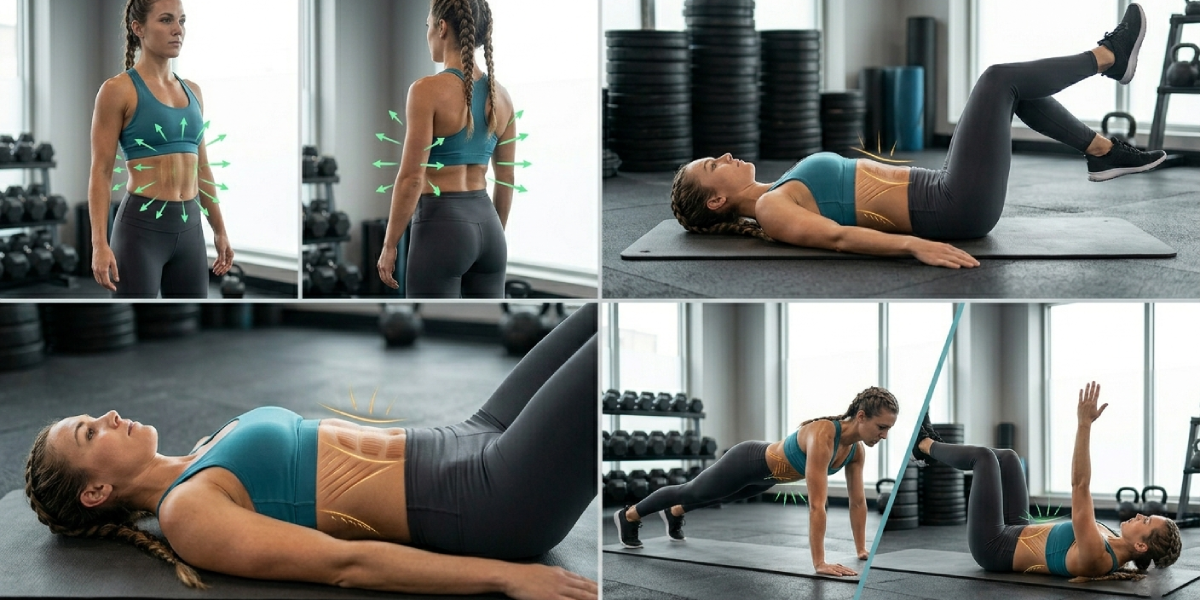
Proper intra-abdominal pressure is the foundation of safe and effective core training. The 360-degree brace technique involves drawing breath into the belly and sides as well as the chest, expanding the thorax in all directions, then bracing the entire midsection as if preparing to absorb a blow. This technique is used by powerlifters, Olympic weightlifters, and rehabilitation specialists alike because it creates maximal spinal stability.
Practice the brace independently before applying it to exercises. Lie on your back, breathe deeply into your belly, then tighten your abs firmly without allowing the breath to escape. Hold for three seconds, release, and repeat. Once this becomes automatic, integrating it into planks, dead bugs, and loaded movements becomes significantly easier.
Frequently Asked Questions
How often should I train my abs?
Most people benefit from training their core two to four times per week. The core muscles recover relatively quickly compared to larger muscle groups, so higher frequency with moderate volume is generally more effective than infrequent, very high-volume sessions. Ensure at least one rest day between intense core sessions.
Can I get a six-pack just from doing ab exercises?
No. Visible abdominal definition requires a sufficiently low body fat percentage, which is achieved through overall caloric balance and consistent exercise rather than ab exercises alone. Core training builds muscle, but dietary habits determine whether that muscle is visible beneath the surface.
Are crunches bad for your back?
Crunches are not inherently dangerous for healthy individuals, but they place repeated flexion stress on the lumbar spine that may be problematic for people with existing disc issues. Anti-extension and anti-rotation exercises are generally safer and more functional for most people, particularly those with any history of lower back pain.
What is the single most effective ab exercise?
There is no single best exercise for all people in all contexts. The plank and dead bug are outstanding starting points for building foundational core stability, while the ab wheel rollout and hanging leg raise are highly effective for intermediate and advanced trainees. The best exercise is the one you perform with correct form and consistent effort.
How long does it take to see results from ab training?
Strength improvements in the core can be felt within two to four weeks of consistent training. Visible changes in muscle definition depend on body composition and may take several months when combined with appropriate nutrition. Functional improvements in posture, stability, and athletic performance often appear sooner than aesthetic changes.
Should I train abs at the beginning or end of a workout?
For most people, training abs at the end of a session is preferable. The core muscles serve as stabilizers during compound movements like squats and deadlifts, so pre-fatiguing them before these exercises can compromise form and reduce safety. However, isolated core activation drills such as dead bugs can be useful as part of a warm-up to improve motor patterns.
Do I need equipment to train my abs effectively?
No equipment is necessary for highly effective core training. Planks, dead bugs, hollow body holds, mountain climbers, and bicycle crunches require nothing but floor space. Equipment such as an ab wheel, cable machine, or pull-up bar expands the range of available exercises but is not a requirement for significant strength development.
Is core training useful for people who are not athletes?
Absolutely. Core strength is relevant for everyone, regardless of athletic background. It supports good posture during prolonged sitting, reduces the risk of lower back injury during everyday tasks like lifting and bending, improves balance in older adults, and contributes to overall physical resilience. Core training is one of the most universally beneficial forms of exercise across all age groups and fitness levels.